
Individuals within the European Union can now utilize alternative app stores due to the Digital Markets Act (DMA), a measure intended to promote greater competition in the app environment. Similar to Apple’s App Store, these alternative app marketplaces offer straightforward access to an expanded selection of applications on Apple devices, but unlike the apps processed through Apple’s App Review system, those in these third-party stores must undergo a notarization procedure to confirm they align with certain “baseline platform integrity standards,” as stated by Apple — such as being free from malware. Nevertheless, each store can evaluate and authorize apps based on its own regulations. Additionally, these stores are accountable for any issues concerning support and refunds, rather than Apple.
To launch an alternative app marketplace, developers are required to adhere to Apple’s alternative business conditions for DMA-compliant apps within the EU. This entails paying a new Core Technology Fee of €0.50 for every initial annual installation of their marketplace app, even prior to reaching the threshold of 1 million installations, which is the requirement for other EU apps distributed under Apple’s DMA business regulations.
In spite of the intricate new guidelines, a small group of developers has seized the opportunity to distribute their applications beyond Apple’s ecosystem.
Outside of the EU, various regions are testing alternative app stores, including Japan. In December 2025, Apple announced its compliance with the Mobile Software Competition Act (MSCA), which provides developers with additional options to distribute apps and handle payments outside of Apple’s App Store.
This option also demands that developers agree to new business terms, such as a reduced commission rate for the App Store ranging from 10% to 21%, a payment processing fee of 5% for Apple in-app purchases, a 5% core technology fee, and a 15% store services commission on web sales made through links in the app.
Presented below is a compilation of the alternative app stores that iPhone users in these regions can explore today.
AltStore PAL (EU)
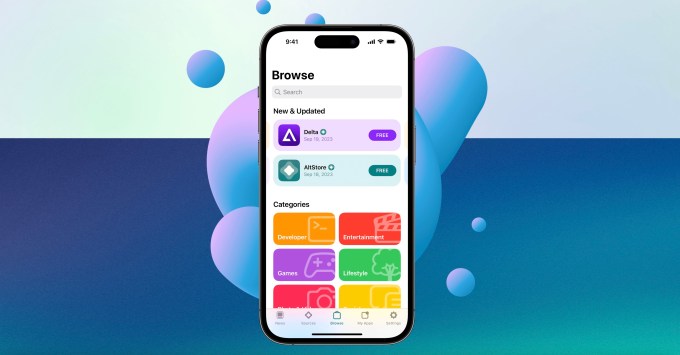
Co-developed by Riley Testut, the creator of the Nintendo game emulator app Delta, AltStore PAL is an officially sanctioned alternative app marketplace in the EU. This open-source app store will enable independent developers to distribute their applications alongside offerings from the makers of AltStore, Delta, and a clipboard manager named Clip.
Techcrunch event
Boston, MA
|
June 9, 2026
Distinct from Apple’s App Store, AltStore apps are hosted by the developer. To function, developers obtain an alternative distribution packet (ADP) and upload it to their hosting server, then create a “source” that users will add to AltStore to gain access to their applications. This means that the only apps visible in the AltStore are those that users have specifically added themselves.
Some popular applications users are adding consist of the virtual machine app UTM, which allows users to run Windows and other software on iOS or iPad; OldOS, a SwiftUI-built re-creation of iOS 4; Kotoba, the iOS dictionary available separately; the torrenting app iTorrent; the iOS remote client for qBittorrent known as qBitControl; and the social discovery platform PeopleDrop.
Setapp Mobile (EU – closed Feb. 2026)
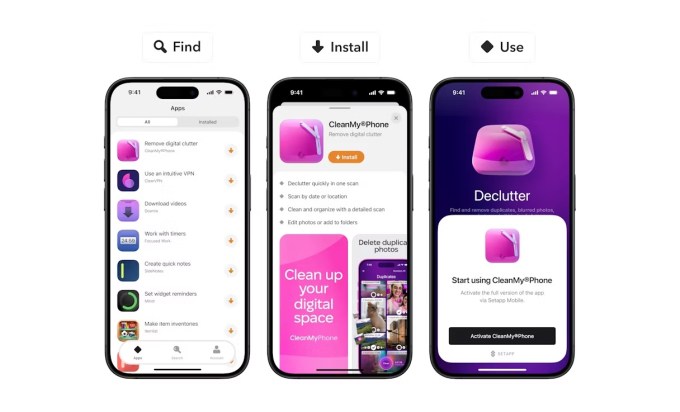
MacPaw’s Setapp became one of the pioneering companies to consent to Apple’s new DMA business arrangements to launch an alternative app store for users in the EU. Regrettably, this app store was short-lived — the company revealed it would discontinue the Setapp Mobile service on February 16, 2026. (Setapp Desktop applications remained unaffected.) The company pointed to Apple’s “still-evolving” and intricate business terms as the motivation for its choice.
For a long time, the company had provided a subscription-based model featuring a range of curated applications for customers on iOS and Mac. Following the DMA’s implementation, it launched the alternative app store for Setapp Mobile for iOS users exclusively within the EU. Similar to its previous subscription services, the now-defunct app store included numerous apps under a single recurring subscription cost, and the collection of apps expanded over time. The apps were free from in-app purchases or advertisements and were generally recognized for their quality. However, it did not encompass prominent applications like Facebook, Uber, Netflix, and others.
Epic Games Store (EU)
[embedded content]
Epic Games, the creator of Fortnite, inaugurated its alternative iOS app store in the EU in August 2024, permitting users to download games, including its own Fortnite and others like Rocket League Sideswipe and Fall Guys, with additional titles on the horizon. The company announced it is also bringing its games to other alternative app stores, such as AltStore PAL, which it is now backing through a grant, alongside Aptoide’s iOS store in the EU and ONE Store on Android.
The decision to reintroduce Fortnite through alternative iOS marketplaces follows more than four years after Apple removed the game from its App Store due to alleged policy breaches, prior to Epic’s legal dispute regarding the claimed App Store monopoly. While U.S. courts concluded that Apple was not engaged in antitrust activities, the lawsuit did establish a pathway for developers to link to their own websites to secure a lower commission.
Aptoide (EU)
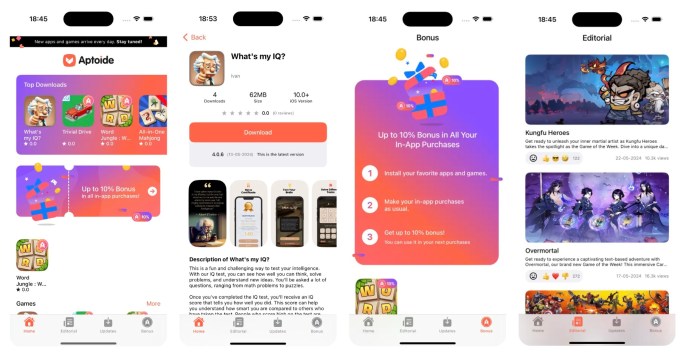
Aptoide is an alternative gaming store for iPhones based in Lisbon that serves as an open-source solution for app distribution. The company, already recognized for its alternative to Google Play, asserts that it verifies the apps to guarantee they are secure for download and installation.
The iOS version of the Aptoide store debuted as an invite-only beta in June 2024, before launching publicly across the EU. As a free-to-use platform, Aptoide doesn’t levy charges on users to cover its Core Technology Fee paid to Apple but retains a 10% to 20% commission on iOS in-app purchases, depending on whether these purchases were generated through the marketplace or not.
Across all platforms, including Android, web, vehicles, and TVs, Aptoide boasts 1 million applications available to its more than 430 million users.
Mobivention marketplace (EU)
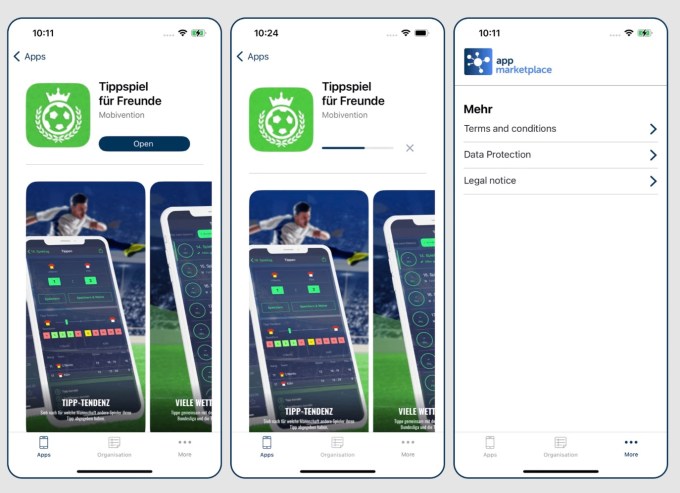
A B2B-oriented application store, the Mobivention marketplace enables EU businesses to distribute their internal applications used by employees, which cannot — or should not — be published in Apple’s App Store. The company also provides development services for a tailored app marketplace for businesses seeking to present their unique app store specifically for their corporate applications. Larger enterprises can even license Mobivention’s technology to further adapt the app marketplace to their specific requirements.
Skich (EU)
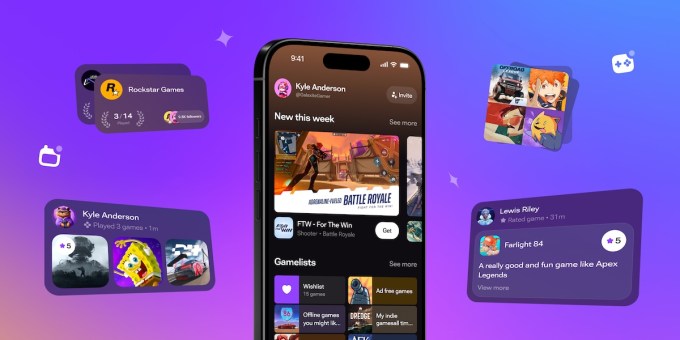
In March, Skich announced the debut of an alternative app store for EU users, which sets itself apart by presenting a Tinder-like interface for discovering applications. Users can swipe right to “match” with apps that may interest them. Additionally, they can create playlists and see which apps their friends are engaging with. This new store will take the place of Skich’s existing app and will feature a 15% commission on all transactions. Rather than populating its app store immediately with many apps, the store focused its marketing efforts on developers during the Game Developers Conference (GDC).
Onside (EU and Japan)
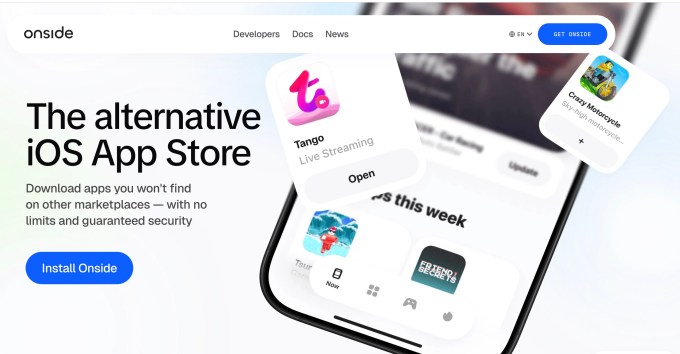
Onside serves as an alternative iOS app marketplace accessible in both the EU and Japan, as of February 17, 2026, due to new regulations. The company asserts it will charge developers lower fees while still maintaining security, including the protection of payment information. Currently, the store supports bank card payments and Apple Pay, with plans to add other payment options like iDeal, Klarna, and more in the future.
For users, Onside promises a diverse selection of top applications and exclusives unavailable on other marketplaces, all presented through a familiar interface that features traditional app store characteristics, including editorial collections, ratings and reviews, and automatic updates.