
BuzzFeed, the media entity headquartered in the U.S. renowned for its quizzes, listicles, and, at one point, an award-winning journalism arm, is reimagining its role for the age of AI. At least, that’s the narrative.
During the SXSW conference in Austin, BuzzFeed co-founder and CEO Jonah Peretti unveiled the company’s forthcoming media initiative: a new offshoot named Branch Office, aimed at delving into artificial intelligence through consumer-oriented applications that foster creativity and connection.
According to Peretti, the new venture is a continuation of the AI experiments BuzzFeed has undertaken over the years, detailed in a somewhat faltering presentation that started with slideshow malfunctions before shifting to app demonstrations met with quiet or restrained chuckles.
“We’ve been secretly working on this for more than a year, and we’ve gained valuable insights from the BuzzFeed platform regarding the emerging AI formats,” Peretti stated. “Utilizing AI will facilitate connections among people, nurturing community around cultural pillars, tastes, and shared interests.”
Bill Shouldis, a product director at BuzzFeed and the mind behind Branch Office, showcased two new applications: BF Island and Conjure.
The first application, BF Island, is a group messaging tool featuring capabilities for altering and manipulating images via AI. While this isn’t entirely revolutionary technology on its own, that’s not the main focus.
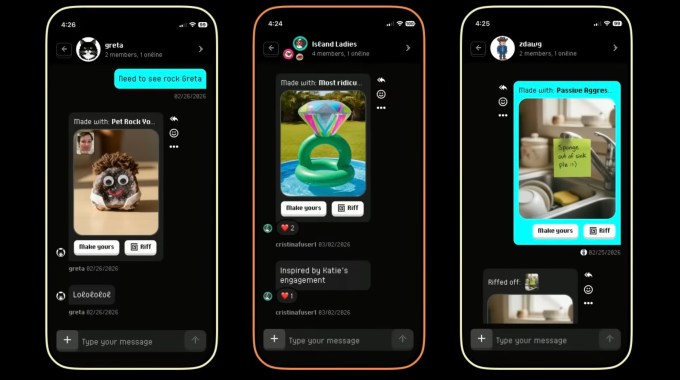
What’s noteworthy here is not the AI features themselves but the app’s library of current online trends and memes, curated by an editorial team, which could motivate users to generate AI images reflecting fleeting trends such as the McDonald’s CEO’s burger taste test or the “frame-mogging” incident. (If these references elude you, you might not be the “highly online” audience they are targeting.)

The second application, Conjure, has similarities to BeReal — the app that allows for a single daily temporary photo — but it instead guides users to capture daily images of subjects other than themselves. (It’s worth noting that BeReal ultimately faded out, rerouted to Voodoo after losing momentum.) For example, during the demonstration, a photo prompt asked, “What lies between the trees and the moon?,” urging users to take a shot of the evening sky. A sequence of eerie visuals appeared on screen, followed by the quiet prompt, “What will you conjure?”

The audience’s confusion was evident, with a solitary cough echoing in the aftermath of the demonstration, followed by some awkward laughter.
Shouldis later remarked that Conjure also incorporates AI, claiming the app has an “AI spirit for a CEO.” (Once more, what does that mean?)
Peretti went on to introduce Quiz Party, a social app that allows users to take BuzzFeed quizzes alongside friends and share their outcomes.
This lackluster presentation from BuzzFeed occurred just days after the media organization disclosed its serious concerns regarding its ability to persist as a functioning business and indicated it was engaged in strategic discussions focused on addressing its liquidity issues. Following a net loss of $57.3 million last year, the company announced its intent to prioritize its Studio IP and new AI applications like these in the upcoming year.
However, even the tech-savvy crowd at SXSW seemed unconvinced.
During the Q&A segment after the presentation, an attendee noted that BeReal had difficulty retaining users once the novelty faded. How would an app like Conjure tackle similar retention issues?
Shouldis responded by stating that the app would evolve “and incorporate various new features, adapting beyond its current format.” He alluded to possibilities like integrating video and audio, and utilizing Claude Code for community-building.
The concepts behind the new applications are not without merit: AI can accelerate software development, enabling companies to adapt more swiftly and maintain user engagement.
“Essentially, software is becoming the new content,” Peretti pointed out.
Nonetheless, before you can refine your offerings, attracting users is essential. With its upcoming apps, BuzzFeed appears to have focused more on the capabilities of AI rather than addressing what users truly desire to accomplish with AI, which isn’t a formula for success.