
Wander through San Francisco, and you’ll quickly notice an empty self-driving car gliding through the streets, either waiting for a passenger or heading to a remote location for charging and servicing. These unoccupied trips — a term in the industry for distance traveled without a fare-paying passenger — represent one of the primary challenges facing robotaxi firms in achieving profitability.
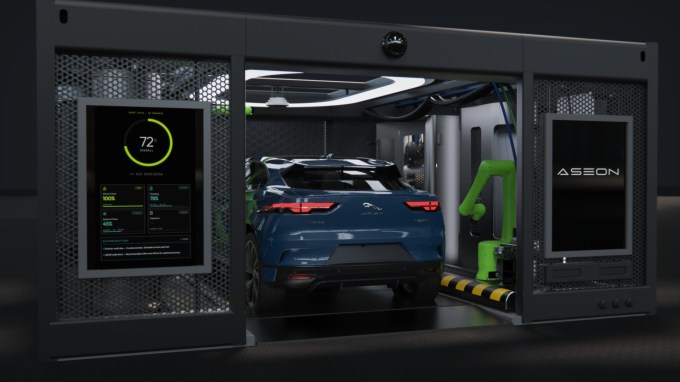
Startup Aseon Labs, based in Redwood City, California, believes it has a solution: automated pods the size of parking spaces that can be deployed throughout urban areas to maintain, clean, and charge robotaxis. Co-founded by the creators of battery-swapping company Pushme, the firm refers to these innovations as robotic pit stops tailored for the robotaxi sector. The concept has drawn interest from investors.
Aseon Labs has secured $10 million in seed funding led by Crane Venture Partners, according to information obtained by TechCrunch. Contributions also came from Y Combinator, Garrett Camp’s venture firm Expa, Robin Hood Ventures, and Founders Capital, along with angel investors including serial entrepreneur and former Google executive Adrian Aoun, Mercury founder and CEO Immad Akhund, Zimride co-founder Rajat Suri, and founding team members from Anthropic, Nuro, Turo, and Revolut.
Currently in its initial phase, Aseon Labs intends to use the seed funding to develop five prototypes of these pods, expand its team of six robotics and engineering professionals to around a dozen, and acquire the necessary real estate to establish its network, as stated by CEO and co-founder George Kalligeros.
“To achieve economic parity with ride-hailing — which is our target for self-driving vehicles — and to cease heavily subsidizing costs, we need to increase utilization,” Kalligeros explained to TechCrunch. “We need the robotaxi actively operating throughout the entire daily demand cycle.”
Aseon’s approach suggests that a network of dispersed autonomous pods would significantly reduce unproductive miles, ultimately transforming robotaxi services into feasible business ventures.
Kalligeros and COO Dan Keene come from outside the realm of self-driving vehicles. However, they bring expertise from developing and scaling a hardware-and-real estate venture. Kalligeros was a mechanical design engineer at Bentley Motors and Tesla before co-founding Pushme in 2016 to create battery-swapping solutions for micromobility fleets. Pushme was establishing a battery-swap network in Europe when it was acquired by Tier Mobility in January 2020.
“The analogy I’ll make is that we were essentially tasked by SoftBank to deploy this across as many viable markets for Tier in an expedited timeframe,” Kalligeros noted. “The strategy became about how to distribute locations around the heart of the city sensibly while ensuring deployment was manageable as non-permanent infrastructure.”
Aseon Labs applies the same mindset to autonomous vehicles.
During their exploration of the sector, the duo visited AV depots where fleets of robotaxis undergo inspections, maintenance, cleaning, and charging. The high costs of real estate often lead businesses to position these depots away from city centers, where the majority of ride-hailing activity happens.
“Depot infrastructure is crucial for launching new cities for any AV operator,” he stated. “And what transpires in the depot at present — the essential framework for autonomy, really — isn’t fully developed.”
The founders focused on developing smaller, autonomously powered pods that can be placed throughout an urban landscape but also relocated as necessary. These units, equipped with cameras for vehicle inspections and robotic arms for retrieving lost items and interior cleaning, are categorized as temporary structures. This classification assists Aseon Labs in bypassing extensive permitting procedures and allows the company flexibility in relocating underperforming units.
The units are designed to operate on propane generators or other mobile power sources or can connect to existing power infrastructures through collaborations with EV charging firms. They are intended to function autonomously, though initial models will include staff, according to Kalligeros.
Aseon Labs is not attempting to address every potential scenario either. Instead, it utilizes computer vision and AI — particularly vision-language-action models prevalent in contemporary robotics — to identify issues that the pod should not attempt to resolve. For instance, if a camera identifies melted chocolate on a backseat, the robotic arm will refrain from intervening as trying to clean it could exacerbate the stain. Rather, the vehicle will be charged and sent directly to the company’s main depot for human intervention.
While Aseon Labs has yet to finalize agreements with any robotaxi companies, Kalligeros mentioned that there is considerable interest in the initiative. “Almost everyone is keen to give it a try,” he stated.
When you purchase through links in our articles, we may earn a small commission. This doesn’t affect our editorial independence.