
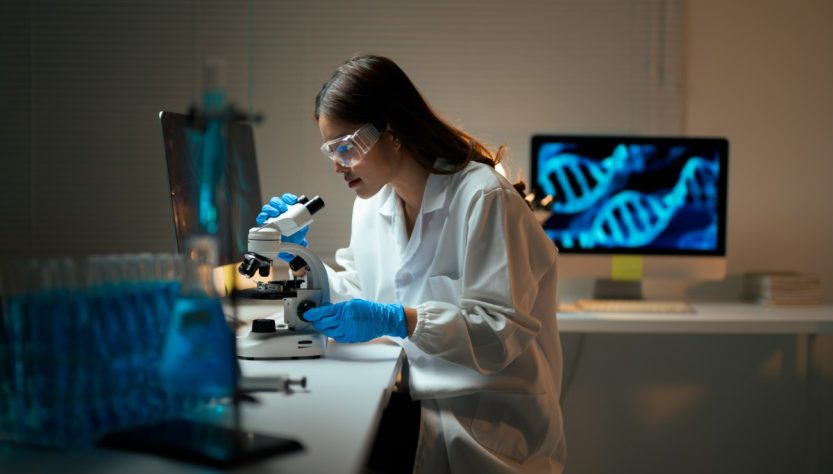
On Tuesday, Anthropic launched Claude Science, an AI workbench designed to provide scientists with a single environment for conducting computational research, eliminating the need to switch between various databases, pipelines, and tools.
To clarify, Anthropic states that Claude Science is “not an entirely new AI model nor a more advanced model for biology. It operates using the same Claude models already accessible to all users today (including Claude Opus 4.8), without any exclusive access or restrictions.”
This workbench is built upon Anthropic’s October 2025 introduction of Claude for Life Sciences, which effectively enhanced the Claude chatbot’s capabilities for life sciences-related tasks. Claude Science serves as a dedicated space for these activities.
The announcement, made during an AI for Science briefing on Tuesday, is part of Anthropic’s broader ambition to evolve beyond merely a model provider and to gain a foothold in the operational layer of specific industries, similar to how Claude Code has established itself in software development. Anthropic is increasingly focusing on vertical, workflow-level products as a means of growth rather than solely relying on basic model capabilities (which may influence its competitive strategy and pricing against other companies).
The functionality is straightforward: one principal AI assistant acts like a project manager for scientists. It connects to over 60 scientific databases and includes pre-assembled toolkits customized for fields like genomics, protein structure, and chemistry. This assistant can then generate sub-assistants to help distribute the workload, akin to a project manager assigning tasks to specialists, or it can transfer tasks to a bespoke “expert” assistant tailored for the user’s specific research. A distinct fact-checker AI subsequently verifies citations and calculations before any material is submitted for publication.
This fact-checking process is crucial, as an increase in AI-assisted writing can lead to fabricated citations and unreliable statistics being integrated into research papers. However, it is important to note that it is the same foundational model conducting the checks, not an independent source verifying the truth.
Anthropic claims that Claude Science incorporates various methods to ensure reproducibility. For instance, the workbench is able to generate visual representations such as 3D protein structures and chemistry configurations alongside the code that created them. Each visual includes the “precise code and environment that produced it, a clear explanation of the creation process, and the complete message history,” as stated by the company. The system also saves researchers time by allowing them to edit visuals using simple language, which then prompts the AI to modify its underlying code accordingly.
Another way Claude Science optimizes efficiency for scientists is by operating on the lab’s existing infrastructure instead of transferring data to Anthropic’s servers.
Early adopters report that they are already benefiting from this functionality. Sean Whalen, a leading scientist in machine learning and functional genomics at Gladstone Institutes, reportedly used Claude Science to construct a genome browser from the ground up in just a few days, according to Anthropic. Jérôme Lecoq, a neuroscientist at the Allen Institute, utilized the tool to develop a multi-agent computational review system.
The rollout of Claude Science follows closely on the heels of OpenAI addressing the same issue from a different angle. In April, OpenAI introduced GPT-Rosalind, a specialized model specifically fine-tuned for biological reasoning.
The distinction between these two strategies involves more than just the necessity of a specialized model — it also concerns accessibility and speed. Rosalind debuted as a research preview restricted to qualified enterprise clients in the U.S., contingent on a qualification and safety review. Partners such as Amgen, Allen Institute, Moderna, Thermo Fisher, and Novo Nordisk received early access.
Additionally, Google DeepMind is pursuing a different tactic altogether. DeepMind actually possesses foundational scientific models such as AlphaFold and AlphaGenome, which the other two organizations can merely invoke as tools. Its Gemini for Science platform consolidates these along with over 30 life science databases into a single skill set.
The overall effect is that three distinct distribution models are now competing within the same scientific research arena: Anthropic is broadening access with widespread subscription availability, OpenAI is adopting a narrower, enterprise-restricted approach, and Google is relying on its proprietary models that aren’t available to others. The outcomes of these strategies may offer early insights into how AI providers may compete in various specialized sectors like law, finance, and engineering in the future.
Claude Science is currently available in beta for users on Pro, Max, Team, and Enterprise subscriptions. Anthropic has also identified Novo Nordisk and Allen Institute as case studies for customers, indicating that pharmaceutical organizations are already collaborating with multiple AI vendors.
Anthropic will provide support for up to 50 Claude Science projects, offering up to $30,000 in credits: “We seek postdoctoral and graduate projects that traverse multiple domains and push the limits of science, initially focusing on areas within biomedical research. Applications are open until July 15, 2026, with notifications of awards to be sent out by July 31. Projects will take place from September 1 to December 1, 2026.”
When you purchase through links in our articles, we may earn a small commission. This doesn’t affect our editorial independence.