
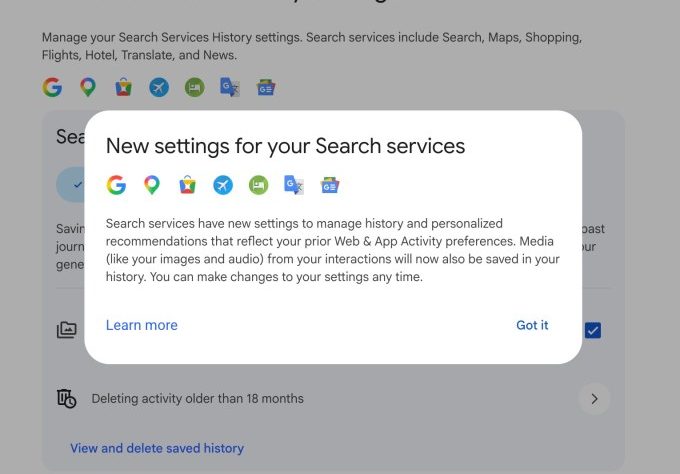
Take this as a late notice: A new alteration to Google’s privacy controls permits the company to retain more of your information, encompassing media like “images, files, and audio and video recordings,” to enhance its AI models. Essentially, if you upload any media to Google’s Search functionalities, it is utilized for AI training unless you choose to opt out.
The modification was introduced through a discreet update to Google’s Search services privacy settings, communicated in June via an email to users. With this update, the company effectively enrolled users in this broader AI training under the pretense of offering greater control over their saved history and tailored recommendations.
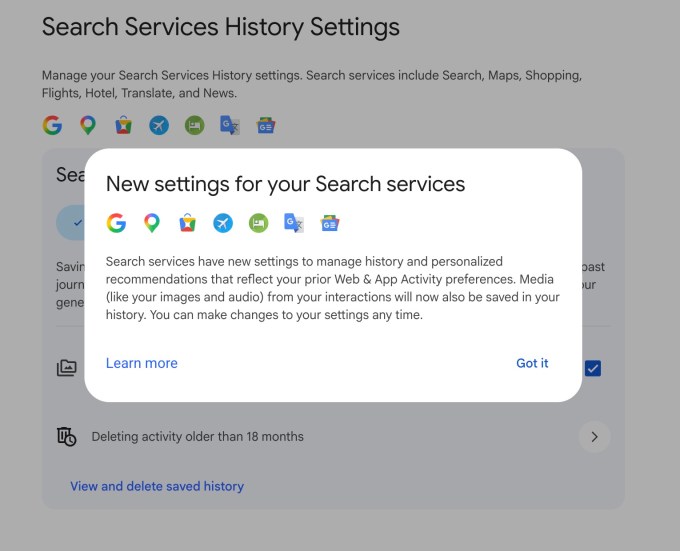
This update brought forth two additional settings, Search Services History and Personalized Recommendations, enabling you to adjust how your activity personalizes your Google experience and the duration your web and app activity is retained.
The update extends beyond Google Search itself, encompassing other search functions like Maps, Shopping, Flights, Hotels, Translate, and News.
For example, when you use Google Lens to conduct a visual search by taking a photo, that image might now be stored for AI training.
Likewise, if you utilize the newer Search Live feature for voice search in the Google app, those audio recordings might be kept, along with any other Google voice searches. If you engage with Google Translate to practice speaking, that audio is also recorded.
These adjustments signify a larger trend in the industry toward collecting data through various means to enhance AI services. Rather than relying solely on data gathered from the web, Google and similar companies are increasingly amassing information that people upload or generate during their service usage. Meta exemplifies this trend by leveraging users’ images and media, as well as content captured by its AI glasses, for AI training on a larger scale.
Google directly acknowledges the media training aspect, stating in the customer email: “Similar to your Search Services History, your saved media is utilized to develop and enhance Google services and technologies, which includes AI models and safety measures.”
The help documentation reiterates this, stating that the company “utilizes your history to provide, develop, and improve its services (such as training generative AI models) and to safeguard Google, its users, and the public with the assistance of human reviewers.”
Some of this data retention is temporary and linked to the operational functionality of the product, but according to Google’s own declarations, saved media can also be specifically held for the purpose of training its AI.
Modifying your settings
The positive aspect is that you possess some control over this. You can alter your preferences on the Search Services History and Search Services Personalization pages. For the former, you can uncheck the “Save Media” option independently from the “Search Services History” option, or opt out of both. You can also set how frequently you want your saved data to be automatically deleted — after three, 18, or 36 months.
Afterward, you can visit this page to explore additional privacy settings, including Web & App Activity, Timeline, YouTube History, and more.
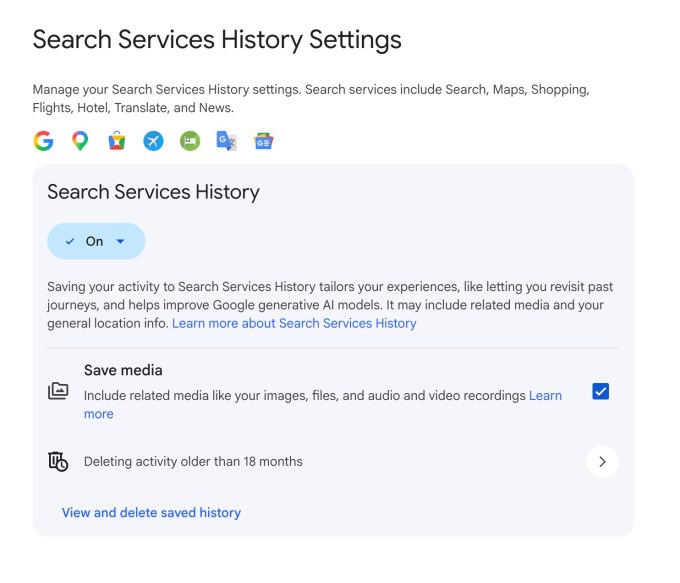
In addition to saved media, Google also utilizes your search history, location, and various data from websites you browse to tailor your experience on Google, which includes the ads displayed.
Prior to this update, Google allowed you to manage how historical search data was retained via its “Web & App Activity” settings. That has now been divided into two distinct settings: the Web & App Activity data and the newly implemented Search data setting, which is enabled by default.
Consequently, if you alter the Web & App Activity data retention settings to opt out of your data being stored by the tech giant, the update will no longer affect your usage of Google Search services, as it is now a separate setting.
When you purchase through links in our articles, we may earn a small commission. This doesn’t affect our editorial independence.