
On Monday, Decagon’s CEO Jesse Zhang released a thought-provoking new perspective titled “Everyone is wrong about open source AI in the enterprise.” The article addresses one of the fascinating paradoxes of the current AI market: more advanced AI implementations are transitioning to lighter models, according to Zhang, even within his own organization. Yet, the overall expenditure on costly, cutting-edge models remains largely unchanged.
This presents a fresh viewpoint on the dynamics between frontier and open source models. Zhang argues that they are not rivals and that the achievement of open source models does not come at the cost of frontier laboratories. Rather, they represent two stages in the same evolutionary process, where expensive frontier models are utilized to validate use cases that can later be transferred to more affordable open source substitutes as they develop.
As established use cases migrate to lighter models, new applications continuously emerge — and the total spending on frontier models hardly decreases.
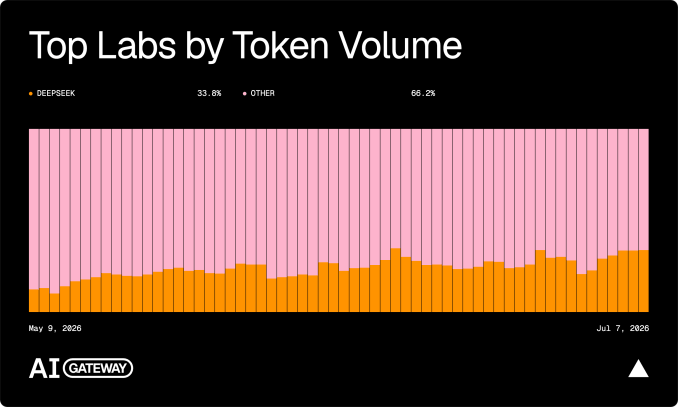
Zhang may not provide extensive data to back his claim, but finding the evidence is not challenging. Vercel’s AI gateway dashboard indicates that, in merely the past week, DeepSeek has surged to dominate the token volumes, processing slightly over a third of the tokens traversing the company’s infrastructure. Z.ai — the organization behind the well-regarded GLM-5.2 model — secured a noteworthy fourth place during the same timeframe.
However, if you examine the total token expenditure, you’ll notice that Anthropic still represents over half of the overall AI spending on the platform. Although much of the recent change results from Anthropic’s own increasing prices, the proportion has decreased slightly in the last month, but not to a significant extent.
OpenRouter narrates a comparable tale, capturing a much broader (though slightly less enterprise-focused) market segment. DeepSeek V4 Flash stands out in overall usage, processing 5.3 trillion tokens each week. The leading frontier model, Opus 4.8, manages just over 2 trillion. OpenRouter does not rank models by total expenditure, but it indicates that the average token cost for Opus 4.8 is approximately 23 times higher than that of V4 Flash ($1.37 per million tokens versus just 6 cents), suggesting Opus likely still dominates expenditure.
These statistics do not even account for the latest addition, Nvidia’s Nemotron, which is expected to ascend to the forefront of the competition due to Nvidia’s robust connections and the model’s remarkable versatility.
These metrics may not definitively substantiate Zhang’s argument regarding AI life cycles, but they indicate that frontier labs like Anthropic aren’t dramatically affected by the rise of open source — not yet, at least. One possible reason is that the market for AI-relevant tasks is expanding rapidly enough that the leading models can retain their status simply by dominating early-stage deployments. As Zhang articulates, “The frontier labs will continue to dominate discovery. Open source will increasingly control production.” Another potential reason could be that, despite clients transitioning to open source, many use cases are complex enough that they cannot be fully supplanted by less expensive options.
Regardless, this dual-layer economy of models might evolve into a relatively stable aspect of the AI market.
As recently as last September, I was discussing the possibility that foundational labs would end up supplying coffee beans to Starbucks — serving merely as commodity inputs while the application layer enjoyed the rewards. Some elements of that prediction have materialized: Vertical AI initiatives have shifted to lighter models, for instance, and the financial dynamics of “GPT wrapper” startups have largely remained stable.
Nonetheless, we are also observing that, token for token, frontier providers have managed to maintain a hold on the most lucrative portion of the marketplace — the premium token price. This doesn’t seem poised to change anytime soon.
When you purchase through links in our articles, we may earn a small commission. This doesn’t affect our editorial independence.