
The smartphone market has evolved into a new arena for AI, with producers striving to incorporate AI-driven capabilities to capture the attention of everyday users. However, Vertu is taking a unique route. This luxurious UK-based phone brand, recognized for its meticulously crafted devices often priced in the tens of thousands, prioritizes prestige over specifications. Its Alphafold, a foldable device, caters to wealthy consumers, particularly CEOs, combining opulent materials with an AI assistant designed to streamline an executive’s workday.
I decided to evaluate this proposition. Instead of concentrating on benchmark results, camera evaluations, and media usage — typical elements of smartphone assessments — I dedicated several days to employing the foldable as Vertu indicates its clients would: managing documents, scrutinizing spreadsheets and contracts, organizing business trips, automating repetitive tasks, and depending on its AI assistant as a digital aide during work hours. The focus shifted from whether it was a competent smartphone to whether it qualified as an effective executive smartphone.
Central to the Alphafold is Hermes Agent, a pre-installed AI assistant developed from the open-source Hermes project. The company claims it can evaluate files, automate tasks across applications, recall conversations, and transfer requests to a human concierge when necessary. In contrast to most smartphone AI helpers that merely react to commands, Hermes is engineered to perform multi-step processes on behalf of users, establishing itself as the focal point of Vertu’s offering rather than the foldable device itself.
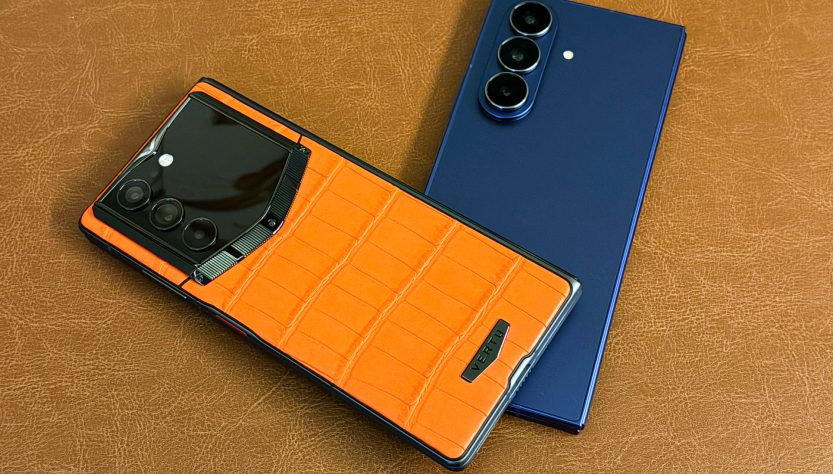
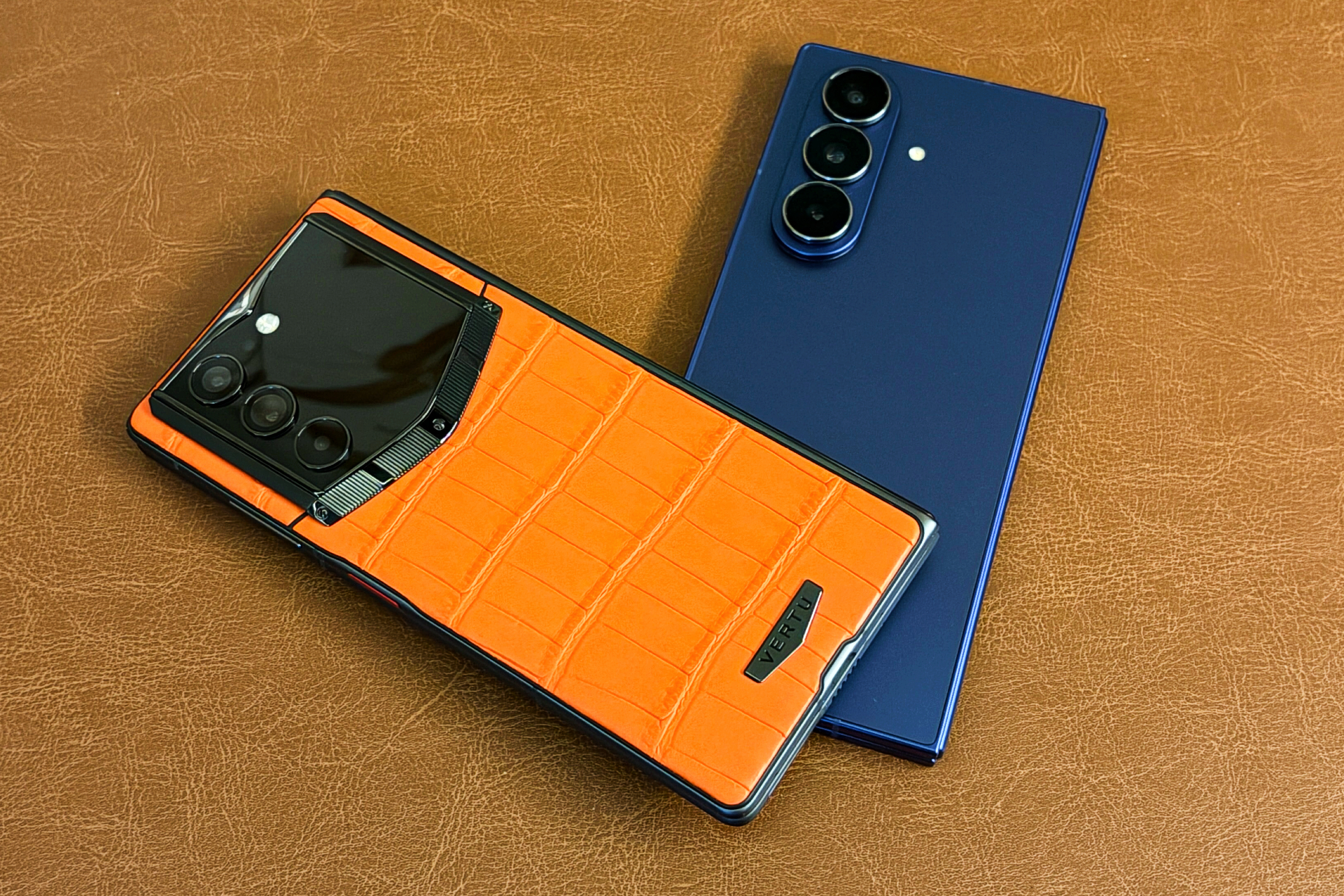
In terms of physical attributes, the Alphafold, priced from $6,880, exudes luxury. The review unit I received featured authentic calfskin leather adorned with titanium details, distinguishing it from mainstream foldables predominantly utilizing glass or synthetic materials. It is evidently constructed for those who regard their phone as both a practical tool and a symbol of status.
When compared to the Samsung Galaxy Z Fold 7, which served as my reference throughout this evaluation, the 264-gram Alphafold feels noticeably weightier than Samsung’s 215-gram counterpart. This additional heft is noticeable during extended usage, though it never becomes cumbersome. The Alphafold’s curved design also facilitates easier unfolding than the Galaxy Z Fold 7’s more angular edges. However, Samsung’s design appears sleeker and more comfortable to hold when folded, granting an edge in one-handed usability.
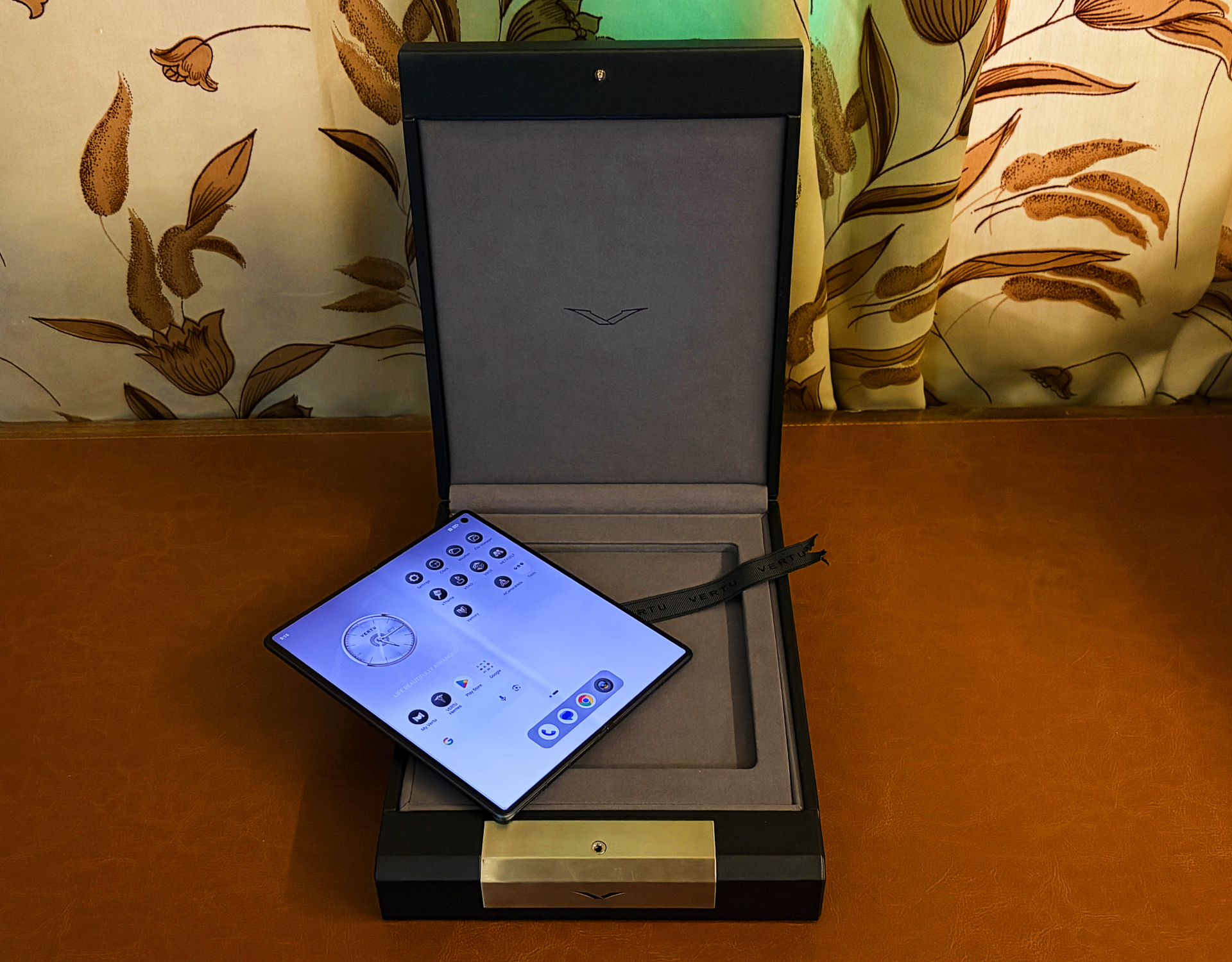
In addition, the Alphafold comes in packaging that resembles a jewelry box rather than a typical smartphone container. The large box opens to showcase neatly organized compartments holding included accessories, such as a leather sleeve and charging cables, further emphasizing that Vertu is offering a high-end experience rather than merely a device.
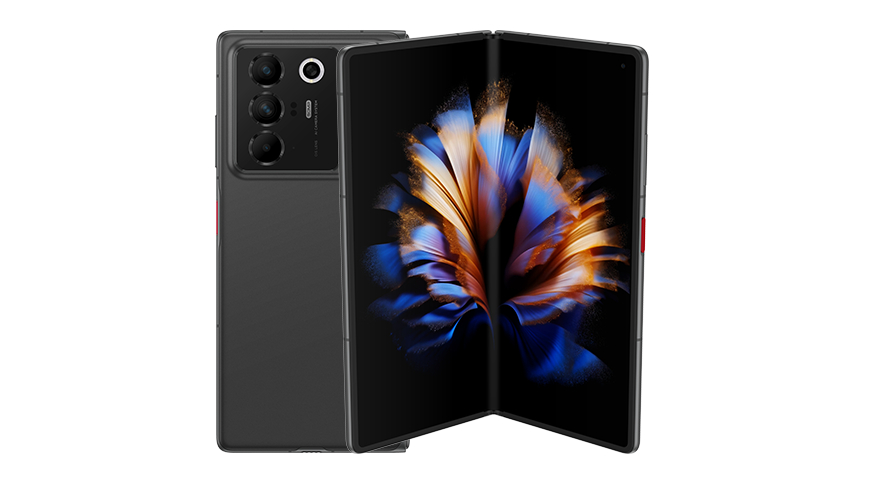
However, underneath the lavish materials, the Alphafold reveals a contrasting narrative. During the review process, I noted notable resemblances between this device and the $1,100 ZTE Nubia Fold — from hinge architecture and dimensions to speaker, microphone, and fingerprint sensor placements. The most prominent difference is Vertu’s leather-covered back panel, but system information also pointed to ZTE identifiers in parts of the software.
In response to inquiries about these findings, Vertu confirmed to TechCrunch that the Alphafold was developed via a specialized supply chain alliance with ZTE/Nubia concerning hardware platforms, component integration, and manufacturing engineering. Nevertheless, the company stated it handled the luxury materials, software service, quality assurance, and after-sale support. ZTE has not provided a reply to a request for comments.
This is not unprecedented for Vertu. In a 2023 review of the MetaVertu, Wired noted the device seemed to be based on a ZTE Nubia model, pointing to hardware parallels and insights from Counterpoint Research that Vertu had been blending existing ZTE designs with luxury finishes and tailored software.
Nonetheless, emphasizing only the hardware overlooks the essence of the Alphafold. Vertu’s significant wager lies not in crafting a superior foldable but in assessing if executives will invest in an AI assistant that facilitates a more efficient workday.
For several days, I utilized the Alphafold as my main smartphone, switching conventional queries for genuine executive-style workflows. Instead of requesting Hermes to draft emails or answer trivia, I assigned it tasks like reviewing spreadsheets and contracts, organizing business trips, managing appointments, and automating activities across multiple applications. I then compared this experience with the performance of Samsung’s Galaxy Z Fold 7 running Google’s Gemini.
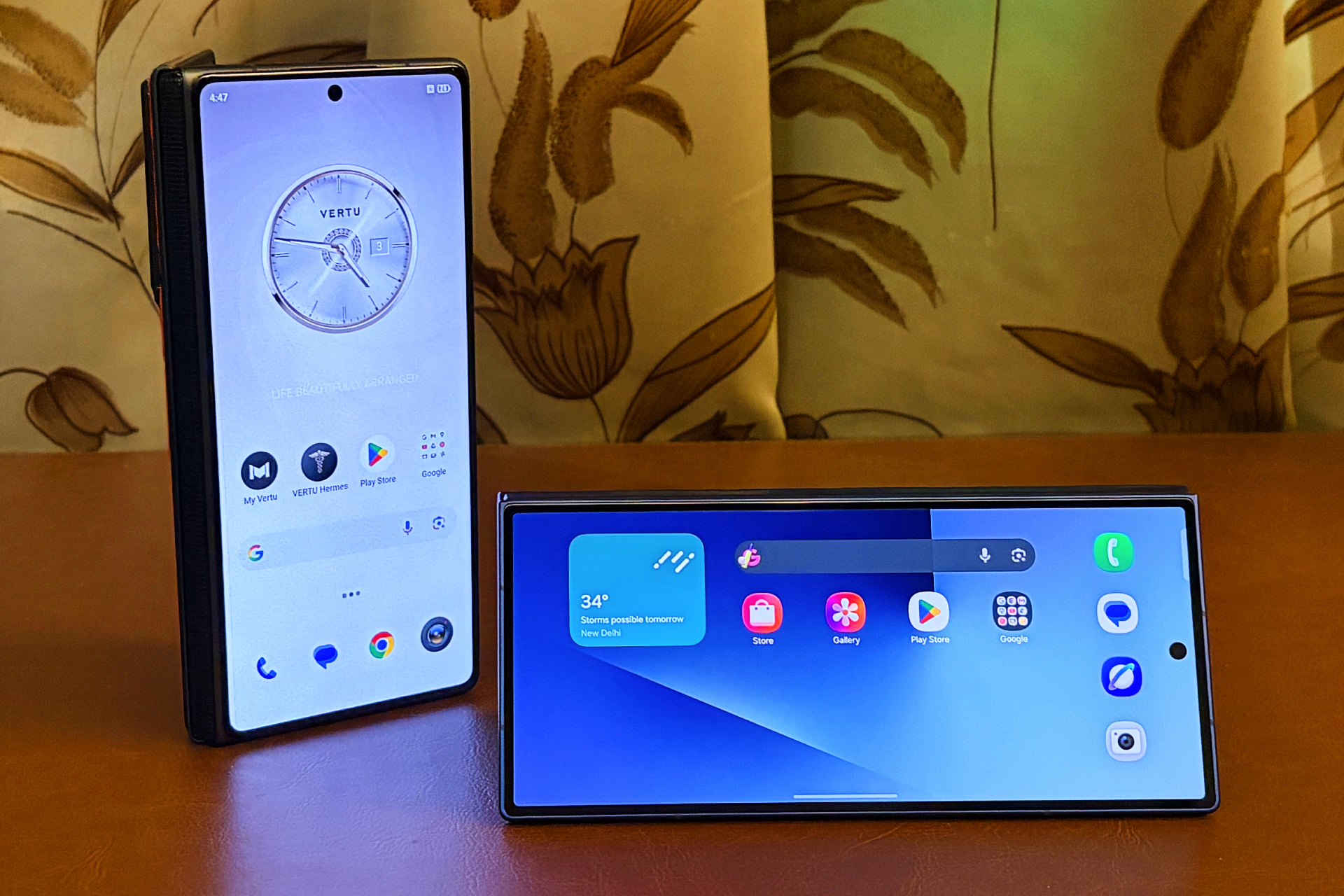
As I progressed through the tests, early software iterations had difficulty uploading documents, interpreting images, and connecting to Vertu’s concierge service. Once I reported these issues to Vertu, the firm implemented server-side adjustments that rectified the missing capabilities, allowing subsequent evaluations to proceed smoothly.
Through days of examination, a more complicated image than what the company’s assertions indicated came to light. Hermes excelled at assessing local files and spreadsheets, where Gemini on Samsung’s device continued to depend on manually uploaded documents during my trials. Additionally, it was more accommodating in automating acts across apps and completing multi-step tasks. However, this increased independence raised questions about when AI should operate autonomously and when it should seek clarification.
Can Vertu’s Hermes Agent replace an executive assistant?
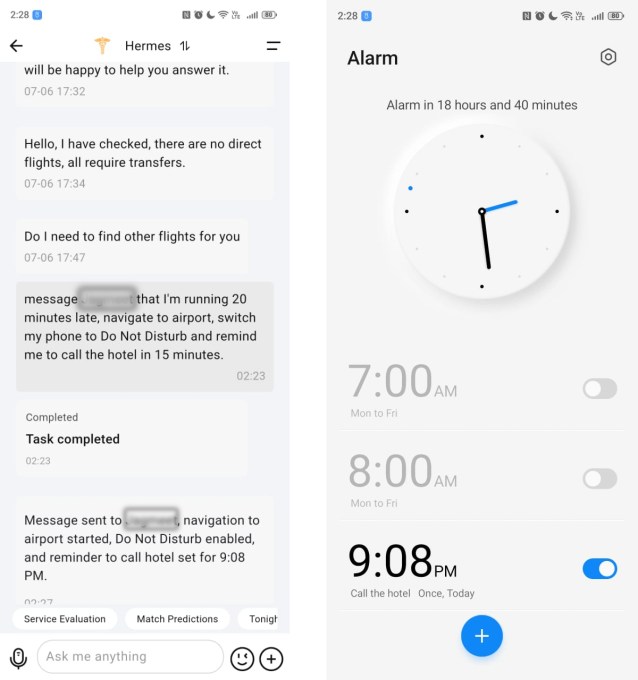
The inaugural test mirrored a typical executive situation before heading to the airport. I instructed Hermes Agent on the Alphafold to inform a contact that I was running 20 minutes behind, navigate to the airport, activate Do Not Disturb mode, and remind me to contact the hotel in 15 minutes. The agent dispatched the message, activated Do Not Disturb, and launched Google Maps with airport directions. However, it did not initiate navigation automatically and instead set the reminder for 9:08 p.m., even though I had made the request at 2:32 a.m. for a reminder 15 minutes later.
Conversely, executing the same request on Samsung’s Galaxy Z Fold 7 resulted in a distinct experience. Instead of attempting every action at once, Gemini posed follow-up inquiries, including which airport I intended to reach and whether the reminder should be made in Google Tasks or Samsung Reminder. After I made those choices, it created the reminder at the correct time.
Hermes exhibited a more proactive approach, while Gemini preferred to verify specifics before moving forward. Consequently, Hermes managed to perform more of the requested tasks, but Gemini ultimately yielded a more precise result.
Planning a business trip
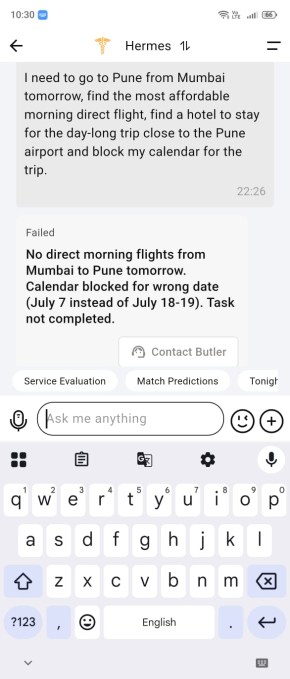
For another test, I asked Vertu’s Hermes Agent to coordinate a business trip from Mumbai to Pune, factoring in a morning flight, hotel suggestions, and adding the itinerary to my calendar. The agent indicated that no direct morning flights were available for the specified trip and offered a Contact Butler button for escalating the request to Vertu’s concierge service. It also generated a calendar entry for incorrect dates, mistakenly scheduling the trip for July 7 instead of July 18–19, thereby leaving the workflow unfulfilled.
In contrast, Gemini on Samsung’s Galaxy Z Fold 7 took a different route. After establishing that no direct morning flight was suitable for the requested trip, it continued organizing the journey by proposing alternative travel choices instead of delegating the task.
Working with business documents
Business documentation exhibited a mixed performance as well. I tasked both Hermes Agent and Gemini with analyzing a locally stored financial spreadsheet, summarizing the quarterly results, and determining if third-quarter sales figures were included.
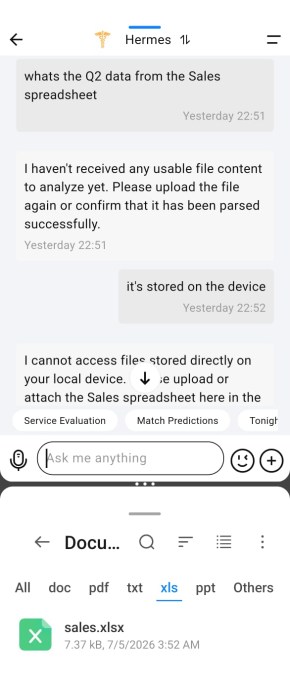
In my initial testing, Hermes evaluated an uploaded sales spreadsheet and accurately summarized the Q2 figures. However, when I revisited the same dialogue days later, it no longer recognized the file I had previously shared, responding: “I cannot access files stored directly on your local device. Please upload or attach the Sales spreadsheet here in the chat, and I will gladly analyze the Q2 data for you.”
Gemini also required the spreadsheet to be uploaded beforehand but maintained the context of the conversation. Days later, it was still able to respond to follow-up inquiries regarding the document, accurately indicating that the North region had the highest sales without needing the file uploaded again.
Overall, the evaluations implied that Hermes Agent aspires to be a capable AI assistant but still needs refinement. Its inclination to act independently frequently made it feel more like an agent than Gemini on Samsung’s phone; however, this approach occasionally led to incomplete processes, erroneous outputs, and inconsistent behavior. The regular updates during the review suggested that Vertu is actively enhancing the platform, indicating that today’s experience may not reflect what buyers encounter in the coming months.
Beyond general assistance, Vertu has structured Hermes around a series of specialized AI agents aimed at affluent professionals, including agents concentrating on legal guidance and investment advice, with options to escalate specific requests to a human concierge. The intention is to market the Alphafold as more than a mere luxury smartphone, presenting it instead as a digital aide for executives.
In practice, though, the specialized agents should be viewed as starting points rather than authoritative advisors. They can offer helpful summaries and suggestions, but their responses remain AI-generated and should be independently verified before being acted upon for legal, financial, or other critical decisions. The ability to escalate specific requests to Vertu’s concierge service highlights the existing limitations of AI agents, proving that human expertise is still vital.
Vertu is also promoting the Alphafold as a business tool rather than simply a smartphone. The company showcased an integrated enterprise resource planning (ERP) system designed to provide executives with access to business insights and workflows from the device. My evaluations, however, were restricted to a demonstration setup, making it challenging to gauge the feature’s effectiveness in practical everyday use or its compatibility with existing corporate systems.
The security aspect
For Alphafold’s intended clientele, security might be just as crucial as AI capabilities. Executives may hesitate to utilize an assistant that reviews contracts, financial documents, and business strategies if they cannot be assured of where that data is processed or stored.
Vertu asserts that communications with Hermes Agent are encrypted and not utilized for training public AI models. The firm also claims that users can select the location for their data processing, with enterprise implementations supporting private infrastructures for organizations that demand enhanced control over sensitive data.
Vertu reinforces these assertions with a dedicated “A5” security chip, which it claims offers hardware-level defenses for sensitive information, encrypted communications, and digital credentials. These assertions could not be independently verified during testing, but they are central to Vertu’s appeal to executives and businesses.
Living with the Alphafold
Apart from AI functionalities, the Alphafold operates similarly to any contemporary flagship foldable. The battery easily lasted over a day throughout my testing. Nonetheless, the lack of wireless charging is an unexpected shortcoming given the price, especially when Samsung’s Galaxy Z Fold 7 supports seamless Qi charging in addition to wired USB-C charging.
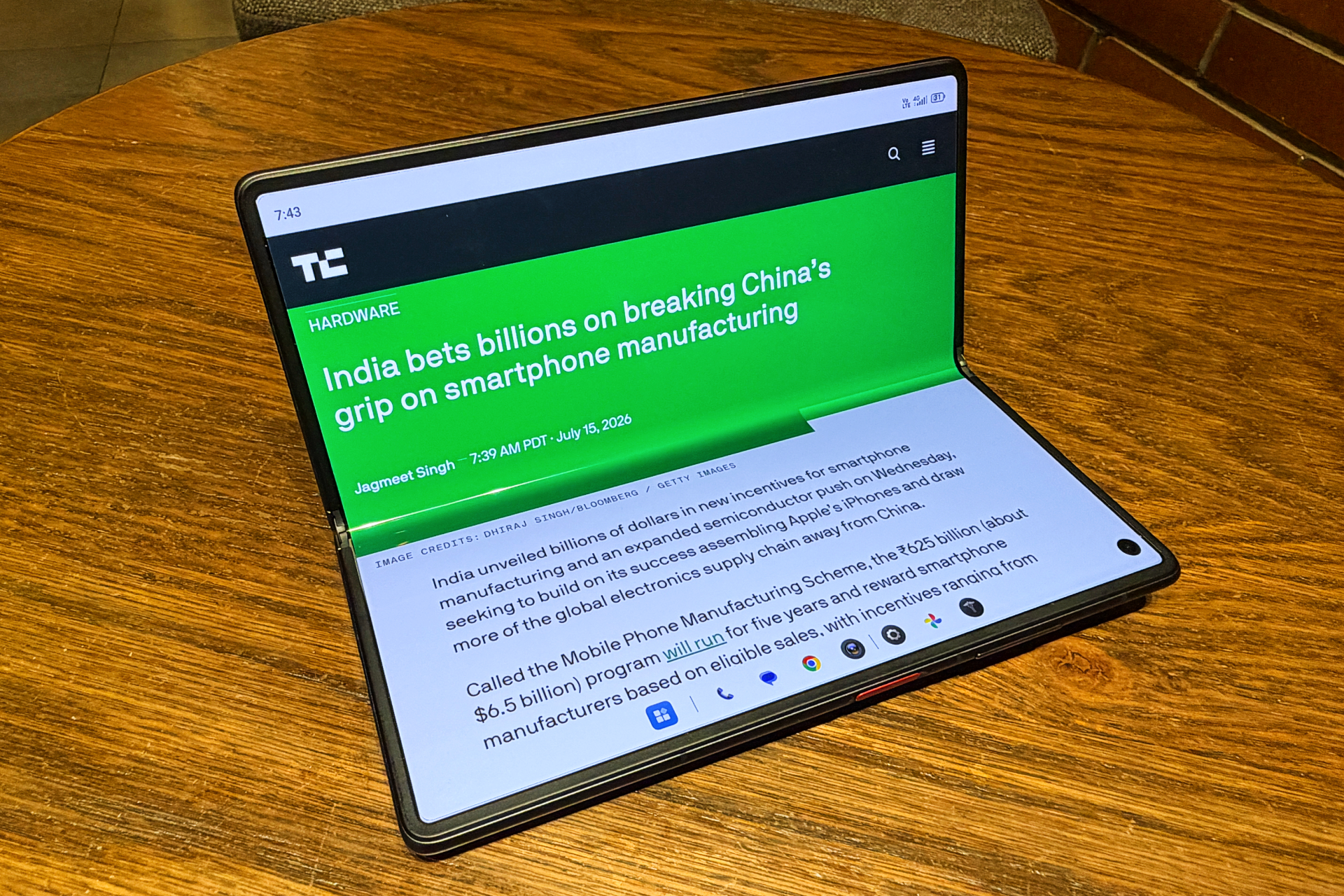
The camera application also boasts a document scanning mode under a “Smart AI” option that can recognize documents and save them with enhancements, making it beneficial for digitalizing contracts, receipts, and various business records. Samsung provides a similar scanning experience through its camera software, making this feature feel more like a standard inclusion rather than a unique attraction.
Verdict
The Alphafold is a bold initiative to create an AI-centered luxury smartphone, yet the execution falls short of the hefty price tag. Despite its upscale materials and exclusive offerings, the fundamental hardware delivers little that can’t be found in significantly cheaper foldables, while Hermes Agent remains a developing service rather than a persuasive incentive to invest significantly more.
Ultimately, Vertu is requesting consumers to pay a considerable premium for branding, craftsmanship, and a suite of AI and concierge services built atop a well-established smartphone framework. Based on my assessments, this premium is challenging to rationalize, particularly when Samsung’s Galaxy Z Fold 7 provides a more sophisticated foldable experience with comparable daily functionalities at a fraction of the cost. With the anticipated arrival of Samsung’s next-gen Galaxy Z Fold 8, the value proposition of the Alphafold becomes even more difficult to uphold.
When you purchase through links in our articles, we may earn a small commission. This doesn’t affect our editorial independence.