
According to a chart released by the company on Wednesday, Tesla’s emerging “Robotaxi” network provided fewer miles for paying customers in the second quarter compared to the first.
This decline from quarter to quarter contradicts Tesla’s narrative and efforts over the past year. The company has largely tied its future to the concept of an extensive, affordable, revenue-generating Robotaxi fleet — or going “balls to the wall for autonomy,” as articulated by CEO Elon Musk in 2024. The drop in Robotaxi miles also coincides with declining profits in Tesla’s main businesses, which fell short of Wall Street expectations, as shown by data released on Wednesday. Tesla’s shares plummeted over 13% in early trading on Thursday.
At first glance, the chart seems to indicate consistent growth in paid Robotaxi rides from August 2025 to June 2026. However, the figures presented are cumulative; when analyzed by quarter, it reveals that Tesla’s Model Y SUVs with paying passengers covered approximately 1.1 million miles in the first quarter, which decreased to about 700,000 miles in the second quarter, representing a drop of nearly 36%.
This occurs even as the firm has broadened its fledgling operation to six cities in Texas and Florida, utilizing a combination of supervised and unsupervised vehicles.
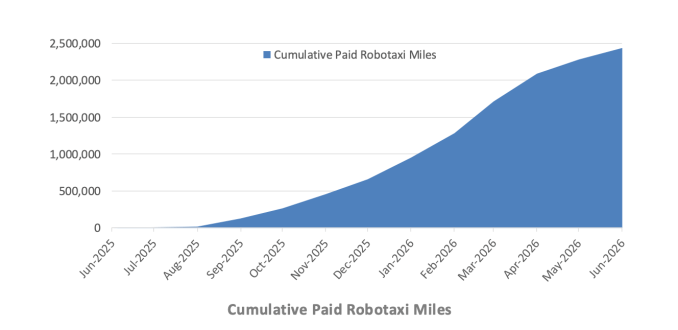
It is probable that Tesla is including the paid miles logged in the San Francisco Bay Area as well, even though these branded Robotaxis lack state-mandated permits for autonomous operation and have a safety driver present. Tesla has referred to this operation as part of its “Robotaxi coverage.”
The reduction in miles traveled also occurs as Tesla made a notable acknowledgment during a conference call on Wednesday regarding its second-quarter findings. When asked about the slow scaling of the Robotaxi service, Musk stated that the company must “gather driving data that is specific to the Cybercab” — the firm’s specially-designed, two-seater sedan that is anticipated to constitute the majority of its autonomous vehicle inventory — “before we can deploy a large number of them on the roads.”
“In contrast to, say, Model 3, Model Y, and our other vehicles where we have a considerable number on the roads, millions of vehicles on the roads, we don’t have that for Cybercab. Therefore, we need to accumulate miles with Cybercabs that are modified with steering wheels and accelerator and brake pedals, among other things, to calibrate to the Cybercab chassis,” he explained. “As we gain confidence with that, the count of Cybercabs in cities will rise significantly.”
This reflects a deviation from the company’s long-standing assertions about how its fleet of nearly 10 million customer vehicles has been quietly gathering data in the background to prepare for future robotaxis (alongside training the driver assistance software for consumers, which Tesla dubs Full Self-Driving).
During the call, Tesla’s executives framed the sluggish progress as a pressing need for safety caution.
“Our ambitions for Robotaxi are quite high, but we must exercise caution to avoid any accidents or harm to individuals,” Musk remarked.
He then expressed his concern that he does not want Tesla Robotaxis involved in accidents, as he believes negative media coverage could prompt a regulatory response.
“Although there are, I believe, 30 to 40,000 automotive fatalities each year in the United States, most do not make the news; you rarely hear about any of them. However, if we harm just one person, it will dominate the headlines globally, and regulators will act swiftly against our operations,” he stated.
Ashok Elluswamy, Tesla’s VP of AI, claimed that Tesla’s Robotaxis have experienced “zero notable incidents” while traveling “over 380,000 miles” without a safety operator present. He did not clarify what the company defines as “notable incidents,” although he asserted that “any reports were of other actors impacting us while we were stationary.”
Tesla has reported 22 incidents to the National Highway Traffic Safety Administration since it began trialing its Robotaxi service. While most of these incidents involve other vehicles colliding with Tesla’s Robotaxis, the company has noted three instances attributed to its teleoperators maneuvering the vehicles remotely, along with several cases of the cars striking objects at low speeds, including curbs, utility poles, and a tow truck’s bed.
This marks yet another shift in the company’s story. Tesla spent years insisting that regulatory barriers were the primary obstacle to full-scale Robotaxi rollout — although the company never specified which regulations were considered prohibitive.
Now, the company claims that proving safety is what is hindering Robotaxis’ progress. And although it is still in the very early phases, Tesla has opted to take this opportunity to celebrate its decision to develop an autonomy system that does not rely on radar or lidar sensors, unlike the industry leader Waymo.
“Historically, so-called experts have always asserted that you need lidars, radars, HD maps, and an entire array of tools to drive safely. Here, we demonstrate that this is not the case. You can achieve safe, comfortable, and affordable autonomy using only cameras,” Elluswamy stated.
Both Musk and Elluswamy pledged that growth is on the horizon. They noted that the amount of unsupervised miles driven has increased by approximately 10% each week since Tesla began offering them at the end of last year.
“We will continue to scale, I believe, very, very rapidly,” Musk remarked.
When you purchase through links in our articles, we may earn a small commission. This doesn’t affect our editorial independence.