
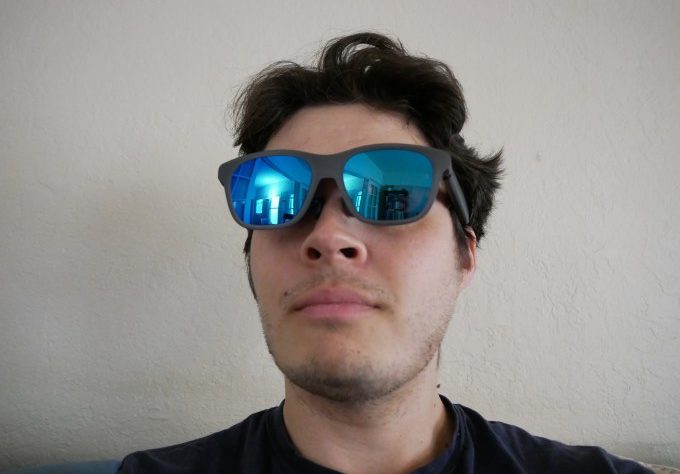
I’m a massive film enthusiast. I consume an excessive number of movies and constantly seek out new formats to enjoy them. So, when XREAL, the company behind smart glasses, sent me the a01 — a recent release from May of this year — I was keen to try them out as the latest means of indulging my media obsession.
The a01 doesn’t boast a particularly advanced design. Unlike software-intensive AR glasses such as the Meta Orion or Snap’s Specs, it functions mainly as an external display. There’s no battery or internal power source. Instead, a straightforward USB-C cable connects the glasses to your chosen device, which acts as the headset’s power supply. Additionally, it’s quite affordable, priced at approximately $300.
The a01 is primarily tailored for gaming, being compatible with devices like the Steam Deck or other handheld consoles. However, XREAL markets it for watching films and TV shows as well — and since that aligns more with my interests, I plugged it into my laptop and started streaming the Criterion Channel. I found myself engrossed in David Lynch’s “Wild at Heart,” thoroughly enjoying the moment when Nicolas Cage, clad in a snakeskin jacket, throws punches at a guy in a bar and then serenades with an Elvis track.
I must admit: The visuals are quite impressive. Equipped with dual mini OLED displays, the glasses deliver a sharp image (with a 1080p resolution and up to 1,600 nits of brightness) featuring vibrant colors. Pointing the glasses at a wall gives a sensation akin to watching a bright home projector — or perhaps as if you’re at a drive-in theater. In a dimly lit environment, you’re closer to a true cinema experience.
Nevertheless, the overall experience raised some questions. Specifically, why would I wear glasses while sitting right next to my computer watching a movie that is merely 14 inches away? XREAL claims the glasses offer a more immersive experience (they equate the projections to viewing on a 147-inch screen). Still, the redundancy of watching a film while it also plays nearby makes one wonder about the device’s actual purpose.
XREAL has indicated that the glasses can serve as a “second monitor” (they’ve been dubbed a “wearable display”), but the practicality of this is questionable. It’s quite challenging to focus on anything besides what the glasses are showing — making it tricky to, for example, work on a laptop while wearing them.
The glasses can also link to your phone. Unfortunately, I own an older iPhone, meaning the cable for the a01 doesn’t fit my device’s port. An adapter would be necessary to make the connection.
However, it’s easy to envision the user experience. Linking the glasses to a phone frees you from being confined to indoor environments, unlike bulkier devices such as a laptop. You could watch a film while flying or on a train (or even while strolling down the street — though I’d advise against this option unless you don’t mind risking bumping into traffic).
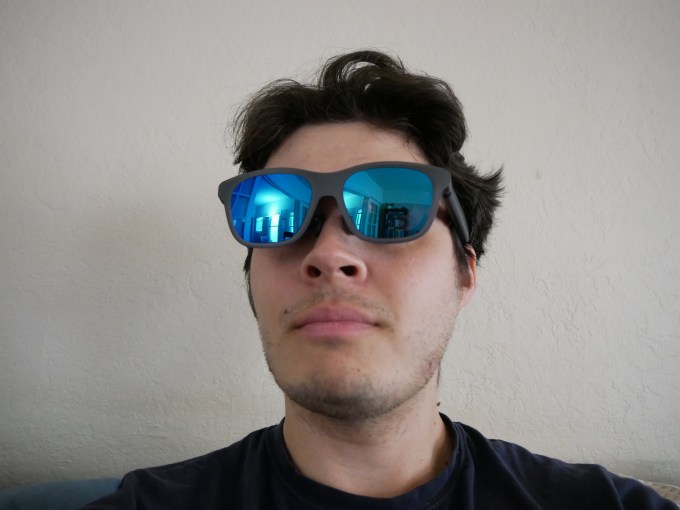
However, there are still troublesome restrictions when using the device this way. For starters, the glasses function solely as a screen-mirroring device — which means your phone’s screen must remain active while using the glasses. This brings us back to the redundancy issue. You’re viewing a video on a screen in front of your face while the same video plays on a different screen that is mere inches away. You could partially address this by stowing the phone in your pocket, but any movement might disrupt the device’s playback capabilities.
It’s also important to note that the device can be paired with an additional accessory called the Beam Pro, essentially a mini-tablet serving as a standalone streaming hub. Users can download films and shows onto the Beam, connect it to the glasses, and enjoy. However, this accessory will set you back another $200.
Then there’s the issue of heat. The a01 heats up fairly quickly — generating a peculiar tingling sensation on the bridge of your nose and over your eyes. This isn’t a problem unique to XREAL’s devices; it’s a common complaint with most XR glasses. You can only fit so much computing power into a compact plastic frame before the electrical components begin to generate heat. Still, it’s somewhat unsettling and not ideal for an accessory worn on your face.
That said, aside from the heat, the a01 is relatively light and comfortable — not nearly as cumbersome as other smart glasses I’ve tried. (After experiencing Snap’s Specs at CES earlier this year, I can assure you those weigh significantly more — though it’s also a completely different type of device than the a01.)
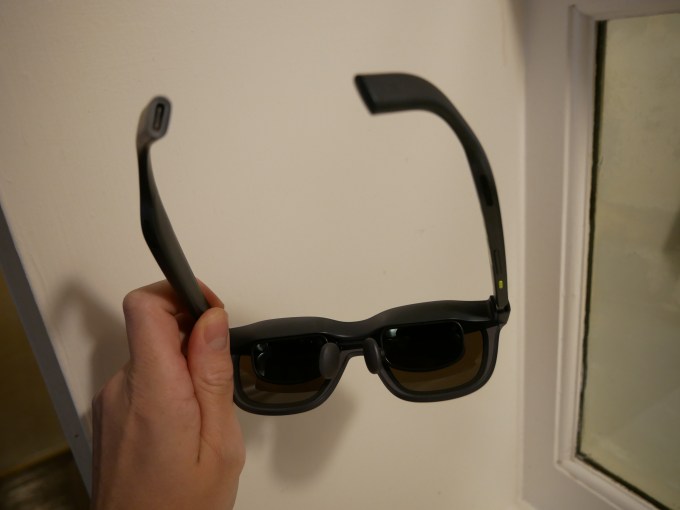
XREAL is continuously enhancing its product offerings, with each new release appearing to advance beyond the last. Indeed, some of the core dilemmas found in the a01 and earlier XREAL headsets seem to be addressed in the company’s latest (and yet-to-be-released) model: Project Aura — which I glimpsed during my visit to Google I/O this year — promises a much more immersive and seamless experience.
The Aura operates on Android XR, an extended reality operating system developed by Google and Samsung. It features native hand tracking (missing in the a01), as well as access to the Google Play Store, significantly enhancing the glasses’ interactive functions and AR capabilities. Additionally, it comes with a puck connected to the glasses that serves as the charging source and computing unit. The puck’s compact design allows you to easily carry it in your pocket, which provides greater mobility compared to the a01, allowing you to use it without being tethered to a separate device.
Returning to the a01, though, it’s unfortunately not ideal for cinephiles to watch movies through a pair of sunglasses. Generally, film lovers prefer a larger screen — the bigger, the better, in fact. In a landscape populated by 4K OLEDs of varying enormous dimensions, consumers have numerous choices. My TV — a 55-inch TCL S-series — isn’t even particularly high-end, yet it delivers a homely viewing experience far more comfortable and satisfying than the a01 can offer. To me, watching a film at home on a sizable flat screen is second only to visiting a theater. Meanwhile, experiencing a film on miniature screens just inches from your eyes offers an intriguing sense of immersion but is far from optimal.
The a01 serves as an engaging insight into a hardware industry that is continuously evolving and still finding its place with consumers. I’m intrigued to observe how the user experience will transform with XREAL’s upcoming Aura, and I’m open to revisiting my movie-watching preferences when that time arrives.
When you purchase through links in our articles, we may earn a small commission. This doesn’t affect our editorial independence.