
This week, Vogue World concluded its Milan edition featuring a group of robots—potentially a glimpse into what attendees can expect when the event arrives in San Francisco next year.
Vogue World is the magazine’s yearly traveling spectacle, now in its fifth edition: part fashion show, part celebrity exhibit, part variety show, part advertisement sales opportunity, staged in a different locale each time. It has previously taken place in New York, London, Paris, and Hollywood. This year’s Milan installment was promoted as a homage to Italian craftsmanship and the “human element” amidst a technological age, making the subsequent events rather odd.
In the segment titled The Age of Intelligence, humanoid robots crafted by the Chinese company Unitree walked into the Galleria to the tune of Gigi D’Agostino’s “L’Amour Toujours.” They waved their arms to encourage applause from the spectators. One even performed a lasso trick. They were unadorned. Alessandro Michele, the creative director of Valentino, was seen with a distressed expression that rapidly went viral.
I haven’t seen any discussion regarding the actual fashion showcased at Vogue World Milan. Instead, it’s all about the robots. (These robots have gained global attention for their dance abilities and mishaps.) Similar robots also appeared on the runway at London Fashion Week, currently ongoing.
Earlier this year, Vogue attracted attention when it announced that the next edition would take place in San Francisco, arguably one of the least fashionable cities in the U.S. The timing is not accidental. Anna Wintour has increasingly aligned herself with the technology magnates of today, and Vogue World Milan was partially sponsored by Meta Glasses, with further support from OpenAI.
This was one of those instances that highlights how disconnected the tech world can be, and that not everyone endorses the swift uptake of new technologies, including Vogue cozying up to the symbols of the excessively wealthy—who are becoming even more affluent—during a cost-of-living crisis. This is before considering AI, mass surveillance, job displacement, and the energy crisis, all overseen by the same elites. For some, a robot on the runway is further evidence of the current world’s issues.
“I’m frustrated by the celebrities applauding the entire spectacle,” one tech entrepreneur messaged me on Instagram. “It’s disturbing. People are genuinely losing jobs and livelihoods because of these technologies. They should stop promoting it. What are they even showcasing? Headphones?”
A fashion journalist friend simply replied “No,” when I sought opinions on the robots and Vogue World San Francisco. Jason Johnson, founder of Culture Impact Agency, mentioned that Vogue has been attempting to foster ties with Silicon Valley for at least a decade, recalling when Jony Ive co-hosted the Met Gala in 2015. The presence of dancing robots at Vogue World Milan seemed inevitable, as does the upcoming Vogue World San Francisco and Jeff Bezos along with his wife, Lauren Sanchez, gracing the Vogue wedding cover and co-hosting the 2026 Met Gala.
“Publications are discovering new avenues to generate revenue, and tech is financially backed,” he shared with me. “Vogue possesses the cultural impact and access that those tech individuals desire.” Ultimately, both parties benefit, he stated.
Nonetheless, the manner in which Vogue is approaching this seems oddly unnatural.
Muna Ikedionwu, founder of MKEDI, a strategy firm for early-stage startups, remarked that what intrigued her most about the robots is that they do not fully encapsulate the innovation and progress underway in the creative technologist realm. “I’ve witnessed remarkable examples of engineering and AI influencing fashion, shaping design and art,” she remarked, adding that robots parading down the runway merely skim the surface of current developments at the confluence of fashion and technology.
She highlights the artist duo AA Murakami, who designed Olympian Eileen Gu’s bubble dress at this year’s Met Gala. They are fashion creators and engineers, Ikedionwu noted, referring to a presentation she recently attended about creating an “everlasting bubble.” They are at the forefront of pioneering “ephemeral technology,” she stated, “this concept of technology and innovation that resonates with the transient nature or the temporariness of art, humanity, and the soul.”
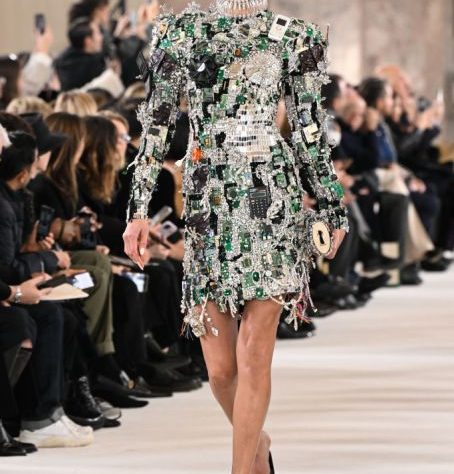
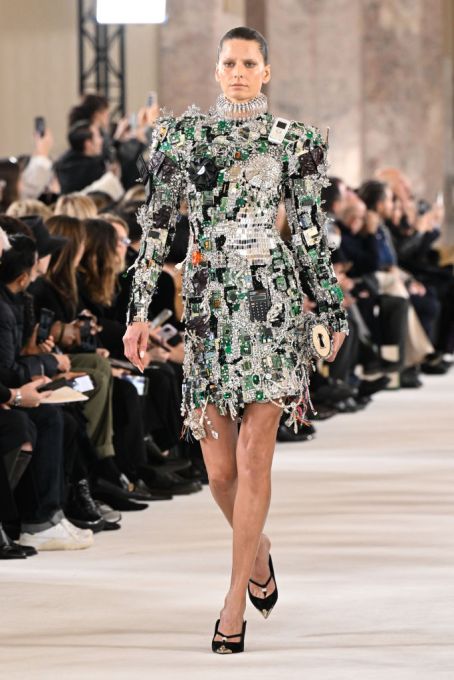
Admittedly, when viewed in this context, the robots did seem quite dull. Whenever I contemplate the crossroads of fashion and technology, the Spring 2024 Schiaparelli collection comes to mind, featuring a robot baby constructed with Swarovski crystals and a gown made from vintage tech such as PC microchips. (I once joked about wearing that gown to Disrupt; see image above.)
Ikedionwu ponders if this robotic performance was an attempt to ease the general public into the idea of technology merging with fashion, a combination that has been quietly developing for years. If that was the goal, it seems it fell flat. However, perhaps Vogue World is reserving all the exciting elements for San Francisco.
When you purchase through links in our articles, we may earn a small commission. This doesn’t affect our editorial independence.