
Following the resolution of its protracted antitrust dispute concerning the Android app ecosystem earlier this month, Google announced on Thursday that it will simplify the process of installing Android apps from sources outside the Play Store. The company revealed new information about an “advanced flow” feature that will permit Android device users to disable a verification requirement, which otherwise restricts the sideloading of apps.
Last year, the tech giant declared that it would mandate all Android apps to be registered by verified developers in order to be installed on certified Android devices. This move was aimed at curbing the capacity of malicious actors to disseminate malware, execute financial scams, and acquire users’ personal information through applications outside the Play Store.
While added security measures can help mitigate such threats, certain Android users desire the autonomy to install unverified applications and accept the risk if these apps prove to be hazardous.
With the newly introduced “advanced flow” feature, users will have the ability to undergo a one-time procedure to deactivate these extra safeguards while still aiding in the prevention of scams.
The procedure starts by activating developer mode within Android’s system settings, a step intended to prevent any accidental actions or “one-tap” bypasses that malicious actors frequently utilize in high-pressure frauds. Google points out that scammers often exploit fear to instill a sense of urgency in their targets, employing strategies such as threats of financial catastrophe, legal complications, or harm to family members. They frequently maintain phone contact with the victim and guide them through the steps needed to disable the security measures on their device.
According to a report by the Global Anti-Scam Alliance (GASA), cited by Google, 57% of adults globally fell victim to a scam in 2025.
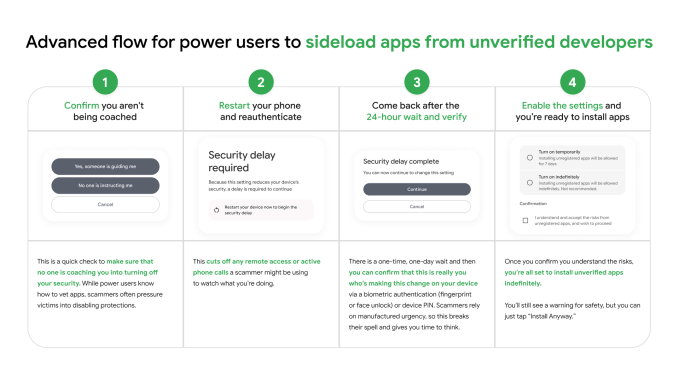
Once developer mode is activated, there’s a brief verification designed to ensure that no one is guiding the user to disable their security measures. Users will then reboot their device and reauthenticate, a method that disconnects any remote access or ongoing phone calls that a scammer might be exploiting to monitor their potential victim’s actions.
After a one-time, one-day protective waiting period, users will be able to verify that it is indeed them making the change. Given that scammers typically depend on artificially created urgency, this waiting period grants users an opportunity to reflect, Google clarifies. Once the waiting time elapses, the device owners can utilize biometric authentication, such as a fingerprint or facial recognition, or their device PIN to validate the alteration.
Upon completion of the process, Android users will have the capability to install applications from unverified developers outside the Play Store. Users may opt to enable this feature for 7 days or indefinitely. Google states that users will still receive a warning that the application is from an unverified developer for safety reasons, but they will have the option to dismiss this warning with a tap.
The company emphasizes that alongside this new flow, it is also providing free, limited distribution accounts for students and hobbyists who wish to share apps with a small audience of up to 20 users without needing to verify their accounts with a government ID or registration fee.
These adjustments follow the resolution of a lengthy legal confrontation between Google and Fortnite creator Epic Games regarding anticompetitive matters on the Play Store. As a result of the settlement, Google announced it would reduce its Play Store commissions to 20% on in-app purchases, with an additional 5% applied if app developers choose to utilize Google’s billing system.