
On Tuesday, Apple disclosed its plans to permit advertisers to reach customers via Apple Maps, commencing in the U.S. and Canada later this summer. The advertisements will be accessible to businesses of all sizes possessing a physical location and having already established a business listing on Apple Maps. Users will, in turn, encounter these ads alongside relevant search results.
These advertisements form part of an overhauled business initiative from Apple termed Apple Business, which encompasses an integrated email, calendar, and directory service, along with tools aimed at managing employee devices.
Apple has stated that it will display just one ad per user in the search results of its Maps. Additionally, the ad will be distinctly marked with a small blue halo encircling the pin on the map and will be labeled as an advertisement in the list of Suggested Places, akin to the way ads are featured on the App Store.
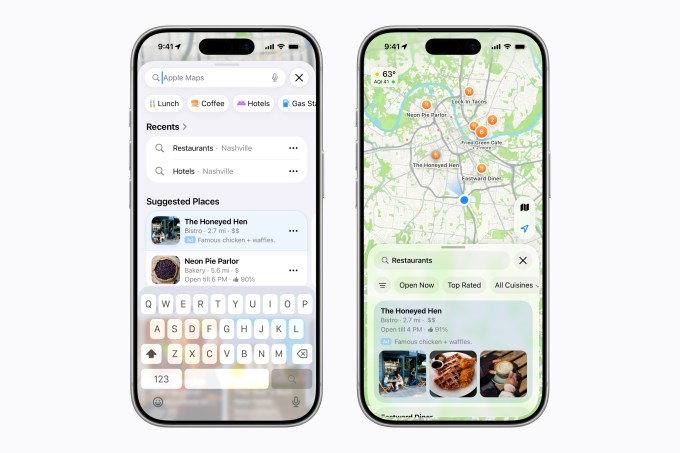
Integrating ads into one of Apple’s premier first-party applications provides the company with a chance to create an additional—and potentially significant—revenue source without fundamentally altering its product or disturbing the user experience. Consumers have already become accustomed to ads in mapping services, particularly after years of utilizing Google Maps, where advertising is a substantial feature. This addition could generate billions for Apple as its advertising enterprise continues to expand worldwide.
Apple asserted that its advertising will safeguard user privacy, as any data regarding ads that users engage with will not be linked to their Apple account. Personal information remains on the device, is not collected or stored by Apple, and is not disseminated to third parties, according to the company.
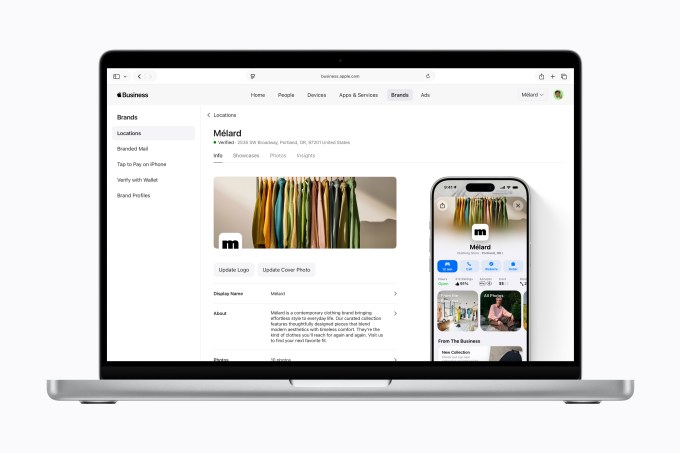
To launch an ad and initiate a campaign, a business is required to first possess a listing on Apple Maps. They can subsequently upload images, include a promotional message, and determine a suitable budget. Apple utilizes automated matching to position the ad before users who are currently searching for a comparable business. Advertisers have the flexibility to commence or halt their campaign whenever they wish.
Larger advertisers have the option for more sophisticated customization, such as scheduling their ad’s display times or selecting specific geographic areas for targeting.
Previously reported by Bloomberg, the incorporation of ads within Maps indicated that the ad placement would entail a bidding mechanism. Apple has now confirmed that a traditional auction-based pricing model will govern these ads. Advertisers incur costs only when achieving a specific objective, like having their ads viewed or clicked.
The growth of Apple’s advertising sector coincides with a broader transformation in its business offerings, which involves the integration of various business tools and services into one cohesive package.
Rather than navigating multiple URLs for resources such as Apple Business Connect, Apple Business Essentials, and Apple Business Manager, these functions will now collectively be called Apple Business. The entire suite is set to be available in 200 countries and territories starting April 14, 2026.
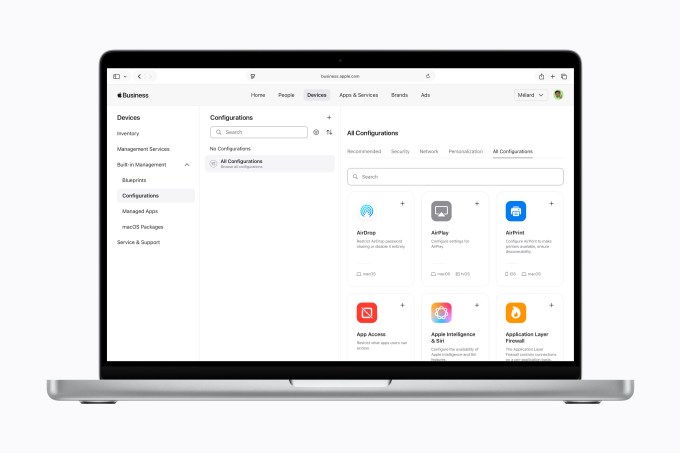
For the first time, businesses will gain access to an employee directory alongside a new collection of productivity tools, which includes an email and calendar tailored under the business’s domain. Employee accounts will provide 5 GB of complimentary iCloud storage, and businesses in the U.S. may opt for upgraded plans starting at $0.99 per user per month (offering up to 2 TB of storage per user). Companies can also choose to subscribe for additional support through AppleCare+ for Business, priced per user or per device, beginning at $6.99/month.
The new offerings provide a range of complimentary tools for businesses, no matter their size, including a mobile device management solution for app distribution to employees, which has been upgraded with added features and will now be available for free (previously a paid service).
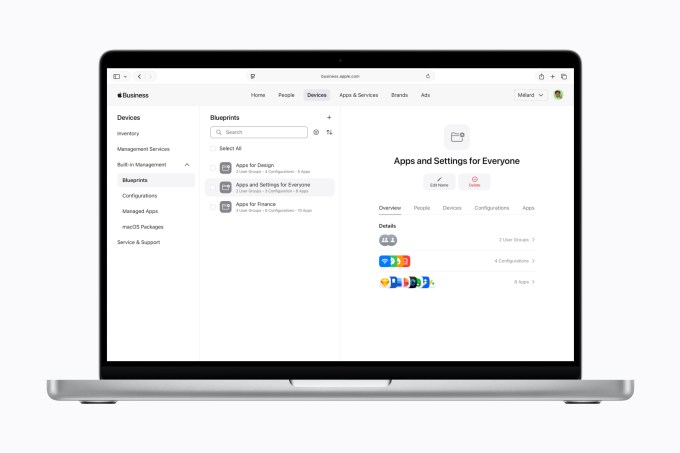
Smaller enterprises will have the capability to utilize preconfigured “Blueprints” to assist in setting up employee devices without needing advanced technical skills. Business owners or administrators can simply select the applications they wish to provide staff, with settings already prepared on their behalf. Larger organizations will manage app distributions via an API, as indicated by Apple.