
Mastodon is implementing modifications aimed at enhancing the attractiveness and usability of its social networking service, particularly for mainstream users seeking alternatives to X or Threads.
On Thursday, the creator of decentralized social networking software announced it is overhauling a crucial element of its platform by providing people’s user profiles with a fresh appearance, which it hopes will attract both organizations and individuals.
Founded on the ActivityPub protocol, Mastodon gained prominence after Elon Musk took over Twitter, now rebranded as X, prompting some users to look for alternatives. The platform’s allure lies in its decentralized nature, meaning no single entity controls the algorithm, and users can transfer their accounts should they disapprove of a specific server’s operations or community management.
Nevertheless, this arrangement is also more complex compared to joining a traditional social network like X. On Mastodon, users must select a server to participate in and experience different timelines (local and federated), which can be perplexing for newcomers. The procedure for following other users on the service can also be tricky.
This has left Mastodon facing challenges in attracting new users, with numbers currently around 800,000 monthly active users, down from a million during the peak of the Twitter saga.
In recent months, Mastodon has been addressing several challenges that might deter users. In February, it streamlined the onboarding experience and incorporated additional features that users typically expect, such as Quote Posts and “starter packs” known as Collections.
Now, it is focusing on user profiles. The revamped edition introduces several alterations, many of which are visual.
What’s changing
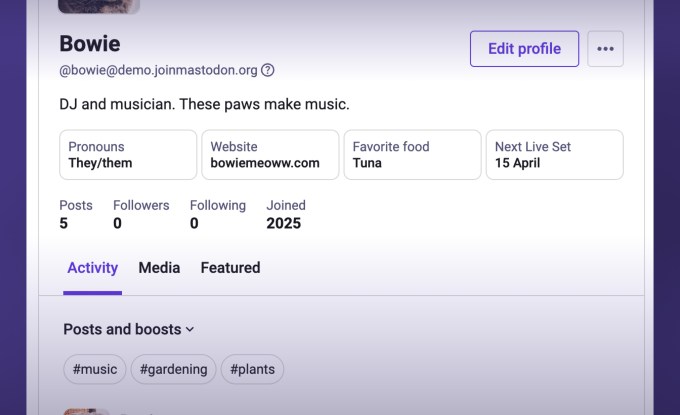
Rather than presenting two views of a user’s posts (“posts” or “posts and replies”), akin to X, profiles now contain a single “Activity” tab equipped with a dropdown menu. This enables users to customize different combinations of posts by enabling or disabling replies and boosts — with boosts being Mastodon’s equivalent of a repost.
Hashtags are now prominently displayed at the top of the Activity tab, enabling users to filter posts on that account by the selected tag.
Mastodon has also eliminated the pinned posts carousel, a feature that many users found unappealing. This was created to reconcile the requirements of those wanting to pin multiple posts with those visiting a profile to quickly access the user’s latest posts. Now, users with several pinned posts will showcase one prominently, while others can be accessed via a new “View all pinned posts” button.
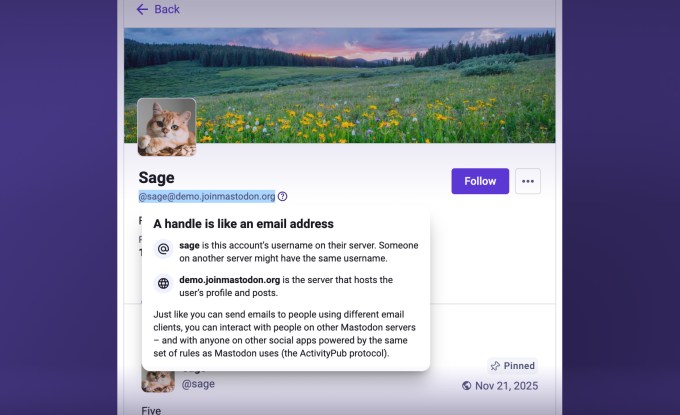
Another alteration aims to clarify Mastodon handles for new users. In contrast to X or Threads, where users are simply @username, Mastodon handles incorporate two @’s — one indicating their account name and the other their server’s name. A new information pop-up elucidates this.
Users are also given greater control over their profile’s appearance, with options to conceal the “Media” or “Featured” tabs, if desired, or to hide replies from their “Media” tab to highlight their work.
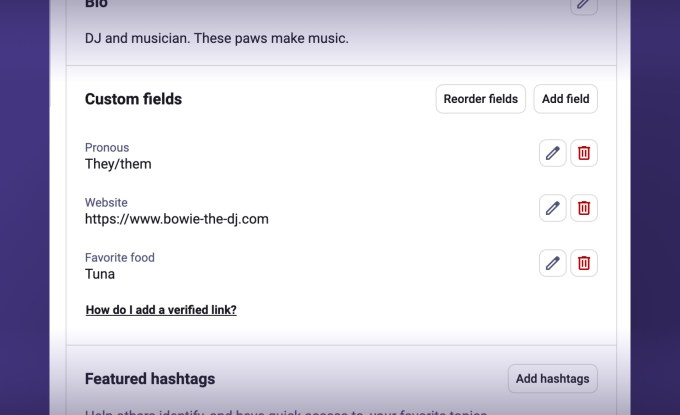
Custom fields on the profiles where users can add elements like links, pronouns, and additional details are now arranged horizontally, creating more vertical space on the screen. These fields can now also be updated on iOS and Android, not solely on the web.
Additional design adjustments make profiles appear less cluttered — such as the elimination of a “following you” badge and repositioning the optional “personal note” users add to their profiles into an overflow menu.
Profile modifications can now all be managed from a single location in the account settings, enabling users to oversee tasks such as their featured hashtags (which Mastodon now thoughtfully suggests), links, and other profile details.
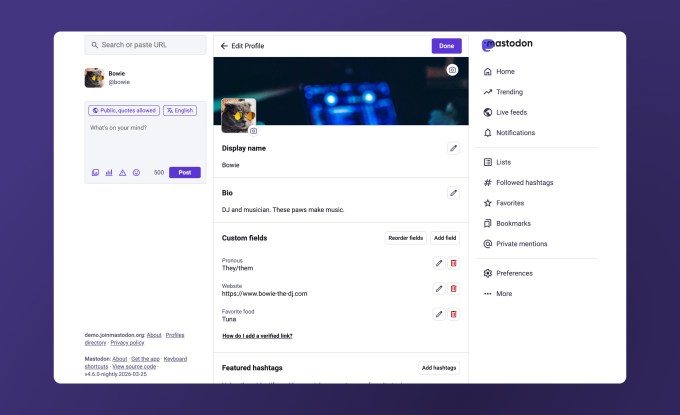
Link verification — a feature of Mastodon to ascertain a user’s trustworthiness without establishing a centralized authority (or demanding payment like X) — is now more accessible rather than being hidden in settings. Users can crop and add alt text to their profile images and cover photos.
These updates will be initially accessible to the mastodon.social server and other servers that choose to operate the nightly build. More servers will receive the update with the launch of the Mastodon 4.6 software version in a few weeks.