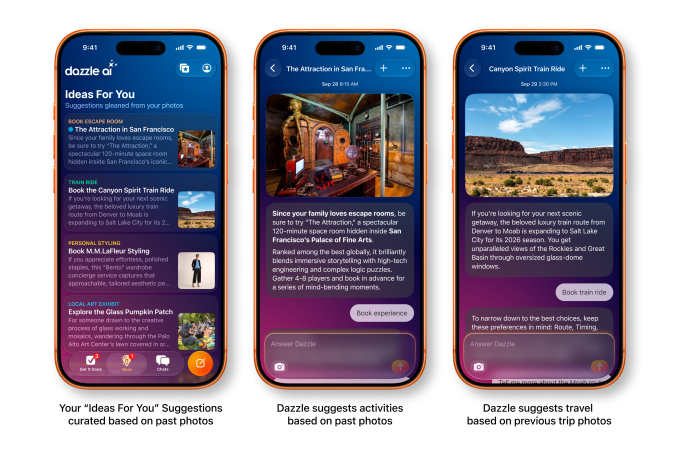
OpenAI provides Codex with versatile cloud environments that function seamlessly across devices.

OpenAI provides Codex with versatile cloud environments that function seamlessly across devices.

OpenAI has unveiled enhanced features for its software engineering agent Codex, extending its utility beyond a developer’s local machine with reusable cloud development environments accessible from any device.

The announcement, made during OpenAI’s Dev Day on Tuesday, is part of a series of updates for Codex. OpenAI also revealed an updated Codex CLI, a revamped code review process, tools for strengthening infrastructure, and additional API improvements.

Although Codex could already initiate cloud tasks for remote work, today’s update indicates that OpenAI is enhancing the persistence and configurability of those cloud environments, rather than viewing each cloud task as an isolated remote sandbox.

As described by the company, developers will now have the flexibility to operate Codex wherever necessary, whether it’s on a computer, remotely via a phone, or in the cloud. The reusable development environments aim to expedite task initiation and provide teams with a shared workspace featuring approved settings and permissions, according to OpenAI.
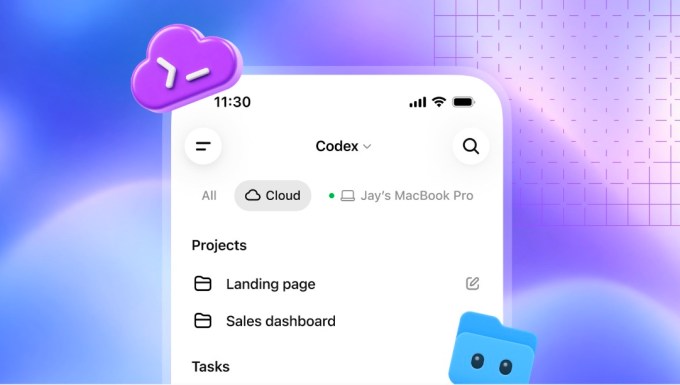
Image Credits:OpenAI

In addition, the Codex CLI is being updated to allow developers to initiate and manage tasks using voice commands.

A newly introduced /agents view is intended to simplify the delegation of work and the simultaneous tracking of multiple tasks. Other adjustments encompass enhancements to routine activities like editing prompts, resuming sessions, and utilizing worktrees. OpenAI is also launching a “cleaner” terminal interface aimed at improving readability during extended sessions.

Image Credits:OpenAI

Codex can also be integrated into a new code review interface within the ChatGPT desktop application, allowing users to read summaries, review code modifications, or inquire about potential issues with Codex prior to providing feedback on GitHub pull requests or GitLab merge requests.

Automatic code reviews enable Codex to conduct an initial evaluation while users are away from their computers.
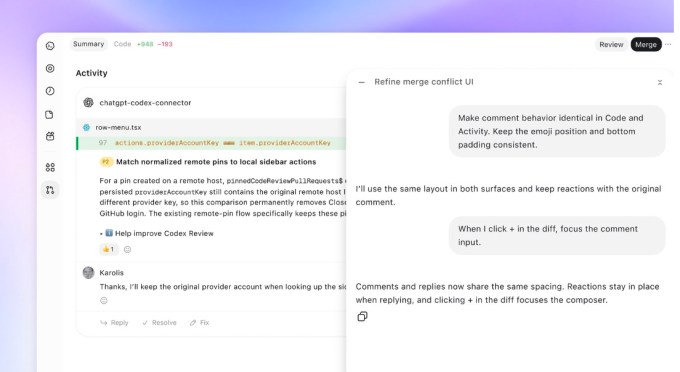
Image Credits:OpenAI

On the security front, OpenAI is launching a new suite of tools known as Codex Security Cloud, aimed at assisting developers in securing their infrastructure. Developers can utilize these tools to scan complete GitHub repositories either on demand or according to a regular schedule, as well as upon the arrival of new commits. Codex will subsequently analyze findings, eliminate duplicates, and prepare fixes in the cloud—even when the user is inactive and their computer is powered off.

Importantly, the toolkit includes access to the models provided through OpenAI’s cybersecurity program Daybreak Blue, without necessitating developers to file a distinct application.

Image Credits:OpenAI

Additionally, OpenAI revealed multiple API updates, such as a new Decisions API designed for real-time decision-making. This API utilizes Luna to respond to a collection of user-defined inquiries with preset answers. The firm has also introduced an enhanced version of the Agents API that now accommodates computer operations and integrates Amazon’s Bedrock Managed Agents to develop OpenAI agents that operate exclusively on AWS.

When you purchase through links in our articles, we may earn a small commission. This doesn’t affect our editorial independence.


Can a chatbot solve the government labyrinth? The White House is on the verge of discovering this.

Can a chatbot solve the government labyrinth? The White House is on the verge of discovering this.

On Tuesday, President Donald Trump declared that the White House is launching America.gov, an AI chatbot designed to assist individuals in locating government services and other resources.

Google has verified its role as a partner in this initiative, stating that its AI model, Gemini, is part of the effort, although it remains unclear if additional AI firms played a role as well.

“Rather than requiring citizens to navigate the overwhelming labyrinth of countless government websites and regulations… you will now have a single access point for any question,” Trump mentioned in a post on X.

Easing the navigation of government services is a commendable objective, but is utilizing an AI chatbot the most effective solution? Large language models are not perfect and are still susceptible to generating hallucinations. Indeed, CNN recently revealed that the U.S. military came close to initiating a military operation against a Chinese ship it thought was transporting components for nuclear arms. The military canceled the operation at the last moment after realizing that the perceived threat was merely an AI hallucination.

If an individual receives incorrect information from America.gov, it likely won’t lead to nuclear conflict, but an error can still carry significant repercussions. People may depend on this chatbot for details regarding food stamp applications, visa renewals, or tax filings, where inaccuracies could result in missed deadlines, denied assistance, or financial penalties.

National Coffee Day 2026: Offers Worth Brewing at Home

National Coffee Day 2026: Offers Worth Brewing at Home

September 29 is well-known for various holidays. Happy Goose Day, Poisoned Blackberries Day, and Attend Your Grandchild’s Birthday Day to those observing. I will mark National Coffee Day. (This should not be confused with International Coffee Day, which is the following day.)

Established by the National Coffee Association around 2009, National Coffee Day previously included complimentary and discounted coffee from establishments like Dunkin’ and Panera, but it seems that many major chains this year are focusing on new product launches rather than discounts. (For instance: Krispy Kreme’s coffee-flavored donuts and Starbucks’ new aerocano.) If you’re searching for bargains, you may need to brew your own coffee at home this year. Fortunately, we’ve discovered some excellent sales to make this a celebration worth having.

Deals From Atlas Coffee Club

WIRED reviewer Matthew Korfhage’s top coffee subscription for the second consecutive year has a multifaceted deal running until October 5. Obtain a 12-ounce bag of single-origin coffee for $5 with any subscription, enjoy a 50 percent discount on pods for Keurig and Nespresso machines, and benefit from up to $50 off gift subscriptions (for example, six months is only $99 instead of $120). Coffee subscriptions make a fantastic gift for those who are difficult to shop for.

Lowest Price We’ve Seen on Our Favorite Super-Automatic Espresso Machine

Korfhage’s favorite bean-to-cup super-automatic espresso machine takes care of everything for you—just fill the hopper, and the Rivelia will assist in selecting grinder settings, extracting your grounds, and even frothing your milk. This is the lowest price this machine has ever reached, with most sales hovering around $1,200. It’s worth considering if you’re in the market.

Save $20 on a Plastic-Free Aeropress

Aeropress is the quickest and best method to manually brew coffee. Traditional Aeropress varieties are made of plastic, but the premium steel-and-glass model is worth purchasing while on sale. Martin Cizmar praised it for its user-friendliness and the espresso-like flavor it yields.

Our Favorite Keurig Is 50 Percent Off

Keurig machines are ideal for offices and homes with varying schedules. The K-Cafe Smart is among our favorites. WIRED reviewer Louryn Strampe commended the K-Café, typically priced at $200. It features six brew sizes, customizable strength and temperature, and a built-in milk frother.

Save $100 on Fellow’s Greatest Hits

Our preferred drip coffee maker sells for $400 and effortlessly produces an excellent cup of coffee. Its elegant design adds a striking element to the countertop. The updated Opus grinder is a strong candidate for WIRED’s favorite coffee grinder, suitable for both espresso and drip. The Opus 2’s new stepless grind system improves its functionality. The grinder retails for $200, making this deal akin to receiving it at half off if you’re in the market for an Aiden.

Instinct's founder mentioned that over 50% of the transactions occurring on the platform pertain to travel.

Instinct’s founder mentioned that over 50% of the transactions occurring on the platform pertain to travel.

Nearly every demonstration of AI tools features a user engaging with the assistant to arrange travel, which appears to be the most common application. The popular Instinct agent is no exception, as over 50% of transactions on the platform relate to travel, according to the company’s founder, Noah Shinn, during a recent podcast.

In a discussion with investor Patrick O’Shaughnessy, Shinn also indicated that the invite-only platform is nearing a billion dollars in yearly transactions. However, he did not clarify the methodology behind this figure.

“Individuals who are not utilizing Instinct rely on travel agencies (or websites) to reserve hotels or flights. What is the advantage of that interface? They effectively consolidate various hotel brands, airlines, and services, presenting them attractively for users, who can opt for immediate checkout,” Shinn stated.

“I believe there is a superior experience with Instinct or similar interfaces where users can say ‘Hey, I urgently need to be in New York tonight.’”

He noted that the platform is experiencing a daily growth of 10%, with transaction volume rising at a comparable pace.

The founder has also referenced several of his comments from the podcast. He remarked that most dining establishments operate on a first-come, first-served reservation basis, which fails to consider occasions of significance. He mentioned that an agent could monitor restaurant sites every five seconds and notify the user about available reservations. Shinn also suggested that the company aims to transform reservations and provide users with preferential treatment.

“If you begin with restaurant reservations from the user’s perspective, they desire the reservation for a notable life event they may have. From the restaurant’s perspective, they are interested in attracting engaging guests. They wish to focus on special occasions rather than, perhaps, the local individual who consistently occupies a table without any special event,” Shinn said.

Some analysts have mentioned that agents might fabricate stories about anniversaries and special events just to secure a table at a dining location. They also noted that certain restaurants favor local customers as they are regulars and contribute more to their business.

Instinct recently secured $1 billion in Series C funding on Monday, achieving a $10 billion valuation from Sequoia Capital, Benchmark Capital, and Coatue. The 14-member startup is vying against Meta’s Muse and Khosla-backed Wajo in the personal agent market.

When you purchase through links in our articles, we may earn a small commission. This doesn’t affect our editorial independence.

After his voice was taken by cancer, this entrepreneur is creating “spectacles for voice”

After his voice was taken by cancer, this entrepreneur is creating “spectacles for voice”

Years ago, Konrad Zieliński lost his ability to speak due to cancer while studying at the University of Warsaw. Traditionally, individuals with his diagnosis have depended on handheld voice devices that sound mechanical and uninspiring, or on surgically set voice implants which need continuous upkeep to avoid issues, Zieliński expressed to TechCrunch.

He later earned a PhD concentrating on bionic systems for laryngectomees, those who’ve undergone removal of their larynxes. During the development of his thesis, he aimed to create a non-invasive apparatus, one that wouldn’t necessitate surgery, enabling individuals like himself to express emotions, laugh, shout, and even perform songs.

In 2023, Zieliński initiated Uhura Bionics, a startup chosen as one of TechCrunch Disrupt 2026’s Battlefield 200, a selection of nascent companies invited to present their innovations at the upcoming conference. The enterprise provides two wearable products: a simpler variant and a premium model known as Whitney, named after the vocalist Whitney Houston.

Zieliński expresses his hope that laryngectomees will use Whitney in the same manner that individuals with impaired vision utilize glasses.

“I’m pleased with what I’ve created because it incorporates the emotional aspect,” he stated in a voice that indeed conveys a great deal of inflection, albeit with a subtle electronic hint.

The subsequent phase in Uhura’s evolution involves introducing higher-pitched voice options for women, alongside personalization features to ensure users maintain unique vocal qualities.

Currently, Uhura markets its offerings as wellness products, implying users must cover costs themselves: $500 for the standard version and $1,500 for Whitney. However, the startup is pursuing classification as Class I medical devices, the least risky category, in Europe and, subsequently, the U.S. This designation would permit partial reimbursement through health insurance.

Zieliński approximates the market potential for devices aiding laryngectomees at around $2 billion, though he believes it could expand significantly if Uhura branches out to accommodate individuals with other speech impairments.

Uhura is not the only one providing contemporary solutions for those who have lost their voices. Rivals include Atos Medical, a company with medical devices in this sector, and startups like Laronix.

Nevertheless, Zieliński is confident that Whitney will appeal to numerous laryngectomees. He will showcase its features not only at TechCrunch Disrupt but also at SF Tech Week in October, where he plans to sing on stage with Whitney’s assistance.

When you purchase through links in our articles, we may earn a small commission. This doesn’t affect our editorial independence.

Oura postpones its $2.2B IPO due to 'uncertainty' in the market.

Oura postpones its $2.2B IPO due to ‘uncertainty’ in the market.

Oura, the smart ring manufacturer, has indefinitely delayed its IPO plan valued at up to $2.2 billion, attributing the decision to “uncertainty in the IPO market.”

The firm, which had intended to offer 55 million shares priced between $40 and $44 each for the IPO, did not disclose further information. The IPO could have positioned Oura’s valuation at as much as $15 billion at the midpoint of that pricing range.

“Our goal is to empower individuals to lead healthier and longer lives, and an IPO is merely one step in our journey. We strive to deliver a remarkable IPO for our employees and investors and have the privilege of selecting our timing. In the meantime, we will pursue the opportunities that lie ahead,” stated Tom Hale, the company’s CEO.

Indeed, Oura appears to be thriving. The company reported that its newest product, the Oura Ring 5, has been well received in the marketplace, with membership rising to 5.7 million from 5 million at the conclusion of June. Oura anticipates revenue growth of 90% for its 2026 fiscal year compared to the previous year, when it generated $907.9 million in revenue.

However, the IPO delay will push back some of the company’s financial plans that were reliant on proceeds from the IPO, as well as those of its shareholders.

Forerunner Ventures, an early backer of Oura, was expected to dispose of its entire 9.3% stake in the IPO, potentially yielding around $1.20 billion (assuming shares listed at the $42 midpoint). Meanwhile, Oura had planned to allocate a majority of the IPO revenues to settle tax obligations tied to employee stock grants that were due to vest upon listing.

Shareholders seeking liquidity will now have to wait as well.

With Dazzle, Marissa Mayer wagers that your camera roll holds more insights about your life than your inbox does

With Dazzle, Marissa Mayer wagers that your camera roll holds more insights about your life than your inbox does

Earlier this month, when former Yahoo CEO Marissa Mayer informed me that she was finally prepared to launch Dazzle, the personal AI assistant that secured an $8 million seed round last December, I couldn’t help but speculate if she’s mimicking Meta’s Muse, Instinct, and the surge of comparable tools that have entered the market in recent weeks.

However, when Mayer eventually delivered a demo, Dazzle demonstrated that it is adopting a unique strategy. Rather than gathering context about you from text-heavy applications such as email, calendars, and shopping histories, Dazzle’s AI assistant derives all its context from a singular source: your camera roll.

“I believe that photos are an undervalued source of information,” Mayer stated. “You might be amazed at what we can ascertain about you and how effectively we can work with your photos.”

Mayer posits that if a picture is worth a thousand words, your camera roll is worth millions. By evaluating all the images saved on your device, Dazzle asserts that it comprehends your hobbies, interests, food and style inclinations, how you prefer to spend your time, and with whom.

“We recognize whether or not you enjoy skiing, where your latest trip was, and what types of interests your children have,” Mayer noted.

It’s unsurprising that Mayer has created an assistant focused on photographs. Her earlier startup, Sunshine, introduced an AI-driven photo-sharing tool named Shine in 2024. Although that product faced widespread criticism for its dated design, struggled to gain traction, and eventually ceased operations, Mayer asserts that it nonetheless produced “interesting intellectual property.”

I was keen to experience Dazzle, which users can engage with through its app or via text. Dazzle divides its functionality into two main experiences. For immediate tasks, it can examine recent photos to extract details — such as filling your calendar from an event flyer or locating a repairman after identifying a broken garage door in your camera roll.

Additionally, it explores your photo library to generate personalized suggestions for everything from holiday trips to birthday presents.

Image Credits:Dazzle

Given the abundance of tools capable of analyzing images — such as finding a product to purchase or researching information on an intriguing piece of art — I was much more interested in exploring what Dazzle could derive from my photographic history.

For instance, Mayer utilizes Dazzle to generate ideas for family outings. By scanning her images, she mentioned, the assistant concluded that her family enjoys escape rooms, subsequently recommending various SF Bay Area venues she had never known about.

When I experimented with Dazzle for vacation suggestions, it proposed several Mediterranean locations, likely picking up on my previous visits to Spain and Greece. However, it also included Sicily, which caught me off guard since I visited there four years ago. After further experimentation, I realized it has limitations — it didn’t recall that my daughter is already proficient at roller skating when I inquired about whether I should purchase her a pair for her upcoming birthday.

Despite these shortcomings, I found value in Dazzle’s suggestions for activities, such as recommending a nearby pottery studio or a bioluminescent kayaking tour in Tomales Bay.

I believe the product will enhance over time, and while I’m undecided about whether I will continue using it, I appreciate that its recommendations feel more tailored than what you might receive from an AI assistant that solely relies on your calendar and email.

In the meantime, Mayer argues that due to security apprehensions regarding products like Instinct and Muse, users may prefer to entrust their photo libraries to an AI rather than granting access to sensitive information such as emails and messages.

She underscored that Dazzle prioritizes user privacy and eliminates any personal data that the AI identifies as sensitive.

This surge of new AI assistants represents an exhilarating time for consumers. While Dazzle may not yet be as widely applicable as other solutions, it provides a glimpse into a future where AI can accomplish more than mere tasks; it genuinely understands who you are.

When you purchase through links in our articles, we may earn a small commission. This doesn’t affect our editorial independence.

Meta is broadening the reach of its AI agent Muse to include small enterprises.

Meta is broadening the reach of its AI agent Muse to include small enterprises.

On Tuesday, Meta declared the extension of its AI agent Muse to small enterprises and introduced new integrations such as Shopify, Dropbox, Slack, and others. The technology powerhouse asserts that the agent can assist proprietors in managing their business and attracting new clients.

By integrating Muse into the tools that small business owners currently utilize for sales, operations, and marketing management, Meta is confident that an AI agent equipped with comprehensive knowledge of a company’s operations will prove to be more beneficial than a standalone chatbot, as it strives to compete with adversaries like OpenAI and Google.

Muse can connect to analytics from Instagram professional accounts, Facebook Pages, and Meta ad accounts. Meta indicates that the AI agent is aware of what a business offers, the tone of a brand, and the most common inquiries from customers.

Further integrations encompass Asana, Box, Canva, Figma, Granola, HighLevel, Intuit QuickBooks, Klaviyo, Lovable, Notion, Stripe, and Zoom.

Muse for Small Business is available at no cost with usage restrictions. Companies seeking increased usage may opt for a subscription plan.

Image Credits:Meta /

“Small businesses have been thriving on our platforms for almost twenty years,” Meta stated in a blog entry. “They’ve expressed that they lack time, not creativity. Therefore, we developed Muse for Small Business to facilitate productivity with the existing tools they utilize.”

Meta is concentrating on broadening its AI offerings from consumer use to the enterprise sector. The introduction of Muse for Small Business follows the announcement of “Meta Enterprise Platform,” a fresh initiative aimed at enhancing the firm’s AI solutions for businesses and corporate clients. This effort may enable Meta to recoup its significant investments in AI.

The technology leader appointed Chirantan “CJ” Desai, the CEO of database software titan MongoDB, to spearhead the new initiative.

Meta plans to offer its complete technology suite, which includes Muse, Meta Business Agent, Muse API, Muse Code, and additional tools, to businesses and developers.

The launch of the Meta Enterprise Platform builds on the momentum achieved by Muse, which debuted earlier this month and surpassed ChatGPT in the U.S. and Canada app rankings.

When you purchase through links in our articles, we may earn a small commission. This doesn’t affect our editorial independence.

Still operating on iOS 26? Update your iPhones, iPads, and Macs for this critical security patch.

Still operating on iOS 26? Update your iPhones, iPads, and Macs for this critical security patch.

Apple has addressed a security flaw in its iOS 26, iPadOS 26, and macOS 26 operating systems, which the company indicated “might have been exploited” by malicious actors. The technology leader announced that the rectified issue could have been leveraged to execute “an exceptionally advanced attack against specifically targeted individuals on versions of iOS preceding iOS 27.”

As stated on Apple’s security pages, the flaw was identified within the primary graphics engine that drives the user interface and visuals on iPhones, iPads, and Macs. 

The product security team at Meta received acknowledgment for the detection.

The specifics of the flaw, officially identified as CVE-2026-86950, were not disclosed; however, a device’s graphics engine usually has extensive access to the rest of the device’s operating system. A successful compromise could enable a hacker to expropriate a wide array of personal information from an impacted device.

When contacted by TechCrunch, representatives from Apple and Meta did not comment on how the flaw was discovered, nor on how many users had their devices compromised due to this vulnerability, if any. The identity of potential exploiters, whether state-sponsored spyware developers or cybercriminals, also remains uncertain.

While the flaw influences Apple’s earlier iterations of operating systems, it continues to see widespread use. Nearly 80% of Apple’s iPhone customers are still utilizing iOS 26, as per the company’s own data. Devices operating on the latest version, iOS 27, iPadOS 27, and macOS 27, which were launched earlier this month, also received an update on Tuesday, but are not affected by the vulnerability in question.

Another ‘zero-click’ vulnerability now resolved

The announcement of the security fix arrives shortly after Apple remedied another significant security flaw, designated CVE-2026-86869, which could have permitted hackers to covertly access data from compromised iPhones, iPads, or Macs. 

Last week, Belgian cybersecurity research company ironPeak released a comprehensive report explaining that the flaw was a “zero-click” vulnerability that could be triggered invisibly via a maliciously constructed iMessage, without the knowledge of the user. Such vulnerabilities necessitate no interaction from the victim, such as clicking a link, and are highly coveted by surveillance technology providers and spyware developers. 

According to ironPeak’s publication, the flaw is capable of circumventing BlastDoor, a security feature that Apple introduced to prevent the escape of harmful code, such as spyware, from iMessage’s protected environment and compromising the user’s device.

Apple remedied this flaw in September with the launch of iOS 27, iPadOS 27, and macOS 27, and credited ironPeak’s Niels Hofmans for the discovery, in conjunction with security researchers at Meta who validated their findings in a post on X.

It remains unclear whether this flaw had been utilized in cyberattacks prior to its rectification.

When you make purchases through links in our articles, we may earn a small commission. This does not influence our editorial independence.

Fireflies incorporates dictation features into its desktop note-taking applications.

Fireflies incorporates dictation features into its desktop note-taking applications.

Voice AI has made significant inroads in several consumer applications: The primary area is note-taking during meetings, while the secondary is AI-enhanced dictation, where filler words are omitted and the text appears polished. Fireflies.ai, having established a strong presence in the meeting note-taking arena, is now expanding into dictation with a new feature available on its Mac and Windows applications.

Named Fireflies Talk, the dictation functionality operates similarly to other existing solutions like Wispr Flow, Willow, or SuperWhisper. Users can activate speaking by pressing the Fn key on Mac or Ctrl + Win on Windows, regardless of the application in use, and Fireflies will capture their speech and transcribe it neatly into the text area of the app.

“Individuals generally communicate approximately three times faster than they type, and using voice is a far more intuitive method to accomplish tasks. Meetings were merely the initial step; the broader ambition has always been for Fred to serve as your AI partner throughout the day. Talk propels Fireflies beyond meetings into email, Slack, documents, prompts, and anywhere else you engage in work,” stated Fireflies CEO Krish Ramineni in an email to TechCrunch.

The organization has integrated the dictation feature into its current subscription packages rather than offering it as a standalone purchase. This approach isn’t entirely novel. Wispr chose an alternative strategy, making its meeting notetaker available for free to users of its existing dictation app. Speechify has also rolled out dictation features across various applications.

Fireflies indicated that it does not retain any recordings and saves dictation transcripts locally.

Similar to other meeting notetaking applications and productivity platforms, Fireflies aspires to automate workflows depending on meeting transcriptions and the contextual information it gathers about its users, with intentions to develop an assistant that utilizes that context.

In the previous year, the company unveiled “mini-apps” designed to derive insights from meetings in diverse manners, and last month, it released a functionality to oversee your inbox and draft emails on your behalf.

When you make purchases through links in our articles, we may receive a small commission. This does not influence our editorial independence.