
The productivity software creator Notion is entering the era of agentic capabilities.
During a live-streamed product launch on Wednesday, the organization, best recognized for its collaborative note-taking application, unveiled a new developer platform that enhances the functionalities of its tailored AI agents, integrates external agents, and enables teams to create automated multi-step workflows that can extract data from any database.
By establishing an orchestration layer — a framework that synchronizes AI tasks across various tools and data sources — Notion aims to redefine itself from merely a note-taking service with AI capabilities into a central hub for collaboration among individuals and agents across different tools and databases.
In February, Notion initially launched its Custom Agents — AI team members responsible for handling repetitive tasks such as responding to FAQs, compiling status reports, and automating workflows. Since their introduction, Notion reports that more than one million agents have been created by its users.
Nonetheless, these agents faced certain restrictions. They were unable to connect to outside data or apply custom logic. Additionally, external agents utilized by companies lacked a means to interact with the Notion workspace, forcing teams to navigate these challenges through third-party automation platforms or custom scripts operated on their own infrastructure.
“Historically, it’s accurate that Notion hasn’t been the most developer-centric platform,” remarked Ivan Zhao, co-founder and CEO of Notion, during the livestream. “But that’s changing.”
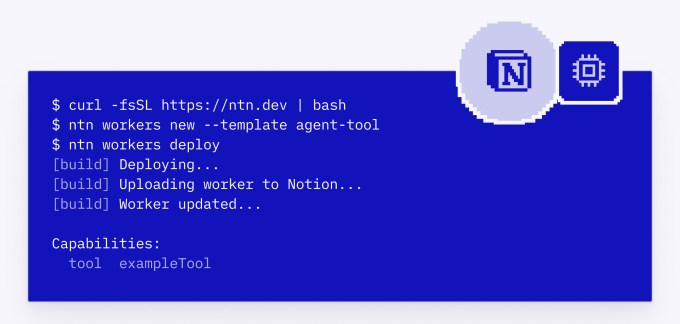
Now, Notion will empower teams to implement their own custom code. With the introduction of its new Workers, a cloud-based infrastructure for executing custom code, clients can craft their logic and deploy it within a secure sandbox (a contained space that prevents code from affecting other systems). This enables teams to perform actions like synchronizing their data with Notion, creating tailored tools, and activating workflows through webhooks — automated prompts that initiate actions whenever a specific event occurs in another application — without having to depend on external systems.
You might not even need to write the code yourself. The company highlights that your chosen AI coding assistant can handle that for you.
The Workers will operate on the same credit system as Custom Agents, but Notion is offering this at no cost until August, encouraging developers to explore.
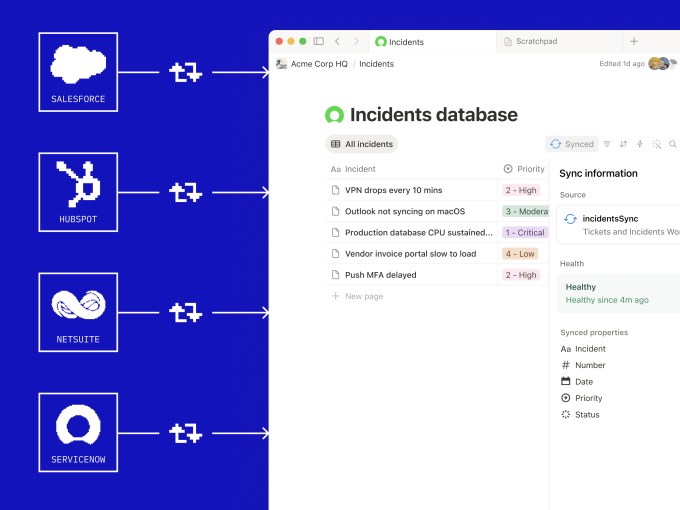
Synchronizing external data sources is also included in the Notion Developer Platform. Driven by Workers, the database synchronization feature can retrieve data from any API-enabled database. This means you could integrate information from resources like Salesforce, Zendesk, Postgres, and others directly into your Notion databases — ensuring the data remains up-to-date.
Zhao emphasized that this allows Notion users to “utilize your Notion database as a versatile canvas to drive both your workflows and your agents.”
Workers are also capable of creating agent tools with custom logic for instances when third-party integration via MCP — short for Model Context Protocol, an emerging standard for connecting AI tools to external data and services — is insufficient.
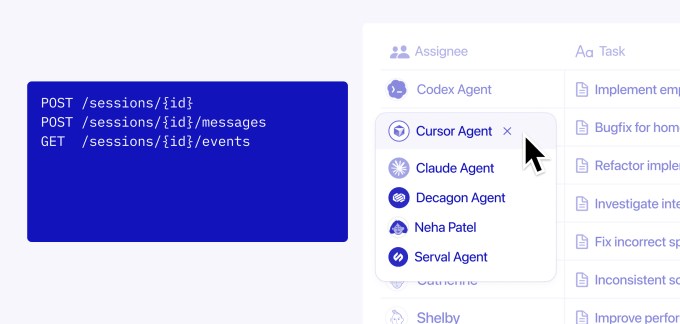
Additionally, a new feature permits Notion users to interact directly with external AI agents they utilize, assign tasks to them, and monitor their progress, akin to Notion’s own custom agents. At launch, Notion confirms compatibility with partner agents such as Claude Code, Cursor, Codex, and Decagon, with plans to incorporate more in the future.
An External Agent API is also available for teams wishing to link their internal agents with Notion, particularly those tailored for their specific organizational requirements.
Developers and agents engage with Notion’s innovative Developer Platform via the Notion CLI, a command-line interface designed for developers, accessible through the company’s Business and Enterprise Plans.
The Developer Platform signifies a strategic pivot for Notion, evolving it into a more programmable framework rather than just an application, positioning it to compete against other workflow automation services. As organizations increasingly seek to automate knowledge work and construct internal AI systems, a platform consolidating agents, custom code, and real-time data begins to resemble core infrastructure rather than just a productivity tool.
This direction aligns with the broader movement among AI firms, which have been advancing beyond chatbot functionalities to provide agentic tools capable of executing actions across varied software platforms.
“Any data, any tool, any agent — that’s the overarching vision for the Notion Developer Platform,” Zhao concluded.
When you purchase through links in our articles, we may earn a small commission. This doesn’t affect our editorial independence.