
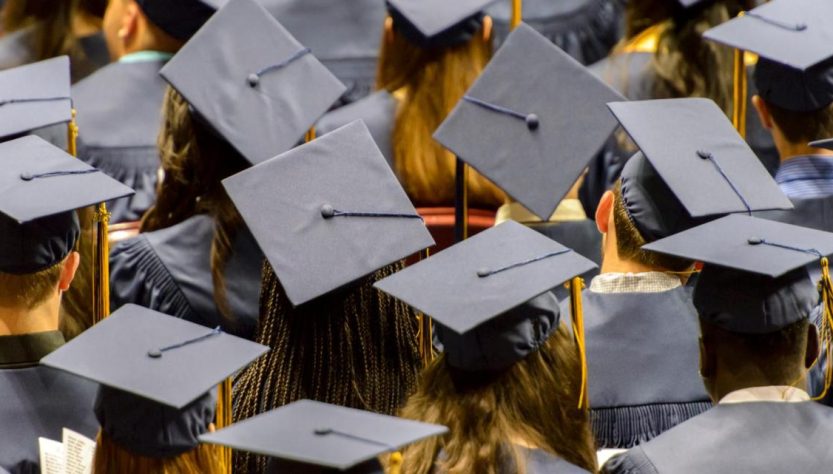
Commencement time has arrived once more — and this year, a few speakers have realized that it’s challenging to engage graduating students about a future influenced by artificial intelligence.
Last week, Gloria Caulfield, a leader at real estate firm Tavistock Development Company, delivered a speech at the University of Central Florida, noting that we are experiencing a period of “significant transformation,” which can be both “thrilling” and “intimidating.”
“The emergence of artificial intelligence marks the next industrial revolution,” Caulfield stated — prompting the audience of students to begin booing, with their noise growing progressively louder until Caulfield chuckled, looked at the other speakers, and inquired, “What just happened?”
“Alright, I struck a nerve,” she remarked. Caulfield then attempted to continue her speech, stating, “Just a few years back, AI played no role in our existence” — only to be interrupted again by the audience, this time with their enthusiastic cheers and applause.
[embedded content]
Former Google CEO Eric Schmidt experienced a comparable reaction when he mentioned AI during a speech at the University of Arizona on Friday.
In Schmidt’s situation, the backlash actually began prior to the speech, with various student groups advocating for his removal as a commencement speaker due to a lawsuit in which a former girlfriend and business partner accused Schmidt of sexual assault. (He has denied the charges.) A local news report indicated that booing started even before Schmidt took the stage.
However, Schmidt also faced loud boos when he told students, “You will shape the future of artificial intelligence.” The booing was so persistent that Schmidt attempted to talk over it, asserting, “You can now put together a team of AI agents to assist with tasks that you could never handle alone. When someone invites you to join the rocket ship, you don’t question which seat, you simply get aboard.”
To be fair, AI isn’t generating a negative reaction at every graduation event. Nvidia CEO Jensen Huang recently addressed Carnegie Mellon’s commencement, and he didn’t seem to encounter any audible dissent when he claimed that AI has “reinvented computing.”
Nevertheless, it’s not particularly surprising to see some students reacting negatively. In a recent Gallup survey, only 43% of Americans aged 15 to 34 felt it was a favorable time to find a job locally, a significant decline from 75% in 2022.
This pessimism isn’t entirely a reaction to the rise of AI (a change that even some software developers are concerned about), but journalist and tech commentator Brian Merchant suggested that for many students, AI has become “the harsh new face of hyper-scaling capitalism.”
“I too would express my discontent vocally at the notion of this next industrial revolution if I were in my early twenties, unemployed, and had aspirations for my future beyond inputting commands into an LLM,” Merchant expressed.
Even when commencement speeches did not explicitly mention AI, “resilience” was a common theme this year. Schmidt himself recognized that there is “a fear among your generation that the future is already predetermined, that the machines are arriving, that the jobs are disappearing, that the climate is deteriorating, that politics are divided, and that you are inheriting a situation that you did not create.”
Caulfield, for her part, may have also misinterpreted her audience of arts and humanities graduates. One student remarked that prior to mentioning AI, Caulfield had already begun losing their attention with her “generic” commendation of corporate figures like Jeff Bezos.
Another graduate, Alexander Rose Tyson, mentioned to The New York Times, “It wasn’t just one individual that sparked the booing. It was more of a collective, ‘This is disappointing.’”
When you purchase through links in our articles, we may earn a small commission. This doesn’t affect our editorial independence.