
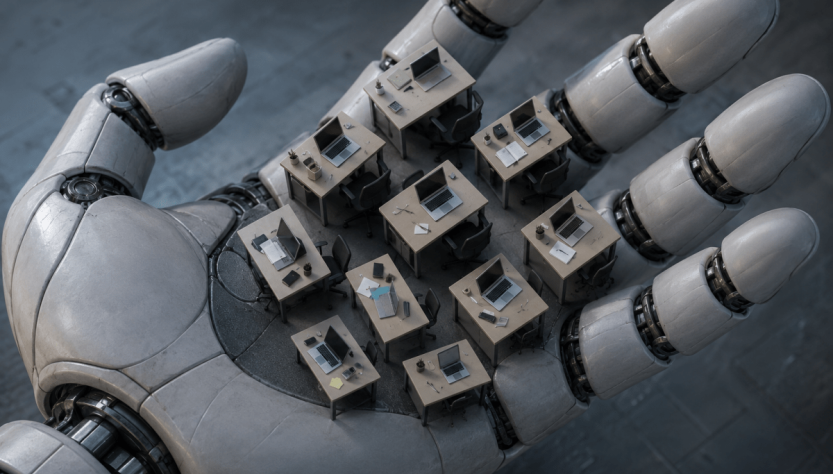

On Monday, Oracle revealed that it has cut its workforce by 21,000 employees in the last year, amounting to a 13% reduction, indicating deeper cuts than previously anticipated, partly due to AI. “The integration and implementation of AI technologies throughout our operations have led, and may continue to lead, to workforce reductions,” the organization stated in an annual financial disclosure.
This disclosure underscores what many in the tech sector perceive as a troubling trend: companies reporting record profits while simultaneously downsizing their workforces, with AI cited as both the catalyst for growth and a justification for job cuts. Tech layoffs reached their highest monthly total in years in May, with AI being the most frequently cited reason, according to outplacement firm Challenger, Gray & Christmas.
We recently highlighted why this reasoning may warrant reconsideration, especially since the jobs being eliminated at many of these firms had expanded during the pandemic hiring boom, raising concerns about the current situation. Below is an ongoing review — in reverse chronological order — of major tech companies that have announced substantial layoffs this year with AI as a noted cause.
GitLab — June 3, 2026. In one of the latest layoffs listed, GitLab let go approximately 350 employees, about 14% of its workforce, to invest in AI infrastructure and manage increased traffic from AI operations. CEO Bill Staples mentioned that agentic workloads are “pushing competitors to the edge” and that the company had initiated a “generational overhaul” of its core infrastructure to meet what he referred to as 100x growth demands. GitLab is withdrawing from 22 nations, streamlining management levels, and collaborating with an undisclosed AI lab to reconstruct its platform for agent-level workloads. The company registered first-quarter revenues of $264 million, a 23% increase year-over-year, and anticipates incurring $30 to $35 million in restructuring expenses.
Google — ongoing through May. Alphabet’s Google has discreetly reduced its workforce within its Cloud division, including its Threat Intelligence Group and Mandiant-associated cybersecurity personnel, even as Cloud revenue surged 63% to surpass $20 billion for the first time and its backlog nearly doubled to over $460 billion. Over the past year, Google has reduced more than a third of the managers overseeing smaller teams — a 35% drop in managers with fewer direct reports. Unlike most companies on this list, Google has not disclosed a single overall number — the cuts have been executed through a consistent performance evaluation process, a voluntary buyout initiative, and structural reorganizations, with external estimates putting the total for 2026 between 1,500 and 3,000+ engineers.
Intuit — May 20, 2026. Intuit disclosed plans to eliminate about 3,000 jobs — roughly 17% of its total workforce — as part of a restructuring aimed at reducing complexity and reallocating resources toward AI. CEO Sasan Goodarzi reportedly informed employees that the company is simplifying its structure to better deliver products.
Meta — May 20-21, 2026. Meta laid off around 8,000 employees, about 10% of its total workforce, while transitioning about 7,000 employees into new AI-centric roles (which they reportedly dislike). CEO Mark Zuckerberg informed staff that the cuts were necessary because “success isn’t guaranteed” in AI.
Cisco — May 14, 2026. Cisco announced it is eliminating nearly 4,000 jobs, around 5% of its workforce, amid reporting better-than-expected profit and revenue. CFO Mark Patterson stated: “This wasn’t just a savings-driven restructuring… it’s more about realigning … resources around silicon, optics, security, and AI.”
Cloudflare — May 7-8, 2026. Cloudflare cut around 20% of its workforce (1,100 employees), reporting quarterly revenue of $639.8 million, a 34% increase year-over-year and the highest quarter in the company’s history. CEO Matthew Prince noted that “most of those laid off last week were in measurement positions” — middle management, finance, legal, internal auditing, and revenue recognition.
General Motors — May 12, 2026. GM cut 500 to 600 jobs, primarily in IT roles in Austin, Texas, and Warren, Michigan, stating it was reviewing its workforce needs amid uncertain market conditions. An insider told CNBC that AI influenced the decision, although it was not the sole reason. GM’s statement indicated it is “transforming its Information Technology organization to better position the company for the future.” Despite the cuts, the firm still had approximately 80 open IT positions, including roles in AI, motorsports, and autonomous vehicles.
Coinbase — May 5, 2026. The cryptocurrency exchange announced it was cutting about 700 employees, or 14% of its staff, as part of a restructuring aimed at addressing market volatility and enhancing AI efficiency. The company flattened its organizational structure to five layers below the CEO and COO and indicated it would explore “one-person teams” combining engineering, design, and product roles. CEO Brian Armstrong stated that AI had dramatically transformed work pace — “engineers utilize AI to deliver in days what once took a team weeks” — and that the firm needed to “integrate AI into every aspect of our responsibilities.”
PayPal — May 5, 2026. PayPal revealed plans to reduce about 20% of its workforce over the next two to three years — over 4,500 jobs — as part of a turnaround strategy focused on AI adoption and organizational streamlining. CEO Enrique Lores informed investors that the company would “actively embrace AI” in its development processes and established a new “AI transformation and simplification” team reporting directly to him, assigned with redesigning the company’s processes “function by function.” Lores portrayed the layoffs as an effort to eliminate organizational layers, asserting that AI would extend beyond coding into customer service, support operations, and risk management.
Microsoft — April-May 2026. Microsoft offered buyouts designed as voluntary separations, without revealing how many employees would be affected. CFO Amy Hood mentioned that total headcount declined year-over-year in fiscal Q3, and is anticipated to continue declining as the company prioritizes “building high-performing teams that operate swiftly and flexibly” in light of increasing AI investments.
Snap — April 16, 2026. Snap cut about 16% of its global workforce — approximately 1,000 full-time employees — and eliminated more than 300 open positions, with CEO Evan Spiegel citing advancements in AI as a critical factor. “Rapid advancements in artificial intelligence allow our teams to lessen repetitive tasks, enhance speed, and better assist our community, partners, and advertisers,” Spiegel noted in a memo submitted to the SEC. The company reported observing small teams utilizing AI tools to drive advancements across Snapchat+, advertising platform performance, and infrastructure efficiency.
IBM — ongoing through 2026. Between Q4 2025 cuts and April 2026 Red Hat engineering reductions, estimates suggest between 3,000 to 9,000 U.S. positions have been eliminated, bringing IBM’s cumulative total since September 2024 above 15,000. Bloomberg reported that IBM plans to triple its U.S. entry-level hiring for AI and hybrid-cloud roles, even as about 200 HR positions were replaced by AI systems. An IBM representative characterized the Q4 2025 cuts as a routine adjustment impacting “a low single-digit percentage” of its global workforce.
Atlassian — March 11, 2026. Atlassian cut approximately 1,600 jobs (10% of its workforce) to “realign” toward AI and enterprise sales, even as its shares rose nearly 2% following the news. CEO Mike Cannon-Brookes stated: “Our strategy is not ‘AI replaces people.’ However, it would be misleading to suggest that AI doesn’t alter the skill mix we require or the quantity of roles needed in certain domains. It does.”
Dell — January 30 (though disclosed in March 2026). Dell’s total workforce declined by about 10% in fiscal 2026 — roughly 11,000 positions — to around 97,000 employees from 108,000 a year earlier, with $569 million allocated for severance. The reductions followed Dell’s anticipation that its AI-optimized server revenue could double in fiscal 2027.
Oracle — March 5-31, 2026. As previously mentioned, Oracle began notifying employees that it would be cutting thousands of jobs via terminal emails. The layoffs occurred even as Oracle reported $3.7 billion in quarterly net income, a 27% increase year-over-year, with remaining performance obligations rising 325% to $553 billion — savings redirected toward AI data centers. The total layoffs would eventually reach 21,000 over 12 months, as Oracle disclosed in its June 22 annual report.
Block — February 26-27, 2026. Jack Dorsey’s Block eliminated 4,000 jobs — nearly half its workforce, reducing it to under 6,000 from over 10,000. Dorsey posted on X: “We’re already witnessing that the intelligent tools we’re developing and utilizing, coupled with smaller and flatter teams, are fostering a new mode of operation that fundamentally shifts what it means to build and manage a company.” He continued: “I believe most companies are falling behind. In the coming year, I expect most companies will come to the same realization and implement similar structural changes.”
Salesforce — February 10, 2026. Salesforce laid off fewer than 1,000 employees across marketing, product management, data analytics, and its Agentforce AI unit. The company informed Fortune, “Due to the benefits and efficiencies brought by Agentforce, we’ve noticed a decrease in the number of support cases we handle, and we no longer need to actively replace support engineer positions.” This followed a prior cut of around 4,000 customer-support roles, reducing that team from approximately 9,000 to 5,000, with CEO Marc Benioff stating the company required “fewer heads” because AI agents were managing the workload.
Amazon — January 28, 2026. Amazon reduced 16,000 corporate jobs, following 14,000 cuts in October 2025 — roughly 9% of its corporate workforce within three months. The company revealed that it was part of “strengthen[ing] our organization by minimizing layers, enhancing ownership, and eliminating bureaucracy.” CEO Andy Jassy had indicated in June 2025 that, “As we introduce more generative AI and agents, it should transform how our work is conducted. We will require fewer personnel for certain tasks being performed today… over the next few years, we expect this will decrease our overall corporate workforce as we gain efficiency from extensively employing AI throughout the organization.”
When you buy through links in our articles, we may receive a small commission. This does not influence our editorial independence.