
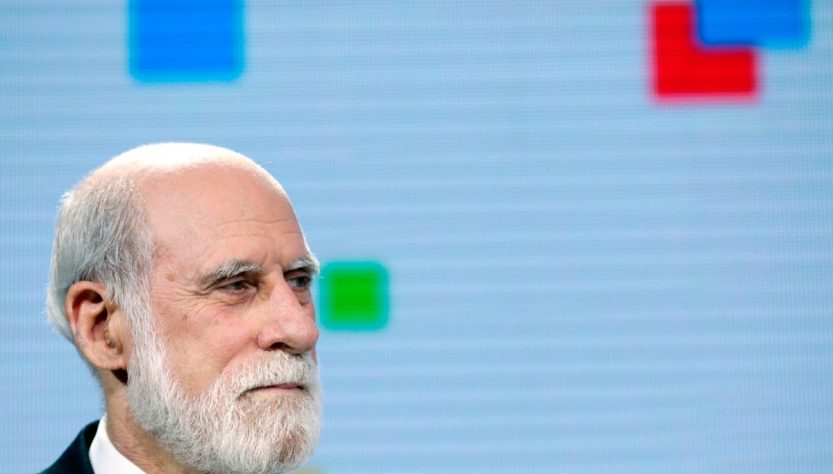

Vinton Cerf will resign from his position as Google’s chief internet evangelist next week, signaling the end of one of the most significant careers in the history of technology.
During a video address at the Open Frontier conference organized by the Laude Institute, Cerf was honored by Dave Patterson, a professor at UC Berkeley renowned for co-developing RISC processor architecture.
“Vint… has been with Google for over 20 years, and he is retiring a week from now, so I believe we should give him a round of applause for a commendable career,” Patterson remarked, drawing cheers from the audience.
Google did not provide a comment by the time of publication.
Cerf, 83, along with collaborator Robert Kahn, is acknowledged as one of the creators of the networking protocols that underlie the internet as we recognize it today. His contributions to the development and dissemination of TCP/IP — the fundamental framework that enables communication among various computer networks — starting in the 1970s have earned him numerous honorary degrees, the Presidential Medal of Freedom, and a Turing Award, among other accolades.
Since 2005, Cerf has held the title of vice president and chief internet evangelist at Google. (At this juncture, we can confidently assert the internet has been fully evangelized, for better or worse.)
Cerf participated in a panel discussion alongside other computer scientists recognized for their contributions to sustainable open-source projects, including Patterson; François Chollet, the creator of the Keras deep-learning library and co-founder of Ndea; John Ousterhout, the Stanford computer scientist who developed the Tcl programming language and co-founded Electric Cloud; and Matei Zaharia, co-founder and chief technologist of Databricks. They shared insights on building open-source systems that thrive — a topic that is increasingly important as founders invest in open infrastructure for the next generation of AI products.
A significant portion of the conference discussions centered on the issues surrounding the centralization of advanced models within a limited number of well-funded labs, contrasting with the decentralized nature of the open internet that enabled Cerf’s protocols to endure. Nevertheless, Cerf anticipated that the emergence of AI agents — software capable of autonomous action and collaboration with other software — would compel tech companies to revert to standardized protocols.
“The agentic model of AI, characterized by multiple agents from diverse sources interacting, will necessitate composability along with a demand for interoperability and standardization,” Cerf stated.
If he is correct, the firms that establish these interoperability standards early on could gain significant influence over the workings of the agentic economy — an interplay reminiscent of the early internet protocol conflicts.
While other panelists suggested that natural language communication between LLM agents would suffice, Cerf foresaw the need for formal standards.
“I don’t believe English will be the optimal choice. Its flexibility brings ambiguity, and I think precision in inter-agent communication will be crucial. An agent must ensure that the other agent comprehends what it is they have just agreed to do together,” Cerf noted.
“Recall the classic telephone game where you wish you’d whispered directly in someone’s ear and by the time it got to the tenth person, the message had completely changed? Picture a bunch of agents communicating in natural language — that’s quite alarming.”
In a lighter moment, Patterson reminisced about meeting Cerf, who is noted for his array of three-piece suits, during his graduate studies in the 1970s.
“He’s always been the best-dressed computer scientist I’ve encountered,” Patterson remarked. “When I recall Vint, he was a grad student sporting a shirt and tie in the ’70s.”
“That is absolutely true,” Cerf responded. “I even had a vest, and for some reason, I always wanted to stand out, opting for unique attire instead of long hair or piercings — I thought dressing differently was the way to do it.”
When you purchase through links in our articles, we may earn a small commission. This doesn’t affect our editorial independence.