
Over three years after the introduction of ChatGPT popularized generative AI, OpenAI is expanding its target audience from individual users to families.
OpenAI is looking for a specialized product manager in San Francisco tasked with creating experiences for families, caregivers, and older adults across its offerings. The position requires a background in developing products aimed at parents and families, as well as other consumer experiences sensitive to trust, based on the job listing.
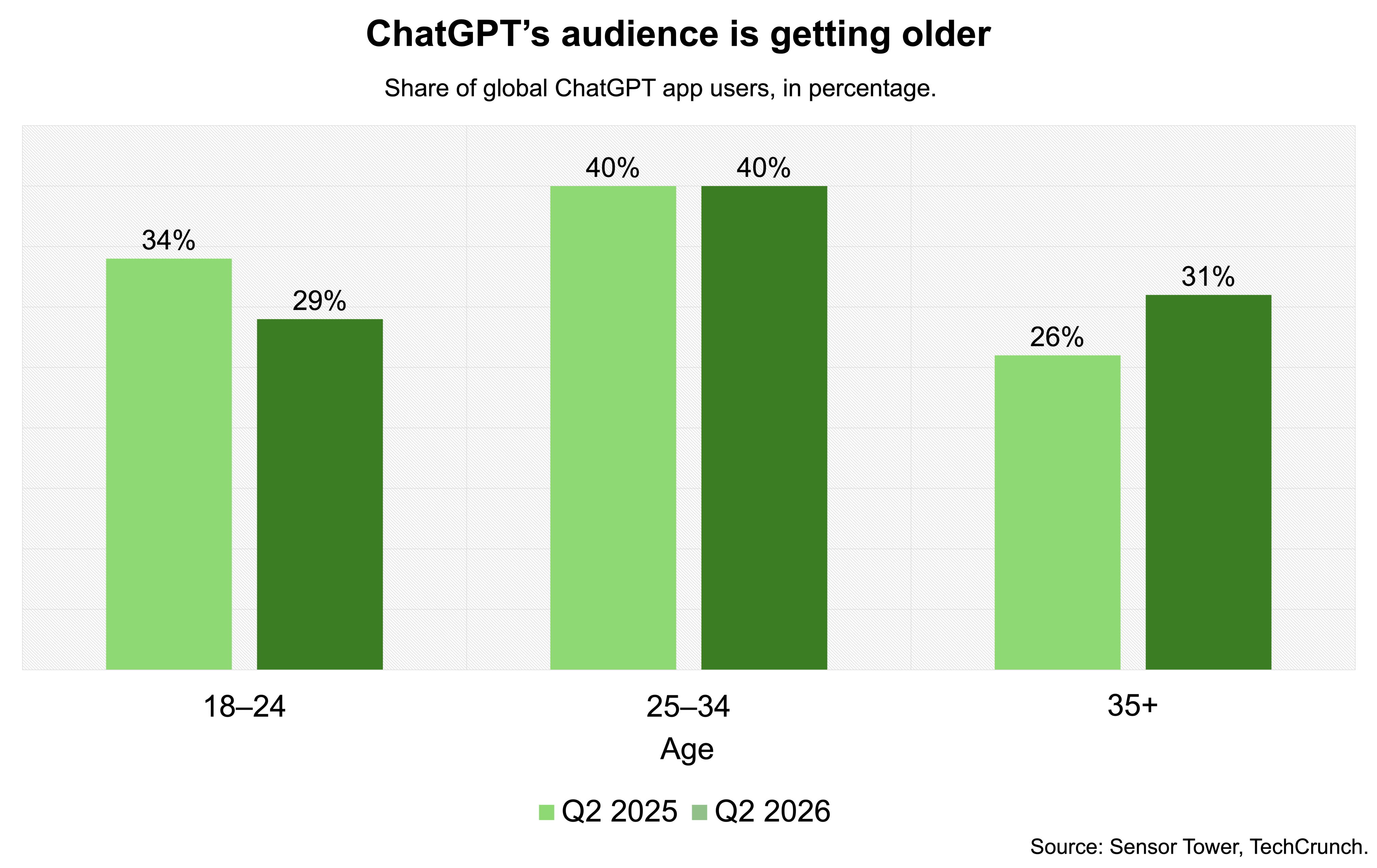
This recruitment coincides with ChatGPT’s user base expanding beyond just younger individuals. Estimates from Sensor Tower, shared exclusively with TechCrunch, show that the proportion of global ChatGPT users aged 35 and older increased to 31% in Q2, up from 26% a year prior, while users aged 18 to 24 decreased from 34% to 29%. In the United States, nearly one in four smartphone parents utilized ChatGPT during the quarter, rising from 16% in the previous year, according to the firm’s estimates.
OpenAI did not reply to inquiries regarding the job listing.
The creation of a product role centered on families indicates that OpenAI is starting to view its offerings less as tools for solitary productivity and more as technology tailored for households, remarked Ben Bajarin, CEO of the technology consultancy Creative Strategies.
“This mirrors the trajectory that Google, Apple, and Meta eventually followed as their platforms became woven into daily life, but AI elevates the stakes since the assistant not only mediates content or devices,” he stated to TechCrunch.
This transition also presents new challenges related to trust and safety. Stephen Balkam, the chief executive of the Family Online Safety Institute, noted that the hiring reflects both the evolution of OpenAI and an increasing acknowledgment that AI products utilized by minors require distinct protections compared to those created for adults.
“I view this as safety through redesign,” Balkam shared with TechCrunch. “You take the initial product or service that was released… not really considering kids… so this is a much-needed reaction and response.”
These remarks come as new research released this week by the Family Online Safety Institute discovered that parents are underestimating how frequently their children use generative AI. While 27% of U.S. parents indicated their child had used generative AI in the past week, 38% of children reported using it themselves, according to a survey of over 4,000 families in the U.S. and Australia.
Balkam told TechCrunch that AI firms should develop products with younger users in mind, implementing stronger content controls, age-appropriate experiences, parental oversight, and reminders to make it clear users are interacting with an AI — not a human.
The recruitment also arises amidst increasing scrutiny regarding how AI companies safeguard younger users. OpenAI has faced several lawsuits from parents alleging that ChatGPT has contributed to harm experienced by their children, including incidents linked to suicide.
In addressing some of these worries, OpenAI has implemented a range of safety initiatives over the past year, including parental controls for teenage accounts, directing sensitive dialogues to reasoning models intended to better manage signs of distress, and, more recently, an optional “Trusted Contact” feature that can notify a family member or caregiver in potential self-harm situations.
AI companies, according to Balkam, have a chance to learn from the errors made by social media platforms, which for years treated children similarly to adults before enhancing their safeguards under growing public and regulatory pressure.
The hiring also supports OpenAI’s extensive initiatives surrounding families. During a recent workshop in collaboration with the San Antonio Spurs Community Impact organization and the Positive Coaching Alliance, the company expressed its goal to explore AI’s role in education, coaching, and youth engagement.
Nevertheless, the demographic transition is not exclusive to ChatGPT, even though OpenAI’s audience is evolving in some unique ways.
Sensor Tower estimates that individuals aged 25 to 34 make up 40% of the total app user base for Anthropic’s Claude and Google’s Gemini, similar to ChatGPT, contrasting with 33% for Microsoft’s Copilot. Copilot, however, skews older, with 20% of its users aged 45 and up, compared to 14% for Claude, 12% for Gemini, and 11% for ChatGPT.
While ChatGPT remains relatively less popular among older users, its growth rate is surpassing that of its competitors. The percentage of users aged 45 and over climbed by three percentage points year-over-year in the second quarter, contrasting with a two-point rise for Copilot and declines for Claude and Gemini, based on Sensor Tower’s analysis.
Among U.S. smartphone parents, Gemini demonstrated the broadest reach at 32% in Q2, followed by ChatGPT at 24%, Claude at 4%, and Copilot at 2%.
For Bajarin, the decision by OpenAI to recruit a product manager focused on families indicates the future direction of consumer AI. As AI evolves into technology utilized across different generations, he anticipates companies will introduce family plans, child and teen profiles, caregiver tools, shared household memories, AI tutoring, and enhanced safety measures.
When you purchase through links in our articles, we may earn a small commission. This doesn’t affect our editorial independence.