
Nvidia is expanding the reach of its GPUs, focusing on a novel destination: the moon.
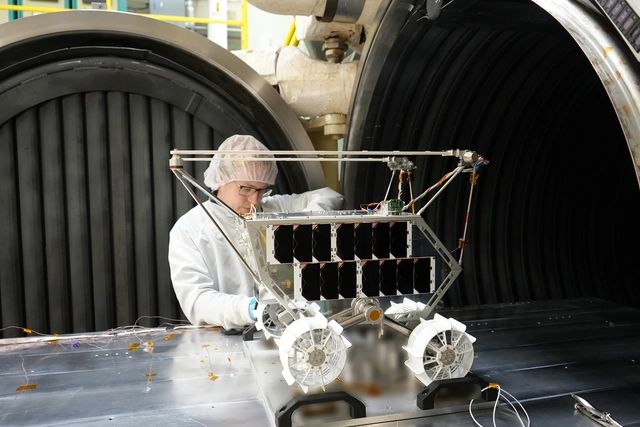
On Thursday, Lunar Outpost, a startup developing robotics for extraterrestrial infrastructure, revealed that its upcoming lunar rover will utilize Jetson chips to manage its lidar system. This could mark the first GPU on the surface of the moon.
“We’re assessing the Nvidia Jetson in comparison to our flight compute platform, which has a greater spaceflight legacy,” stated Justin Cyrus, CEO of Lunar Outpost. “[We’re] evaluating the advantages and disadvantages. Our goal is to integrate these advanced GPU-driven systems into extreme environments.”
NASA has initiated a program to incentivize private enterprises to survey the lunar landscape, preparing for the return of human astronauts, potentially as early as 2028. The strategy is based on its collaboration with SpaceX, urging tech firms to create vehicles equipped with scientific sensors to explore the moon’s surface to analyze its geography and search for resources like water that could be beneficial or lucrative for extraction.
Recently, Nvidia announced a partnership with Firefly Aerospace, the first private entity to successfully land a robot on the moon, which will enable the Jetson platform to function on a satellite orbiting the moon for image processing. This satellite is intended to gather data for researchers attempting to chart the moon, while also monitoring the increasing number of robots on its surface.
The next rover from Lunar Outpost is set to be delivered via a lander designed by Intuitive Machines, another tech company focused on lunar exploration. This rover is engineered to transport a suite of sensors into craters and other challenging areas that are hard to investigate from orbit. The subsequent mission will target a region known as Reiner Gamma, where scientists have been perplexed by a magnetic anomaly.
Each mission is slated to launch on a Falcon 9 rocket by year’s end.
While Nvidia’s Jetson platform may not be as recognized as AI powerhouses like Blackwell and Vera Rubin, it plays a crucial role in numerous physical AI applications. Designed to be space-efficient and compact, Jetson enables robotic systems to process sensor data locally, facilitating quicker understanding and reaction to their surroundings.
“Five years ago, our autonomy stack was more deterministic, and now it incorporates both deterministic and physical AI, which is quite exciting,” Cyrus commented. “We operate both in tandem, and it’s our responsibility to identify where physical AI can integrate into our stack and assist us in achieving unprecedented tasks.”
Employing GPUs in space presents challenges due to harsh conditions. Most space-capable GPUs orbit close to Earth, where they enjoy relative protection from radiation and significant temperature fluctuations. The moon, however, faces direct exposure to cosmic radiation and temperature extremes as it transitions through its phases.
“Your system must endure the lunar night while operating on very little power,” Cyrus stated.
Should they succeed in operating the chips in such conditions, Lunar Outpost’s engineers aspire for their vehicles to demonstrate enhanced capabilities — enabling swifter environmental processing and decision-making. NASA has extensive plans for a sustained human footprint on the moon, which will likely necessitate autonomous systems to precede and facilitate the groundwork.
“Our current mission at Lunar Outpost is to transition from exploration to establishing permanence — how we can concretely create that outpost on the moon?” Cyrus explained. “We believe that merging our deterministic models with the physical AI component will enable a sustainable human presence in space, effectively building that robotic workforce.”
In the coming years, Lunar Outpost plans to launch several smaller autonomous rovers to the moon along with a larger unit, Pegasus, intended to transport astronauts. Pegasus is awaiting launch on a rocket developed by Jeff Bezos’ Blue Origin, but the launch vehicle experienced an anomaly this summer, and the timeline for its return to service remains uncertain.
“They appear to be making good strides on the pad,” Cyrus said. “I can’t provide specifics on Blue Origin’s or NASA’s timelines regarding the pad repairs, but from what we’ve been informed, we are aligned for the 2028 timeline.”
This leaves advanced concepts of space data centers and robot fleets functioning on the moon both dependent on the same requirement: a larger rocket.
Purchases made through links in our articles may result in a small commission for us. This does not influence our editorial independence.