
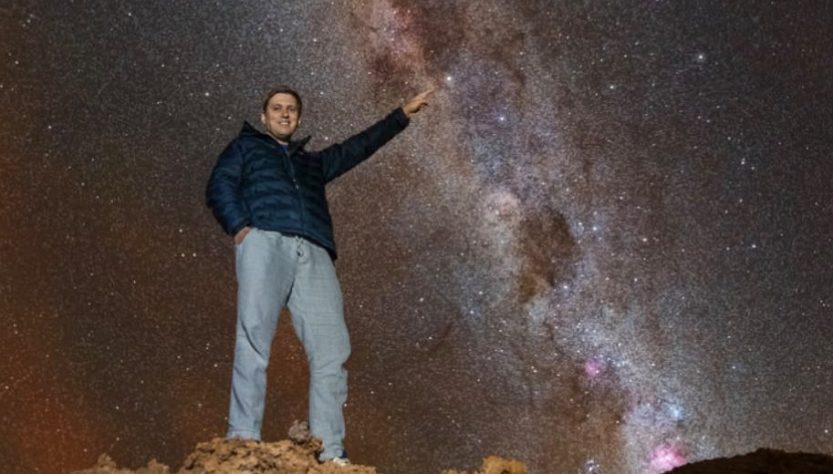

The creators of Starcloud, a startup aiming to deploy a fleet of GPUs in space, have unveiled a fresh proposal for potential backers: a mission to dispatch a small craft on an 80,000-year expedition to Alpha Centauri.
Should they proceed, it would mark the first human-constructed artifact specifically directed towards another star, making it the sixth to exit our solar system.
Named Fermi Explorer, the non-profit organization initiating this endeavor surfaced today to seek collaboration, funding, and guidance. The founding team—Starcloud’s Philip Johnston, Adi Oltean, and Ezra Feilden, together with program director Garret Jameson—has devised a strategy to utilize established space technologies to propel a craft featuring a 10 cm square payload, weighing 1 kilogram, into the realm of interstellar space.
The founders assert that they are launching this venture in the name of human exploration; to accomplish a historic milestone; and to probe the boundaries of the Fermi paradox, which seeks to clarify our lack of findings of intelligent extraterrestrial life and lends the mission its name.
The mission aims for a budget of approximately $15 million, targeting a launch in 2029. The non-profit is reaching out to suppliers for the construction of the craft, financial backing, and scientific and artistic payloads for delivery, similar to the sensors and Golden Record aboard NASA’s Voyager spacecraft, the first human vessel to venture beyond our solar system.
Most proposals for interstellar exploration falter due to the enormous distances involved and the relatively sluggish methods available to traverse them. Voyager, which was launched in 1977, is currently situated roughly 26 billion km from Earth; Alpha Centauri, the closest star to our solar system, is positioned around 41 trillion km away.
The previous attempt from Silicon Valley to tackle this challenge, a non-profit called Breakthrough Starshot, founded in 2016 by Yuri Milner and supported by Mark Zuckerberg, envisioned a multibillion-dollar initiative employing a groundbreaking laser-based propulsion system to reach Alpha Centauri within two to three decades. This effort came to a halt in 2025, yet the aspiration appears to endure.
Fermi Explorer adopts a contrasting approach: instead of advancing technological boundaries, the objective is to leverage existing capabilities to accomplish something.
“I too became enthusiastic and subsequently let down!” Johnston remarked regarding Starshot. “That’s why we are pursuing this mission. We are determined to actually send something off in three years… the significant distinction between most other [interstellar] missions and Fermi Explorer is that others attempt to achieve it within a human lifetime, necessitating costly billion-dollar propulsion R&D projects. We have intentionally selected 80,000 years as the minimum feasible mission.”
The strategy involves launching the spacecraft via a rocket rideshare, followed by utilizing efficient, low-powered electric propulsion to slingshot the vehicle into a sequence of orbits that will ultimately set it on course for Alpha Centauri. The spacecraft is expected to function for around 12 years prior to commencing a final coast phase towards the other solar system.
“If a dinosaur bone can endure for 200 million years, then a metal box can certainly withstand the anticipated radiation environment for 50,000 years,” Johnston stated. “We do not intend to power the spacecraft at the conclusion of the 80,000 years. Our hope is that a future human civilization will discover it.”
If you make a purchase through the links within our articles, we might earn a small commission. This does not impact our editorial freedom.