

Fusion energy is returning to its original focus. While fusion startups persist in their quest — integrating electrons into the power grid — many are also adopting, or revisiting, the defense applications that formed the groundwork for the field.
The industry took shape many years ago when scientists sought positive applications for the principles behind the thermonuclear weapons that surged during the Cold War. The aspect of national security has always remained relevant. An innovative fusion energy experiment took place in 2022 at the National Ignition Facility, which has been instrumental in national security initiatives for over 25 years.
This transition has intensified as investment in climate technology — the financial resources that generally back fusion startups — has slowed down. Fusion startups have secured a significant amount of recent climate tech capital, yet fusion remains a costly venture, and venture capitalists appreciate when their invested companies identify alternative funding routes.
This is where the defense sector steps in. The defense industry has been investigating laser weaponry for years, but interest surged as unmanned aerial vehicles transformed contemporary combat. Classical air defense mechanisms were crafted to engage manned aircraft, which are typically larger and fewer in numbers. This has resulted in some ludicrous disparities between attacker and defender. For instance, roughly ten years ago, a coalition partner of the U.S. fired a $3 million Patriot missile to destroy a $200 consumer drone. Efficient but not cost-effective.
Laser weaponry has the potential to change the dynamics. Instead of launching a single, costly, one-time missile with each shot, they can fire rapidly and at a lower cost, utilizing electricity sourced from a generator or a ship’s reactor or engine.
Fusion startups focused on laser reactor designs are perfect collaborators for creating such weaponry. Recently, laser-driven fusion firm Xcimer revealed a collaboration and investment from RTX, the corporation that encompasses defense contractor Raytheon. As part of the arrangement, Xcimer gains backing from RTX Ventures, while RTX can begin investigating how to leverage Xcimer’s robust lasers for their own objectives.
Based in Denver, Xcimer claims to operate the largest privately held laser system globally, intent on utilizing it for power plant development. Within its power plant, lasers will strike fuel targets, compressing them until the atoms combine and release energy. The startup’s current laser system, Phoenix, operates at a significantly lower power level than will ultimately be necessary for a power plant, yet it is sufficient to attract attention from the defense sector.
Xcimer is not the sole entity in the defense arena. Pacific Fusion disclosed a memorandum of understanding last month with the National Nuclear Security Administration (NNSA) to collaborate on high-energy-density fusion studies.
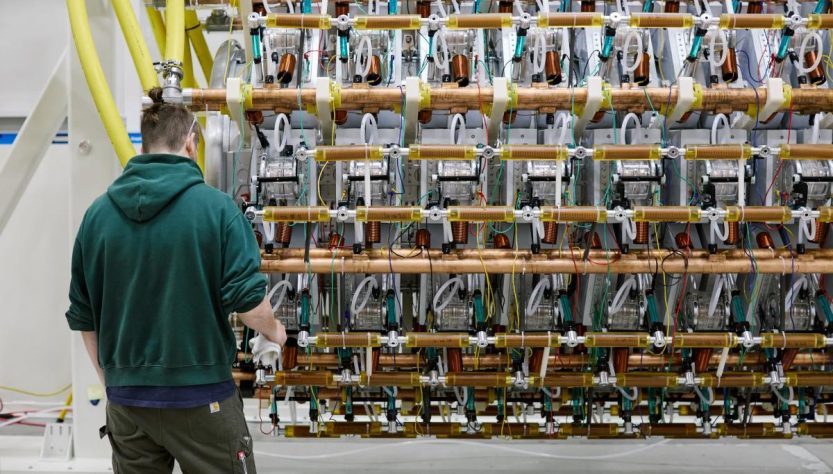
The startup has recently commenced construction on a demonstration facility in New Mexico, close to the Sandia and Los Alamos National Laboratories. While its main goal is to showcase that the company’s design can produce more energy than it consumes, it holds additional potential. The fusion reactions at Pacific Fusion’s facility will be significantly more powerful than those currently employed by the government for nuclear weapon experimentation.
“Interestingly, the facility we’re developing also has relevance for this leading-edge defense application,” Keith LeChein, co-founder and chief technical officer at Pacific Fusion, mentioned to TechCrunch recently.
It may seem like a fortunate coincidence, but it’s not. Defense applications were “always in our considerations,” stated Carrie von Muench, co-founder and chief operating officer at Pacific Fusion. LeChien, who engineered the company’s fundamental technology, has a history with Sandia National Laboratories, the Lawrence Livermore National Laboratory, and the National Nuclear Security Administration.
Fusion energy has progressed significantly since the initial concepts were conceived by weapons scientists decades ago, yet its applications for national security have not been overlooked. Their recent rekindling may be timely and offers promising support to enthusiastic fusion startups.
When you purchase through links in our articles, we may earn a small commission. This doesn’t affect our editorial independence.