
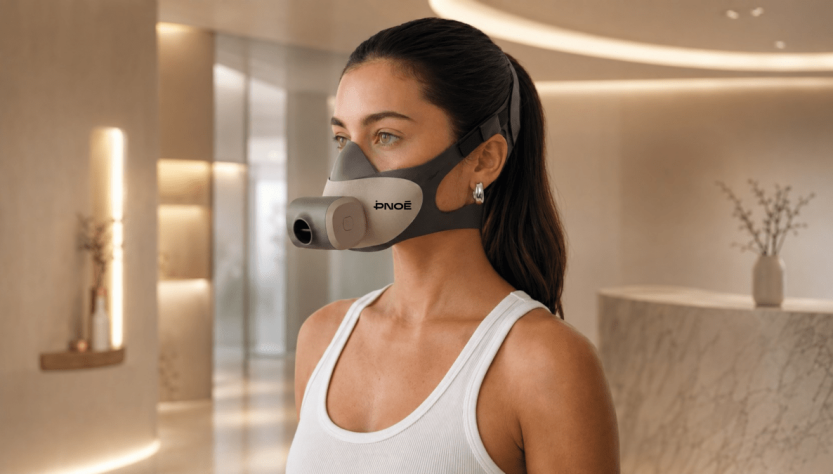
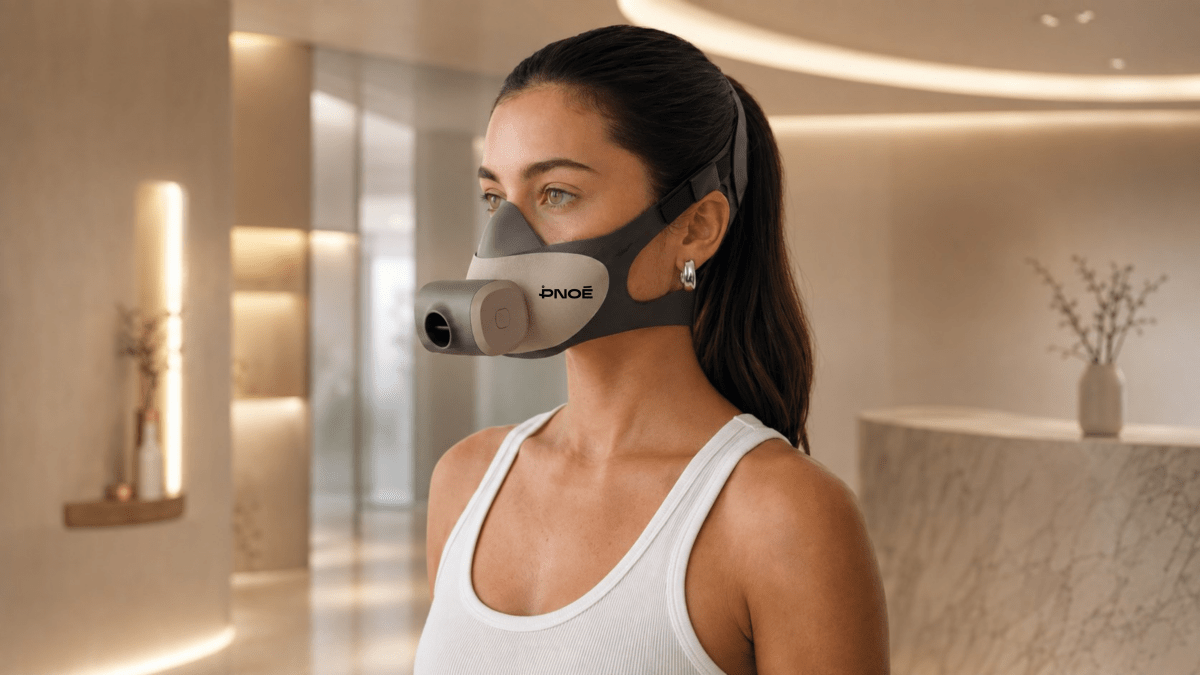
At first sight, the latest gadget from PNOĒ resembles something a supervillain from a comic book might don. The mask, which encloses the nose and mouth and secures at the back of the head, uncannily resembles Bane’s mask, Batman’s formidable adversary. However, its mission is much more innocent; it tracks your oxygen intake and carbon dioxide output, then interprets that information into recommendations on diet, exercise, and what the company aspires to be, longer life.
Based in Malden, Massachusetts, and also operating in Athens, Greece, PNOĒ is set to release the PNOĒ 2.0 on October 1. The significant upgrade from its existing model is that individuals can conduct the test independently. Co-founder and CEO Apostolos Atsalakis stated that one could walk into a gym, “simply wear the mask, press the button, sit down,” and breathe for eight minutes. “That’s all. It’s that straightforward,” he recently shared during a Zoom discussion from the company’s Athens branch.
This improvement matters because PNOĒ’s current device necessitates a trained technician, which limits its usage locations. An independent version could potentially provide access to fitness facilities without full-time staff and even pharmacies, Atsalakis explained.
The science underlying PNOĒ isn’t novel. Metabolic assessments, which evaluate the gases in a person’s inhalation to determine how the body generates energy, have existed for over a century. For many years, it’s been regarded as the benchmark for assessing VO₂ max, the peak quantity of oxygen the body can utilize during physical activity, a widely recognized index of cardiorespiratory fitness. However, these tests have typically required cumbersome, costly apparatus found primarily in sports laboratories and healthcare establishments, thus being predominantly accessed by elite athletes and corporate wellness programs.
What the decade-old PNOĒ promises is identical precision in a portable form, combined with software that interprets the findings into actionable advice. “We made it accessible to everyone,” Atsalakis emphasized.
The firm asserts that its test captures 23 biomarkers, encompassing (in addition to measuring VO₂ max) resting metabolic rate (the amount of calories the body expends at rest) and metabolic flexibility (the efficiency with which the body transitions between burning fat and carbohydrates). Atsalakis contends that these metrics address queries that blood tests fail to resolve, like how many calories an individual requires or how they should exercise.
The timing is advantageous for PNOĒ. VO₂ max has gained traction among longevity advocates, partly due to studies correlating enhanced cardiorespiratory fitness with decreased mortality. Atsalakis identifies VO₂ max as the most significant predictor of human longevity and views his company’s data as a type of scorecard for the thriving wellness sector.
The new gadget is more compact and simpler than its predecessor, with fewer components, which Atsalakis noted enhances its reliability. It was developed in collaboration with Milan-based Design Group Italia during what Atsalakis characterized as “a considerable number of iterations,” since a self-administered metabolic testing device had not been previously created.
It also resolves a concern that users, especially post-pandemic, are likely to have: who used it last? The response: it’s irrelevant, as the electronics can be detached from the silicone mask and straps, allowing multiple users to share the expensive hardware while retaining their own mask.
Despite its clinical aspirations, PNOĒ is cautious about its assertions. The device has not received clearance from the U.S. Food and Drug Administration, and Atsalakis stated that “we do not provide medical advice.” Rather, PNOĒ regards itself as a wellness tool. “It’s similar to a body composition device, like a scale,” he explained. “A physician cannot prescribe medication based on our outcomes.”
That may evolve in the future. Researchers have continuously examined whether elements in human breath could indicate illnesses such as cancer, and Atsalakis believes the company’s expanding data collection could eventually aid in identifying health concerns. Nonetheless, he acknowledged that comprehensive diagnoses are “definitely a few years away,” with regulatory barriers likely extending that timeline. “We’re not at that stage yet,” he admitted.
PNOĒ finds its origins in Atsalakis’s PhD research in sensing technologies at the University of Cambridge, a period when wearables were gaining momentum and he became intrigued by what breath could reveal about the human body. He co-founded the company with Panos Papadiamantis, a longtime friend who currently serves as the chief product officer.
The startup participated in Y Combinator’s Winter 2019 cohort, at a time when “longevity” was not yet the widespread industry it has become. Since then, it has secured approximately $22 million in funding, inclusive of a recently closed $11 million round, from investors such as 50 Years and Google Maps co-founder Lars Rasmussen, who is now based in Athens himself.
PNOĒ exclusively sells to businesses, which in turn provide the test to their clientele. Its customers comprise Equinox, where the test is available at nearly all locations, according to Atsalakis, along with Four Seasons hotels, Red Bull, the NBA, the Mount Sinai Health System, and the med spa chain Restore Hyper Wellness.
Approximately 85% of its revenue is derived from the U.S., which Atsalakis characterized as “by far the most advanced market globally” in terms of longevity. The firm is currently expanding into Europe and, via partners, into Latin America and Asia.
Businesses pay a monthly subscription fee ranging from $400 to over $1,000, which encompasses the hardware, software, training, and marketing resources, a package Atsalakis refers to as a “business in a box.” PNOĒ also links its findings to the services offered by a business, allowing a gym or spa to recommend specific products based on a customer’s test results. Many clients utilize the test during onboarding, Atsalakis noted, placing it between a comprehensive clinical evaluation and the approximations provided by personal fitness trackers.
This intermediate space is becoming increasingly competitive. Apple, Garmin, and Whoop estimate VO₂ max using heart rate data, while consumer products like Lumen evaluate breath to assess fat and carbohydrate utilization. At the high end, traditional metabolic carts continue to be the standard in clinical and laboratory settings.
PNOĒ, which employs 110 staff members, reports that it has recently become profitable while experiencing annual growth exceeding 100%. Atsalakis stated that the company intends to initiate a Series B funding round in the next six to twelve months as it aims to place its mask — Bane associations and all — in front of a wider audience.
When you purchase through links in our articles, we may earn a small commission. This doesn’t affect our editorial independence.