
Razer Blade 16 (2026) debuts with Intel Core Ultra 9 processor, RTX 50 graphics cards, enhanced LPDDR5X memory, and better battery performance.
sparta
Reddit might require you to verify your humanity as it intensifies efforts against bot accounts
Reddit is tightening its grip on bots by implementing new human verification measures for accounts that appear suspicious. Additionally, it aims to provide clearer labels for automated profiles, allowing you to distinguish whether you are engaging with software.

Amazon Spring Event: Enjoy 30% Discount on the Typhur Dome 2 Air Fryer
I was originally doubtful about air fryers, partly because of questions regarding their versatility. How many wings, nuggets, and fries does one genuinely require? The Typhur Dome 2 resolved this issue by including pizza, browned meats, grilled asparagus, and toasted bread—not to mention perfectly crispy bacon. This cutting-edge appliance provides most functions of a traditional oven with enhanced convection power. After evaluating over 30 air fryers in the last year, the Dome 2 emerges as the most powerful, versatile, precise, and swift model I’ve encountered. However, the cost is a considerable drawback; it’s priced at $500, but seldom falls below $400.
During Amazon’s Spring Sale, the Dome 2 is reduced to $340—the lowest since Black Friday. If you’re thinking about an upgrade, now is an excellent opportunity. The sale continues until March 31.
The rapid, versatile, app-managed cooking of the Dome 2 makes it my top choice. Typhur, an innovative company based in San Francisco with connections to China, reengineered the fryer with a wider, shallower basket and dual heating elements. This configuration allows for cooking a frozen pizza with direct bottom heat, imparting charring and crispiness akin to a grill-oven combination. The shallow basket facilitates even distribution for optimal airflow, and it crisps two dozen wings in merely 14 minutes. It toasts bread uniformly and crisps bacon without any odors, thanks to its self-cleaning capability. Its temperature accuracy is within 5-10 degrees, alongside speed-adjustable fans. The intelligent app offers around 50 recipes synced with a button press, but certain functions like baking necessitate using the app. Although less space-efficient, it proves to be highly effective.
For larger meats, I suggest the Breville Smart Oven Air Fryer Pro, which is one of my preferred convection toaster ovens. It doesn’t crisp wings and fries as effectively as basket fryers but excels at roasting substantial proteins. The Breville is currently discounted by 20 percent.

The gap in AI skills has arrived, asserts an AI firm, with advanced users gaining an advantage.

Recent research from Anthropic indicates that although AI is swiftly altering the landscape of work, it has not substantially reduced the number of jobs — at least, not at this stage. However, according to Peter McCrory, Anthropic’s head of economics, while the labor market remains “still healthy,” early indications show varying effects, particularly for younger individuals just starting their careers.
During a discussion at the Axios AI Summit in Washington, D.C., McCrory mentioned that the company’s latest economic impact analysis reveals minimal indications of large-scale job displacement thus far.
“There is no significant difference in unemployment rates” between individuals using Claude for the “most essential functions of their jobs in automated manners” — such as technical writers, data entry personnel, and software developers — and those in less AI-exposed occupations requiring “physical interaction and dexterity in the real world.”
However, given the rapid integration of AI across various sectors, this situation could change rapidly. If Dario Amodei, CEO of Anthropic, is accurate, AI could potentially eliminate half of all entry-level white-collar positions and escalate unemployment to as high as 20% within the next five years.
“Displacement effects could emerge very rapidly, so it’s essential to implement a monitoring framework to understand that before it occurs, enabling us to catch it in real-time and ideally pinpoint the right policy response,” McCrory shared with TechCrunch.
Understanding those trends is crucial, he stated, highlighting the importance of monitoring AI’s growth, adoption, and diffusion.
In theory, McCrory noted, AI models like Claude are capable of performing nearly any task a computer can manage. However, in reality, most users are merely beginning to tap into those functionalities.
Techcrunch event
San Francisco, CA
|
October 13-15, 2026
He mentioned that Anthropic examined which job roles involve tasks that AI excels in, are currently being automated, and are associated with actual workplace applications — these are the areas most likely indicative of where displacement could arise.
Anthropic’s fifth economic impact report, released on Tuesday, also indicated that even in sectors where minimal displacement has occurred, a widening skills gap is emerging between early Claude adopters and newcomers.
Those who adopted the technology earlier are more likely to derive significantly greater value from the model, utilizing it for work-related tasks instead of casual or sporadic uses, and applying it in more advanced ways, such as acting as a “thought partner” for iteration and feedback.
McCrory remarked that these results imply AI is evolving into a technology that benefits those already skilled in its use — and that individuals who can successfully incorporate it into their workflows will increasingly maintain a competitive advantage.
This benefit is also not uniformly distributed geographically. The report further revealed that “Claude is utilized more intensively in high-income nations, within the U.S. in areas with a larger concentration of knowledge workers, and for a relatively narrow range of specialized tasks and professions.”
In essence, despite claims of AI serving as an equalizer, its adoption may already be skewing in favor of the affluent, and could further amplify those advantages as proficient users advance more rapidly.

Convicted spyware leader suggests that the Greek government was involved in multiple phone hacks.

The creator of the spyware company Intellexa has announced intentions to contest a conviction issued by a Greek court related to accusations that he and three other executives unlawfully acquired personal information during a large-scale wiretapping operation in the nation.
The surveillance controversy, often dubbed “Greek Watergate,” involved the infiltration of numerous devices owned by high-ranking Greek government officials, opposition leaders, military personnel, and reporters through the use of Intellexa’s Predator spyware. This software can access both iPhones and Android smartphones to extract call history, text conversations, emails, and location details, typically by deceiving a target into clicking a harmful link.
Numerous high-ranking officials within the Greek government, including the director of Greece’s national intelligence agency and a key advisor to Prime Minister Kyriakos Mitsotakis, stepped down following disclosures that several journalists’ phones had been monitored. Thus far, no government officials have faced conviction regarding the surveillance, and dissenters have alleged that the Mitsotakis administration is engaging in a cover-up.
The founder of Intellexa, Tal Dilian, received a conviction in February and was sentenced to eight years behind bars. In a statement initially reported by Reuters on Wednesday, he expressed that he would not serve as a “scapegoat.”
Regardless of whether Dilian is, as he asserts, a scapegoat, the comment stands as the clearest indication yet from anyone associated with Intellexa that the Mitsotakis administration sanctioned the hacks.
“I contend that a conviction without proof is not justice; it may be part of a cover-up and potentially a criminal act,” Dilian articulated to Reuters. He mentioned his readiness to provide evidence to both national and international regulatory bodies.
Dilian did not reply to TechCrunch’s inquiry about his comments. The Greek embassy in Washington, D.C. has yet to respond when reached for comment by TechCrunch.
Dilian also informed Reuters that surveillance tools like Predator are generally sold strictly to governments, which bear responsibility for their lawful deployment.
In 2024, the U.S. government placed sanctions on Dilian after it was discovered that Predator was used against the phones of U.S. officials and journalists. These sanctions effectively prohibit any business dealings with Dilian and his other sanctioned commercial partners.

Who’s operating Waymo’s autonomous vehicles? At times, it’s the police.
In August of last year, a blaze swept across 10 acres of grassland flanking California’s I-280 close to Redwood City. As firefighters battled the fire, traffic came to a standstill, and officers from the California Highway Patrol (CHP) instructed drivers to turn around and take the freeway exit in the opposite direction.
Among those drivers was a new hurdle: a Waymo robotaxi.
Video of the event captures the Waymo AV attempting to navigate around stalled vehicles by driving on the shoulder, ultimately having to reverse from the approaching wrong-way traffic before coming to a complete stop.
Despite intervention from the company’s remote assistance team, the robotaxi remained stationary. Consequently, Waymo resorted to a solution that has proven effective before and dialed 911.
“Highway patrol turned everyone around, but regrettably our vehicle can’t turn around,” one of Waymo’s remote assistance agents told a local 911 dispatcher, as per a recording acquired by TechCrunch through a public records request. The agent requested that officers onsite transport the robotaxi away and arrange for the passenger’s transport.
Approximately 30 minutes post-call to 911, a CHP officer entered the vehicle and transported the robotaxi to a park-and-ride lot adjacent to the highway, according to a CHP incident report obtained by TechCrunch. Subsequently, one of Waymo’s “roadside assistance” personnel drove it from that location, the company conveyed to TechCrunch.
The Redwood City occurrence could be regarded as an atypical event, a somewhat embarrassing yet unavoidable hiccup in Waymo’s swiftly growing robotaxi service network.
Techcrunch event
San Francisco, CA
|
October 13-15, 2026
However, this was not a standalone incident. Waymo has depended on taxpayer-supported first responders to maneuver its vehicles when complications arise, even with its own roadside assistance team in place. In at least six cases identified by TechCrunch, first responders were required to take control of Waymo vehicles and relocate them from traffic during emergencies, including one situation where an officer was engaged in responding to a mass shooting.
Recently, Waymo has faced backlash from lawmakers regarding its employment of remote assistance staff, including some who work from the Philippines, to assist its robotaxis in determining the most suitable route through complicated circumstances. The roadside assistance team has garnered far less attention.
Representatives from the company did not mention the roadside assistance team during a contentious March 2 hearing in San Francisco concerning the behavior of Waymo’s robotaxis that had become immobilized during a significant power outage in December. At the gathering, city officials voiced concerns that the immobilized autonomous vehicles hindered or redirected first responders from their primary duties.
“What has begun to occur is that our public safety officers and responders are having to physically move [Waymos],” Mary Ellen Carroll, the executive director of San Francisco’s Department of Emergency Management, stated at the hearing. “In a sense, they’re transforming into a default roadside assistance for these vehicles, which we don’t believe is sustainable.”
Waymo informed TechCrunch that its roadside assistance personnel managed to clear numerous immobilized robotaxis during the blackout, with some still requiring to be transported by first responders.
“Waymo Roadside Assistance is a specialized team that provides additional on-the-ground support to our fleet,” the company stated in an email to TechCrunch. “Waymo’s standards for roadside response and service quality emphasize minimizing potential impacts on the community.”
The company did not respond to TechCrunch’s inquiries regarding the number of roadside assistance employees it has or which third-party entities might employ them. Waymo also did not clarify how it intends to scale this team as it strives to launch in approximately 20 additional cities this year, broadening its reach beyond existing markets of Atlanta, Austin, Los Angeles, Dallas, Houston, Miami, Orlando, Phoenix, San Antonio, and the San Francisco Bay Area.
Waymo’s helpers
Waymo’s robotaxis offer over 400,000 paid rides weekly, underscoring the company’s extensive years of research in self-driving technology. Nevertheless, these robotaxis occasionally depend on human intervention, and they do so in various ways.
The robotaxis often require guidance in complicated scenarios, especially since — as Waymo asserts — the company aims to be exceedingly careful as it expands its service.
This guidance is provided to Waymo’s robotaxis by the “remote assistance” personnel. At any moment, about 70 of these workers are overseeing Waymo’s fleet of around 3,000 vehicles, as stated by the company. Half of these personnel are located in the U.S., while the other half are situated in the Philippines.
These specifics, which were disclosed in a letter to Congress in February, prompted critical feedback for Waymo regarding concerns over safety and security. The company has defended its use of remote assistance workers, claiming they are well-qualified and asserting that there is no significant delay caused by their geographical distance, whether they are in Arizona, Michigan, or the Philippines.
“Our vehicle-to-RA connection is as quick as the blink of an eye. Average one-way latency is around 150 milliseconds for U.S.-based operations centers and 250 milliseconds for RAs located abroad,” the company recently conveyed.
Remote assistance workers carry out a variety of tasks. If a Waymo vehicle encounters a challenging real-world scenario, it might issue a request to these employees to help determine the best route forward. Waymo clarifies that these workers “provide advice and support to the [robotaxis] but do not directly control, steer, or drive the vehicle.” They additionally address lesser priority inquiries from Waymo robotaxis, such as confirming if the car’s interior is clean.
However, this system isn’t without flaws.
The National Transportation Safety Board recently disclosed that in January, a Waymo in Austin sought confirmation from a remote assistance worker about whether a nearby school bus was in the process of loading or unloading children. Although the stop sign and flashing lights were activated, the remote assistance worker mistakenly instructed the robotaxi to proceed. Consequently, the Waymo drove past the school bus while it was loading children, even as the bus’s “stop arms” remained extended, the NTSB reported.
Waymo informed TechCrunch that it “regularly audits RA responses, including their accuracy. If an incident occurs, it will be promptly flagged for follow-up actions, ranging from additional coaching to complete decertification.”
In the event of a collision or an emergency situation, Waymo relies on its “event response team.” The company asserts that this team is “exclusively situated in the U.S.” — although they are still remote — and that they are “qualified for more intricate tasks such as coordinating with emergency responders and managing post-collision procedures.”
By that definition, the remote assistance worker who aided CHP in relocating the Waymo robotaxi from the Redwood City incident was likely part of that event response team, although Waymo did not confirm this.
There are also growing pains evident here. Audio records from CHP dispatch, along with the incident report procured by TechCrunch, reveal that officers believed for roughly 10 minutes that Waymo intended for the passenger to drive the robotaxi away from the blaze.
It was only when the remote worker placed a second call to 911 that CHP understood an officer was required to drive it away from the situation. (Waymo opted not to respond to specific inquiries about this miscommunication. The company maintained that it never requests riders to take control of its vehicles.)
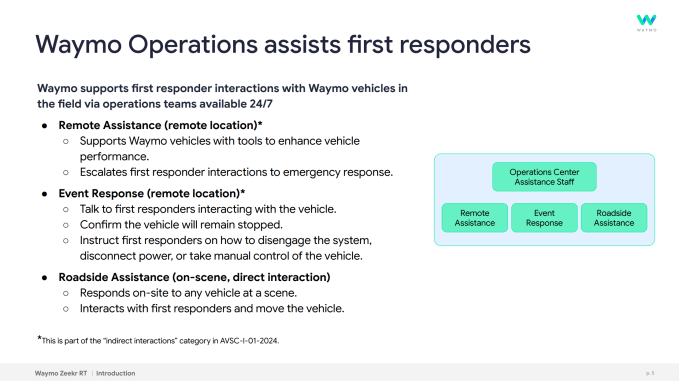
Next is the roadside assistance team. These individuals manage “on-site, direct interaction” tasks and are frequently responsible for relocating a vehicle. Waymo refrained from addressing inquiries about how many times these workers have moved a robotaxi, how many are available on call at any given time, or how many are situated in each city.
Some are believed to be employed by Transdev, a third-party contractor that Waymo has utilized previously, and a few even have backgrounds as safety drivers or monitors for Waymo, based on profile data on LinkedIn.
The company also informed TechCrunch that it “requires local tow partners to sustain rapid response capabilities for urgent towing requests and strategically place support across our service locations.”
“Should a Waymo vehicle require assistance, we dispatch Waymo Roadside Assistance and/or local tow partners to provide on-scene support,” the company stated in a statement. “While we don’t anticipate first responders to move our vehicles routinely, we acknowledge that timing is critical in emergencies. Therefore, we established a simple process that enables first responders to gain control of the vehicle within seconds.”
Relying on first responders
Although Waymo claims it doesn’t foresee first responders needing to engage with its vehicles, this continues to happen — and it remains uncertain if it will be entirely avoidable.
In at least six instances over recent months, first responders have had to manually maneuver Waymo vehicles, including at two active crime scenes.
Earlier this month, a police officer in Austin had to reposition a Waymo to allow an ambulance access in response to a mass shooting incident. In February, a first responder in Atlanta was required to disengage a Waymo after it drove into an active crime scene, before a member of the company’s roadside assistance team “retrieved it,” according to the company. This week, a Nashville police officer had to manually drive a Waymo robotaxi away after it became stuck at an intersection.
During the March 2 hearing in San Francisco, city officials persistently questioned Waymo about what actions it would take to reduce its reliance on first responders. Waymo did not mention its personnel dedicated to moving vehicles during the three-hour session.
District supervisor Bilal Mahmood, who supervised the hearing, expressed to TechCrunch that he felt Waymo didn’t offer many satisfactory responses.
“I kept asking: How are you going to take more responsibility to ensure that our first responders aren’t doing that?” he stated. “And we did not receive that answer during the hearing which we were seeking, that is: What measures will they implement to ensure they take more ownership of that roadside assistance aspect?”
A manager from Waymo’s incident response team, Sam Cooper, indicated at the hearing that the company has instructed “over 30,000 first responders globally on how to interact” with its robotaxis. He also lauded Waymo’s partnership with first responders in the creation of the system that permits them to gain control.
“We merely want to empower them, in that scenario, to effectively relocate that vehicle from the site and secure the area so they can perform their duties,” he articulated.
Cooper stated that Waymo has made “enhancements to our surge staffing capabilities” to be better equipped for larger emergency situations. However, he did not elaborate on those improvements, and Mahmood informed TechCrunch that his office has not received a promised follow-up.
Cooper also noted that Waymo would contemplate leveraging collaborations similar to its engagement with DoorDash, which involves gig workers shutting robotaxi doors that were left ajar, to relocate vehicles.
How that would differ from the existing roadside assistance staff Waymo employs remains unclear. However, city officials reiterated the same sentiment. “Our first responders should not function as AAA,” district supervisor Alan Wong remarked.
This article was originally published March 25, 2026 at 9:30 a.m. PT.

Google introduces TurboQuant, an innovative AI memory compression algorithm — and indeed, the internet is referring to it as ‘Pied Piper’

Had Google’s AI researchers possessed a sense of humor, they might have dubbed TurboQuant, the newly unveiled, highly efficient AI memory compression algorithm revealed on Tuesday, “Pied Piper” — at least that’s what the online community speculates.
This jest alludes to the fictional startup Pied Piper, which was central to HBO’s “Silicon Valley” series that aired from 2014 to 2019.
The show depicted the startup’s founders as they maneuvered through the tech landscape, grappling with obstacles such as rivalry from larger corporations, securing funding, addressing technological and product challenges, and even (much to our amusement) impressing judges at a fictional iteration of TechCrunch Disrupt.
Pied Piper’s landmark technology in the series was a compression algorithm that significantly minimized file sizes with near-lossless compression. Google Research’s TurboQuant similarly focuses on extreme compression without sacrificing quality, but directed towards a critical limitation in AI systems. Thus, the parallels.
Google Research referred to the technology as an innovative approach to reduce AI’s operational memory without compromising performance. The compression technique, which employs a variant of vector quantization to alleviate cache bottlenecks in AI processing, essentially enables AI to retain more information while occupying less space and ensuring accuracy, according to the researchers.
They intend to showcase their discoveries at the ICLR 2026 conference next month, alongside two methods facilitating this compression: the quantization technique PolarQuant and a training and optimization strategy referred to as QJL.
While grasping the mathematics involved may be within the reach of researchers and computer scientists, the outcomes are generating excitement across the broader tech industry.
If realized in practice, TurboQuant could lower the operational costs of AI by lessening its runtime “working memory” — known as the KV cache — by “at least 6x.”
Some, including Cloudflare CEO Matthew Prince, are even dubbing this Google’s DeepSeek moment — referencing the efficiency improvements inspired by the Chinese AI model, which was trained at a much lower cost compared to its competitors on inferior chips while remaining efficacious in its results.
However, it’s important to highlight that TurboQuant has not yet been widely adopted; it remains a laboratory breakthrough at this point.
This makes comparisons with something like DeepSeek or even the fictional Pied Piper more complex. In the series, Pied Piper’s technology was poised to dramatically alter computing paradigms. In contrast, TurboQuant may result in efficiency improvements and systems needing less memory during inference. However, it does not necessarily address the broader RAM shortages associated with AI, as it exclusively focuses on inference memory, not training — which continues to demand substantial amounts of RAM.
Melania Trump desires a robot to educate your child at home

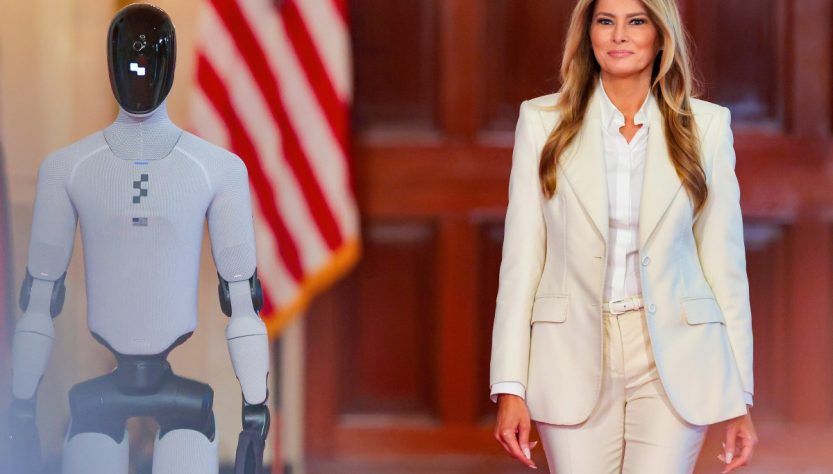
During a press event at the White House on Wednesday, First Lady Melania Trump made an appearance alongside a humanoid robot created by the robotics company Figure AI. The pair gracefully walked down a red carpet before the robot delivered a short address, stating: “I am thankful to be included in this groundbreaking initiative to empower children with technology and education.”
Shortly after these comments, the robot casually exited the room and vanished.
This peculiar event was part of the first lady’s newly introduced initiative, the Fostering the Future Together global summit, which gathered global leaders to explore ways to enhance children’s education through technology, including AI.
The gathering certainly invoked dystopian images of the future — where the gentle (human) educator has been supplanted by a Terminator-like machine capable of walking and conversing in Latin. Indeed, during her address, the first lady urged participants to envision a future where a humanoid robot serves as the ultimate teacher for the children of the world. (The summit coincided with the Trump administration unveiling a separate tech council filled with traveling Silicon Valley leaders.)
“Envision a humanoid teacher named Plato,” the first lady declared. “Access to classical studies is now immediate — literature, science, art, philosophy, mathematics, and history — Humanity’s complete body of knowledge is accessible from your own home. Plato will offer a tailored experience, focusing on each student’s requirements. Plato is perpetually patient and always on hand. Understandably, our children will cultivate more profound critical thinking and autonomous reasoning skills.”
“Grateful to have been invited to the White House by First Lady Melania Trump,” the Figure AI X account tweeted on Wednesday.
The first lady’s statements are clearly forward-thinking and do not accurately represent the current state or near-future potential of robotics and educational technology. Nonetheless, the notion that AI and technology can facilitate automated learning (and, in numerous ways, substitute human instructors) has been gaining traction within the tech sector. Such concepts have been consistently endorsed by the White House.
Techcrunch event
San Francisco, CA
|
October 13-15, 2026
In the last year, educational innovations like the Alpha School, a series of private institutions leveraging AI to rapidly teach children, have gained momentum and attracted media attention.
The Trump administration has welcomed such experiments while simultaneously criticizing the traditional public education system.
Secretary of Education Linda E. McMahon, who is currently dissolving the very agency she leads, has still managed to visit an Alpha School campus, where she commended the “opportunity” offered by this educational network.
“Alpha School is reinventing K–12 education by equipping students with essential AI skills and preparing them for an ever-changing technology-focused job market,” the administration recently stated regarding McMahon’s visit.
Melania Trump’s event on Wednesday similarly underscored the role the administration believes the tech industry should have in shaping the future of education in America — with Trump acknowledging the “involvement of leading American technology firms, whose participation reflects the increasing importance of the private sector in fostering safe and effective educational innovation.”

Capitalizing on the GLP-1 surge, VITL secures $7.5M to transform cash-pay clinic prescribing

In recent years, there has been a significant increase in the number of med-spas, weight-loss clinics, and concierge practices where patients pay a membership fee for immediate, often same-day access to physicians. However, despite patients paying for these services out-of-pocket, providers frequently depend on software designed for traditional, insurance-reliant care.
VITL, a startup founded 18 months ago, asserts that it is addressing one of the major technological challenges in the sector by developing an e-prescribing platform—a digital solution for managing and sending prescriptions—that is customized for cash-pay medical practices.
On Wednesday, VITL disclosed a $7.5 million Series A funding round spearheaded by SignalFire.
Founder and CEO Charlie Jordan established the Nashville-based firm after recognizing the significant amount of time medical providers devote to managing prescriptions for treatments not reimbursed by insurance.
Many providers continue to use faxes or phone calls to send prescriptions to compounding pharmacies, which create custom medications on demand, often without knowledge of the final cost to the patient or the timeframe for fulfilling the order. VITL’s platform addresses this issue by linking clinics to a nationwide network of compounding pharmacies, providing real-time price comparisons and order tracking similar to Amazon’s.
“We reduce the prescription processing time from several minutes to just a few seconds,” Jordan told TechCrunch.
For clinics that place numerous orders daily, this time savings accumulates.
Techcrunch event
San Francisco, CA
|
October 13-15, 2026
VITL estimates that its technology can save clients up to two complete workdays each month by automating a process that is otherwise tedious and unclear.
Cash-pay providers are evidently recognizing the benefits of VITL’s platform. Just over a year after its establishment, the company reports having onboarded more than 630 clinics and generating eight figures in annualized recurring revenue (ARR), indicating the company is on track to earn at least $10 million annually.
Nonetheless, 630 clients represent only a small portion of a market that encompasses tens of thousands of clinics throughout the U.S. With the rising popularity of GLP-1s—the class of drugs that includes Ozempic and Wegovy—along with peptides and aesthetic procedures such as Botox becoming more mainstream, the number of cash-pay healthcare businesses is anticipated to increase.
VITL never formally approached SignalFire, yet the rapid growth of the startup captured its interest. This interest resulted in a fresh $7.5 million Series A investment led by the venture firm, known for leveraging data and AI to pinpoint emerging companies.
VITL partially competes with Surescripts, a pioneer in e-prescribing within the industry, and with boutique clinic platforms like Jane Software, which integrate prescription functionalities into their broader electronic health record (EHR) offerings. What distinguishes VITL from these rivals, it claims, is its exclusive focus on the workflow needs of the cash-pay medical sector.

Jury determines Meta and Google to be negligent in groundbreaking social media addiction case

Just one day after Meta faced a similar child safety lawsuit setback in New Mexico, a jury in Los Angeles delivered another blow to the social media behemoth — this time alongside Google. In a case asserting that social media platforms significantly impacted a young woman’s mental well-being, jurors favored the plaintiff, identified by her initials, K.G.M., or her first name, Kaley.
This verdict requires Meta and Google to disburse $3 million in compensatory damages, with Meta responsible for 70% of that amount. Additional damages may be forthcoming as jurors continue their deliberations.
The pivotal case, held in Los Angeles County Superior Court, sought to hold the social media giants accountable for the harm linked to Instagram and YouTube specifically, which Kaley, now 20 years old, claimed exacerbated her anxiety, depression, body dysmorphia, and other issues during her childhood. Attorneys for Meta attempted to assert that external factors, such as Kaley’s tumultuous home environment and her parents’ split, were primarily to blame for her mental health challenges, not the company’s applications.
However, the evidence brought forth at trial convinced the jury to side with the plaintiff, highlighting that Meta was aware of how addictive its platforms could be for teenagers and that it was actively investigating this issue and applying its findings to boost engagement among young users.
In the lead-up to this case’s trial, both TikTok and Snap, who were also being pursued legally, reached settlements with the plaintiff.
The ruling — alongside other recent judgments, such as Tuesday’s decision in New Mexico — could set a precedent holding social media companies accountable for the harm their platforms inflict, whether due to insufficient safety protocols or algorithm-driven recommendations. This may pave the way for a new wave of lawsuits as other claimants seek damages.
Neither verdict is expected to be conclusive. Both Google and Meta are anticipated to appeal, and Meta has already indicated its intentions, with a spokesperson stating to the press that the company contests the verdict and is exploring its options.