
President Trump is enacting a 10 percent tariff on almost all imports into the US, following a Supreme Court ruling that annulled most tariffs that were applied by the US government last year.
In an executive order issued Friday evening, Trump mentioned a few exceptions, such as imports of essential minerals, beef and fruits, automobiles, pharmaceuticals, and items from Canada or Mexico. The new tariffs are expected to take effect on February 24, 2026.
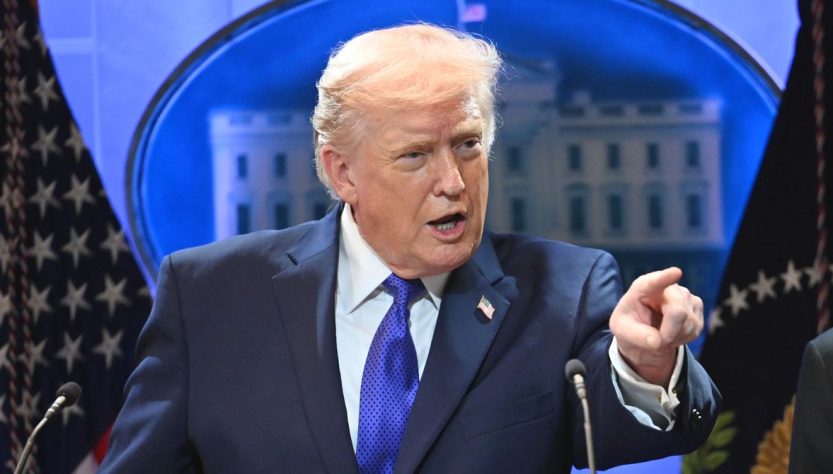
During a press briefing on Friday afternoon, Trump voiced his disappointment over the Supreme Court’s ruling and openly criticized the six justices who opposed his trade policies, calling them “a disgrace to our nation.” When asked about how two of the justices he appointed, Neil Gorsuch and Amy Coney Barrett, voted to overturn, Trump referred to them as “an embarrassment to their families.”
The revised trade approach is based on Section 122 of the Trade Act of 1974, which enables the president to independently and swiftly implement tariffs of up to 15 percent in scenarios of “large and serious” trade deficits. These tariffs last for just 150 days unless Congress extends them. Similar to the International Emergency Economic Powers Act (IEEPA), this legislation has not previously been used by a US president in this way.
After the 150-day period, it is possible for Trump to repeatedly reapplied Section 122 tariffs. Alternatively, the administration may utilize this duration to formulate other tariff strategies, effectively changing legal frameworks to sustain similar regulatory impacts, as noted by Gregory Husisian, a partner and litigation attorney at Foley & Lardner LLP, who has aided numerous companies with tariff refund requests. “[Section 122 tariff] is for a limited time period, so it’s going to be a bridge authority,” Husisian remarks.
Meanwhile, the Trump administration could accelerate the process of conducting trade inquiries based on national security or unfair trade practices abroad, which are necessary for implementing Section 301 and Section 232 tariffs. “We are also starting multiple Section 301 and other inquiries to safeguard our country from unfair trade practices by other nations and companies,” Trump mentioned at the press briefing, referring to these alternative tariff options that require more time to activate.
In a different executive order, the administration confirmed that despite the nullification of IEEPA tariffs, the de minimis exemption—which exempted ecommerce parcels valued under $800 from taxes—remains on hold. The termination of de minimis last year resulted in considerable delays in package processing at the US border and increased prices on budget shopping platforms.
During the press briefing, Trump did not clarify what would happen with companies requesting tariff payment refunds. The Supreme Court’s ruling did not specify how the tariffs should be refunded. In response to a reporter’s question on the subject, Trump suggested that the matter would likely be resolved in court.
Experts inform WIRED that they expect the refund process to be intricate and lengthy, potentially necessitating companies to file grievances and calculate the amounts they believe are owed. The government could dispute the assessed amounts. This process could take several months up to more than two years.
The Supreme Court ruling underscored that the IEEPA provides the president with significant powers during emergencies but does not encompass taxation. In the press briefing, Trump repeatedly misrepresented the ruling: “But now the