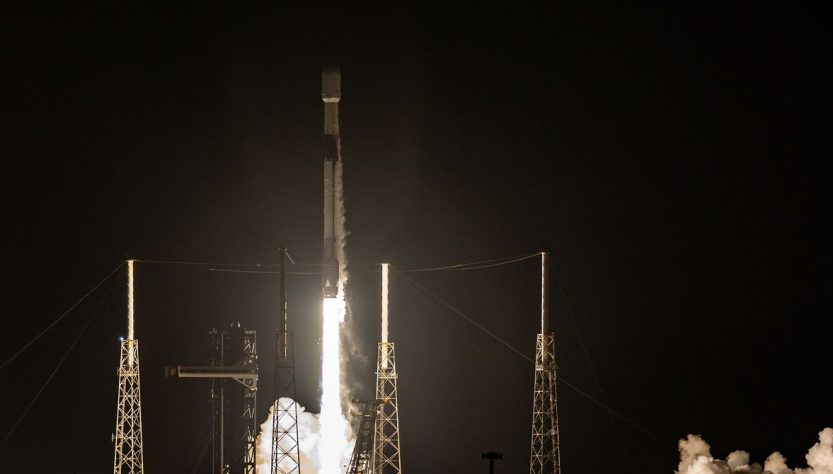
If you possess a robust telescope, you might experience a momentous occasion on Wednesday: An inactive rocket is poised to strike the Moon.
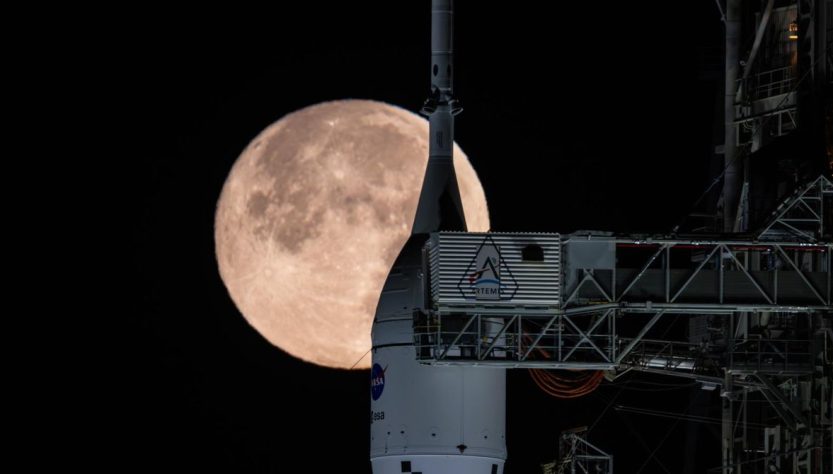
On August 5, at approximately 6:34 am UTC, a used SpaceX Falcon 9 upper stage is anticipated to collide with the Moon’s illuminated western limb close to the Einstein crater at speeds surpassing 5,400 mph. Should the event transpire as expected, the impact could create a debris plume observable from Earth with the appropriate tools.
This would be a first, as no collision flash has been documented on the Moon’s sunlit face. The Falcon 9 crash is estimated to create dust plumes that may stand out against the vastness of space. These forecasts are partially based on two recent studies.
One research paper, released on arXiv on July 27, led by doctoral candidate William Jo from the University of Texas at Austin, forecasts the magnitude of the impact. Jo employed a high-definition physics simulation to depict the consequences of 3,900 kilograms of hollow metal hitting the lunar terrain, differing from solid meteorite impacts.
Describing the Falcon 9, David Goldstein, an aerospace engineering professor at UT Austin and Jo’s advisor, remarks, “It’s akin to an empty eggshell,” alluding to the hollow framework that previously held fuel, featuring a denser rocket engine at one end.
Rather than embedding like a cannonball, the shell will crumple inward from its perimeter, producing a broad, low curtain of soil extending up to 183 kilometers and a narrower, swifter spike shooting nearly vertically. The collision is expected to displace around 12,700 kilograms of debris.
Jo describes the simulation as a “best-case” outcome. The software is two-dimensional and axisymmetric, modeling the stage dropping directly down, engine-first. In actuality, the spent Falcon 9 stage, which transported two landers to the Moon in January 2025, is likely to strike at an angle. A grazing impact would yield a smaller and dimmer plume.
Goldstein referred to their study as the most hopeful regarding the visibility of sprays. Whether the plume will be seen from Earth remains unclear.
Lawrence Trafton, a UT Austin astronomer, indicated that visibility is feasible, though uncertain until the moment of impact. The plume, if reaching 50 kilometers beyond the lunar limb, would span approximately 28 arcseconds—an angle around one-sixtieth the apparent width of the Moon—a size that can be resolved by a small telescope.
The recent research provides a precise target location for telescope observation. Nevertheless, the contrast with the night sky could create obstacles. The plume will appear faint compared to the bright Moon, complicating observation due to scattered lunar light. A very stable mount will be essential, according to Trafton.
The observer’s timing will be favorable, as the plume should reach its peak around 90 seconds after impact, allowing for sufficient viewing opportunity. However, geographical factors may affect visibility, depending on the observer’s position.
The flash needs to be seen at night. For individuals situated north of a line from Massachusetts to Texas, the low-hanging Moon implies observers will be looking through considerably more atmospheric layers, resulting in a turbulent, unclear view that could obscure the plume from the crash.