
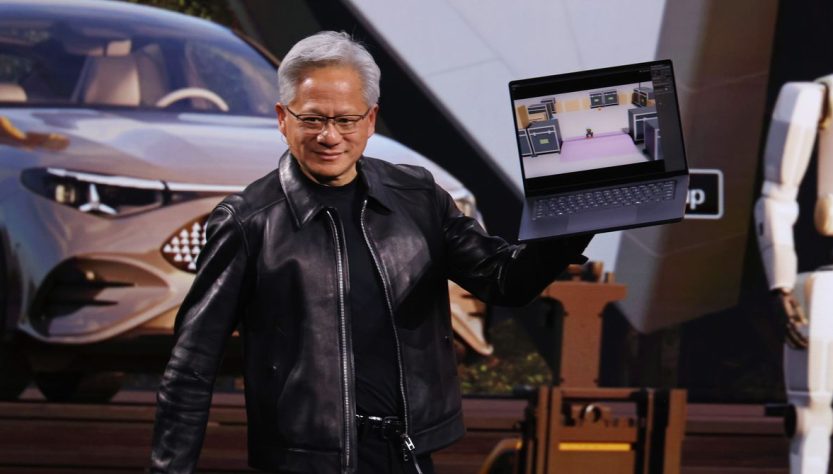
Jensen Huang articulated his aspirations for Europe’s future during Nvidia’s worldwide conference in Berlin, highlighting robotics, AI agents, and modular data centers, all driven by Nvidia technology. During the gathering, Huang urged attendees to engage in AI creation rather than merely consumption, reaffirming that all of this is achievable within Europe.
This conference’s emphasis, in contrast to the earlier one in San Jose, was on power, agents, and tangible AI, showcasing robots such as the Microduck from Nvidia’s acquisition, Hugging Face. Huang unveiled the DSX Pod, a modular “AI factory” designed for expedited establishment of AI data centers within 14 days, presenting a viable solution for Europe’s sluggish infrastructure evolution.
The session, conducted at Berlin’s Tempodrom, featured numerous announcements and forecasts, including advancements in humanoid robotics and collaborations with VW and Mercedes on self-driving vehicles. Nvidia also revealed a comprehensive robotics platform and the forthcoming Agile One reference robot to support developers in building physical AI systems.
Huang indicated that companies are likely to employ both open and proprietary AI models customized with exclusive data, and he remarked that AI agents will amplify the utilization of software tools and the demand for Nvidia GPUs. The event wrapped up with an AI-generated Eurovision-style song summarizing Huang’s announcements.