
Meta has recently introduced a new AI generator, Muse Image, and users are already expressing concerns regarding the use of their images.

Meta has recently introduced a new AI generator, Muse Image, and users are already expressing concerns regarding the use of their images.

On Tuesday, Meta introduced Muse Image, a new AI image generator developed by Meta Superintelligence Labs, the company’s specialized AI division. The functionality, which was internally referred to as Mango, is now accessible for free via the Meta AI app, as well as on Instagram Stories and WhatsApp.

Regrettably, the new model is already stirring up controversy.

What can you do with Muse? It appears that the use cases are akin to those of most other AI image generators — you will have the ability to create a multitude of whimsical, cartoon-like images, for example.

If you find yourself lacking inspiration and unable to create original prompts, Meta states that Muse offers “presets”— ready-made image prompts — to “inspire creativity.”

However, one particularly eyebrow-raising functionality enables users to alter another Instagram user’s images using AI, as long as that user’s profile is public. Users simply tag the person, allowing them to take their photo and utilize it to generate a new AI image.

One X user remarked after The Verge highlighted how potentially intrusive this is: “Incorporating real users into generated images without explicit consent is a privacy issue just waiting to explode.”

Meta’s policy indicates that “individuals may be able to produce content with your Instagram content using AI features at Meta” and that “you will not receive a notification regarding content created using AI features at Meta.”

Meta asserts that users “possess control” over this feature, emphasizing that there are settings available to prevent this type of appropriation of your images, should you choose to do so.

Muse also has other, less intrusive uses. One function is generating customized advertisements (AI has significantly entered the advertising space in the past year). Another is exploring ideas for interior decor — in a promotional video, a user utilizes Muse to envision how a secondhand couch could appear in their garage. This last feature is designed to connect with Facebook Marketplace, Meta’s popular platform for used furniture and accessories.

The model additionally offers prompt-based image editing, allowing users to create images to share among Meta’s apps and platforms.

“Request it to generate an image of you in front of a historical site, cleanly remove a photobomber from a background shot, or create a custom prompt to design a functioning QR code,” the company suggests.

Simultaneously, Meta is introducing various new AI effects for Instagram Stories, powered by Muse — notably, the same platform at the center of the photo-tagging debates mentioned earlier. These effects comprise customizable filters capable of altering existing photos.

Meta states that the use of the new AI model is free for “everyday creation,” although users will require a subscription plan upon surpassing a certain limit.

The company also indicated that Muse Video — presumably an AI video generator — is “currently under development.” TechCrunch has contacted Meta for additional details.

Over the past year, Meta has launched a variety of AI applications and services, including an AI assistant named Creator and Pocket, an application that can be used to vibe-code video games. The company has faced accusations of possessing an unclear AI strategy, even as it continues to plan significant investments in AI infrastructure this year as it expands its offerings.

Meta’s record on privacy contributes to users’ apprehension regarding Muse. The company previously paid a then-record $5 billion penalty to the FTC in 2019, after regulators discovered that the political consulting firm Cambridge Analytica had improperly harvested data from millions of Facebook users — without their awareness — to create voter-targeting profiles before the 2016 U.S. election. Facebook had been aware of the data misuse for years prior to its public revelation.

Separately, the company discontinued Facebook’s facial-recognition system in 2021 — a tool that automatically recognized individuals in images and videos — amid lawsuits and regulatory pressure concerning its acquisition of biometric data. Essentially, Muse’s photo-tagging functionality, which is opt-out by default, aligns with a pattern highlighted by users and regulators: widespread use of individuals’ data unless they actively deactivate it.

When you click on links within our articles, we may earn a minor commission. This does not impact our editorial independence.

Why the growth of open source AI isn't negatively impacting Anthropic … at least for now

Why the growth of open source AI isn’t negatively impacting Anthropic … at least for now

On Monday, Decagon’s CEO Jesse Zhang released a thought-provoking new perspective titled “Everyone is wrong about open source AI in the enterprise.” The article addresses one of the fascinating paradoxes of the current AI market: more advanced AI implementations are transitioning to lighter models, according to Zhang, even within his own organization. Yet, the overall expenditure on costly, cutting-edge models remains largely unchanged.

This presents a fresh viewpoint on the dynamics between frontier and open source models. Zhang argues that they are not rivals and that the achievement of open source models does not come at the cost of frontier laboratories. Rather, they represent two stages in the same evolutionary process, where expensive frontier models are utilized to validate use cases that can later be transferred to more affordable open source substitutes as they develop.

As established use cases migrate to lighter models, new applications continuously emerge — and the total spending on frontier models hardly decreases.

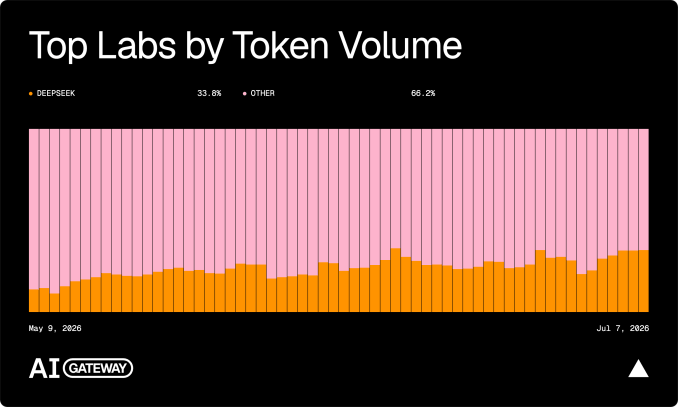
Zhang may not provide extensive data to back his claim, but finding the evidence is not challenging. Vercel’s AI gateway dashboard indicates that, in merely the past week, DeepSeek has surged to dominate the token volumes, processing slightly over a third of the tokens traversing the company’s infrastructure. Z.ai — the organization behind the well-regarded GLM-5.2 model — secured a noteworthy fourth place during the same timeframe. 

However, if you examine the total token expenditure, you’ll notice that Anthropic still represents over half of the overall AI spending on the platform. Although much of the recent change results from Anthropic’s own increasing prices, the proportion has decreased slightly in the last month, but not to a significant extent.

Image Credits:Vercel dashboard / data export

OpenRouter narrates a comparable tale, capturing a much broader (though slightly less enterprise-focused) market segment. DeepSeek V4 Flash stands out in overall usage, processing 5.3 trillion tokens each week. The leading frontier model, Opus 4.8, manages just over 2 trillion. OpenRouter does not rank models by total expenditure, but it indicates that the average token cost for Opus 4.8 is approximately 23 times higher than that of V4 Flash ($1.37 per million tokens versus just 6 cents), suggesting Opus likely still dominates expenditure.

These statistics do not even account for the latest addition, Nvidia’s Nemotron, which is expected to ascend to the forefront of the competition due to Nvidia’s robust connections and the model’s remarkable versatility.

These metrics may not definitively substantiate Zhang’s argument regarding AI life cycles, but they indicate that frontier labs like Anthropic aren’t dramatically affected by the rise of open source — not yet, at least. One possible reason is that the market for AI-relevant tasks is expanding rapidly enough that the leading models can retain their status simply by dominating early-stage deployments. As Zhang articulates, “The frontier labs will continue to dominate discovery. Open source will increasingly control production.” Another potential reason could be that, despite clients transitioning to open source, many use cases are complex enough that they cannot be fully supplanted by less expensive options.

Regardless, this dual-layer economy of models might evolve into a relatively stable aspect of the AI market.

As recently as last September, I was discussing the possibility that foundational labs would end up supplying coffee beans to Starbucks — serving merely as commodity inputs while the application layer enjoyed the rewards. Some elements of that prediction have materialized: Vertical AI initiatives have shifted to lighter models, for instance, and the financial dynamics of “GPT wrapper” startups have largely remained stable. 

Nonetheless, we are also observing that, token for token, frontier providers have managed to maintain a hold on the most lucrative portion of the marketplace — the premium token price. This doesn’t seem poised to change anytime soon.

When you purchase through links in our articles, we may earn a small commission. This doesn’t affect our editorial independence.

Microsoft aligns with the AI cost-reduction movement by increasing its dependence on its proprietary models.

Microsoft aligns with the AI cost-reduction movement by increasing its dependence on its proprietary models.

With the escalating expenses of AI, businesses are seeking methods to reduce costs. The latest instance is Microsoft, which is said to have started implementing a cost-reduction approach by decreasing its reliance on software from OpenAI and Anthropic while instead utilizing its in-house models.

In fact, regarding two of its most frequently utilized applications — Excel and Word — Microsoft has initiated the use of its proprietary MAI models to handle a certain fraction of user requests, as reported by Bloomberg on Tuesday. Previously, the firm had promoted the fact that significant portions of Office 365 are supported by models from both OpenAI and Anthropic.

Although Microsoft continues to depend on those external models, it has also progressively aimed to establish its own AI agents. Last month, during its annual Build event, the company unveiled seven new MAI models, including an agentic coder and a text-to-image creator.

When contacted for feedback by TechCrunch, Microsoft stated that it had no additional information to provide.

Microsoft’s noticeable reductions are part of a larger trend. Following a brief surge of “tokenmaxxing” earlier this year, the past few months have been filled with reports of technology firms behaving significantly more frugally. Other major corporations — such as Amazon, Uber, Meta, and Accenture — have likewise been indicated to take steps to decrease spending.

The significant costs associated with supplying and purchasing AI services have become a contentious issue within the industry. The price shock has grown so severe in certain areas of Silicon Valley that some businesses are reportedly exploring Chinese models for more cost-effective agentic alternatives — despite concerns over potential security risks.

Discord acknowledges that an AI moderation error unjustly banned users for innocuous images

Discord acknowledges that an AI moderation error unjustly banned users for innocuous images

Discord has recognized that an issue in its AI moderation framework erroneously banned over 8,000 users in the last two months, as harmless images—including spreadsheets, chessboards, gaming textures, plus white and gray transparent backgrounds—were wrongly identified as harmful material.

The corporation confirmed that this problem had been impacting accounts since May, with an extra 200 users banned over the weekend before the team identified and resolved the issue. All impacted accounts are in the process of being reinstated.

This situation underscores one of the escalating challenges related to AI-driven moderation as many platforms increasingly depend on automated systems to detect illegal or abusive content at a large scale.

In an extensive thread on X, Discord clarified that its automated safety system functions by comparing uploaded content against known harmful material databases. Although the technology aims to identify illegal content, the company admitted that false positives can sometimes occur. A human moderator assesses the content, but a glitch led to the immediate banning of affected accounts.

“We’re working on improved safeguards to ensure this doesn’t happen again,” the company stated. 

On X and Reddit, users reported being permanently banned merely for uploading images with square grid patterns. Many users theorized that Discord’s AI moderation tools have grown increasingly sensitive to grid-like designs because they have been used before to camouflage or conceal NSFW and child exploitation material from automated detection systems. 

Impacted users have expressed their anger on social media, with some claiming that permanent account bans based exclusively on automated detection can lead to serious repercussions, especially for individuals who depend on Discord for work, gaming communities, or long-distance social interactions.

“Losing a Discord account over something as unjust as this can be highly damaging and significantly impact users, and daily millions are affected by erroneous AI bans. This must be stopped,” a user on X commented. 

Discord is not the only platform facing moderation issues due to automated systems. Last year, Instagram and Facebook Groups users reported numerous unexplained account suspensions that many suspected were due to AI moderation mechanisms. Although users pointed to automation as the probable cause, Meta never publicly confirmed if AI errors were to blame. Now, Meta’s Oversight Board is advocating for greater transparency.

Tumblr also encountered complaints from users last year who claimed their accounts were mass-suspended without clear justifications.

When you make purchases through links in our articles, we may receive a small commission. This doesn’t influence our editorial independence.

Google's Pixel event is scheduled for August 12

Google’s Pixel event is scheduled for August 12

Google is gearing up for its Made by Google launch event, which is set for August 12 in New York City, as stated on Tuesday.

We’re optimistic that this event will be less awkward than last year’s, which included appearances by Jimmy Fallon and other celebrities, like Stephen Curry and the Jonas Brothers.

Many rumors are floating around regarding the upcoming Pixel 11 lineup. Based on email invitations disseminated by outlets such as The Verge and Bloomberg, the new devices are anticipated to showcase design enhancements, including a new gold color option for the Pixel 11.

Further leaks indicate that the standard Pixel 11 might feature narrower bezels and a sleek black camera bar, while the Pixel 11 Pro is rumored to be slightly slimmer than its predecessor. Additionally, there is buzz about the Pixel 11 Pro Fold, which could have a reimagined camera bump and a lighter build compared to the earlier model.

On the downside, one report suggests that Google may forgo the 128GB variant for the new models, launching instead with 256GB, which might result in a higher price point.

In the previous year, the event was held on August 20, where Google unveiled the Pixel 10 series, AI-driven enhancements, and other devices, including a new foldable, the Pixel Watch 4, and the second generation of its economical A-Series earbuds.

Figma purchases the team responsible for a vibe-coding application

Figma purchases the team responsible for a vibe-coding application

Figma is aiming to evolve beyond a design tool by incorporating additional AI capabilities and aligning the coding and prototyping functionalities more closely with its canvas. To achieve this, it has purchased the team that developed the vibe-coding and AI agent platform Bud (previously known as Orchids).

“Figma stands out as one of the, if not the, crucial product companies of our era poised to take advantage of this. It’s the birthplace of ideas that begin, evolve, and become reality, making it a natural hub for this thrilling new phase of work,” remarked Bud’s CEO Kevin Lu on X.

The Y Combinator-supported startup initially functioned as a vibe-coding platform, enabling users to quickly create applications for mobile, web, Slack, browser, and beyond. It later transitioned to Bud, an agent platform capable of interfacing with various services, browsing the web, and writing code to automate processes.

As part of the agreement, the startup will discontinue both Bud and Orchids by July 18, necessitating that users transfer their projects prior to that date.

Earlier this year, referencing a security researcher, the BBC reported that applications developed on Orchids were vulnerable to cyber threats.

Figma has not detailed how it intends to utilize this team, but recent product releases suggest that the publicly traded company aims to equip teams with enhanced tools for creating and prototyping applications, rather than merely brainstorming static ideas. Last year, it introduced Figma Make for web app development. This year, it has integrated with tools such as Codex and Claude Code, and launched its own agents.

Netflix experiments with brief video content through its latest agreements with Variety and other publishers.

Netflix experiments with brief video content through its latest agreements with Variety and other publishers.

Netflix is once more testing various forms of content on its streaming platform, as the binge-watching model has become outdated. Following its enhancement of live content offerings, video games, and, more recently, video podcasts, the platform is now including video material from publishers like BuzzFeed Studios, Condé Nast, Hearst Magazines, People Inc., Tastemade, and several brands under Penske Media PMX, including Variety, THR, Billboard, Eater, Rolling Stone, and IndieWire.

Beginning August 3, Netflix will provide video content from these publishers to subscribers in the U.S., Canada, the U.K., Ireland, Australia, and New Zealand, as per Netflix and additional reports released on Tuesday by Netflix’s deal partners such as Variety, Billboard, THR, Rolling Stone, and others.

The newly introduced videos will vary greatly in duration—some lasting only two to three minutes, while others extend beyond 20 minutes, according to the partners.

For Netflix, this agreement serves as a low-risk method to assess whether its audience is interested in content typically found on the web, like news, lifestyle pieces, how-tos, and other short-form content that is generally more affordable and quicker to produce than scripted series. If successful, Netflix might eventually create similar content internally, although the company has not indicated that this is the intention.

The lineup will feature both licensed archival and ongoing series arriving on Netflix, including BuzzFeed Celeb’s “30 Questions” and “Tasty”; Vanity Fair’s “Lie Detector Test” and “How Well Do They Know Each Other?”; AD’s “Walking Tour”; Elle’s “Where Is the Lie?”; Harper’s Bazaar’s “Burning Questions”; Billboard’s “24 Hours”; People’s “My Life in Pictures”; Travel + Leisure’s “Travel Unfiltered”; Tastemade’s “Struggle Meals”; and others.

Netflix has stated that more publishers will be included over time.

This announcement comes after a Bloomberg report indicating that Netflix is having difficulty keeping fans engaged between the first and second seasons of popular shows. This trend has reportedly raised concerns among executives, though it can largely be attributed to well-known issues: high cancellation rates, lengthy gaps between seasons, and varying quality. The report indicates that Netflix is also contending with a shift in viewer habits, now competing with YouTube and TikTok—arguably as much as it competes with traditional television networks.

To attract viewers interested in short-form video, Netflix has already introduced a TikTok-inspired feature called “Clips” that allows users to scroll through brief snippets from its library. However, while Clips is aimed at directing viewers toward longer shows and films, these new publisher agreements are oriented in the opposite direction, introducing short-form content onto the platform independently.

“Members don’t just want to watch a show or film and move on—they want to continue exploring the stories and personalities they adore long after the final credits have rolled. These partnerships assist us in deepening fan engagement and creating more opportunities for members to carry those stories with them throughout their day,” expressed John Derderian, Netflix VP of Animation Series + Kids & Family TV, who is overseeing this initiative.

When you purchase through links in our articles, we may earn a small commission. This doesn’t affect our editorial independence.

Best iPhone 17 Cases (2026): Our Picks Following Tests on More Than 100

Best iPhone 17 Cases (2026): Our Picks Following Tests on More Than 100

Your Old Case May Not Be Compatible—With One Exception

New iPhones occasionally match the sizes of previous models, permitting case reuse. However, the design of the iPhone 17 series diverges sufficiently that most older cases won’t fit. Don’t throw away your old case if it’s in decent shape. Think about donating it to Goodwill or find accessory brands with recycling initiatives, such as Casetify or PopSockets. Your carrier or nearby stores like Best Buy and Staples might also provide recycling or repurposing solutions.

The sole exception is the iPhone 17e, which can utilize iPhone 16e cases. Nonetheless, the iPhone 17e has MagSafe functionality, so it’s advisable to use a case that supports this feature. A MagSafe-compatible case facilitates seamless integration with magnetic accessories.

What Are the Camera Plateau and Camera Control?

These phrases will be commonly referenced in this guide. They denote relatively new features within Apple’s iPhone lineup.

The “Camera Plateau” is Apple’s term for the elevated camera unit on the back of the iPhone 17 Pro and iPhone 17 Pro Max. It occupies the top quarter of the device with a raised appearance.

“Camera Control” denotes a dial brought in with the iPhone 16 series, located below the power button. A press activates it for taking photos or switching to video mode through a long-press. It also supports Apple’s Visual Intelligence feature, akin to Google Lens, outside of the camera application. Case manufacturers generally design a cutout for this button for optimal functionality, although some opt for glass buttons instead.

Ensure You Purchase a MagSafe Case

All suggested cases in this guide, unless specified otherwise, incorporate MagSafe technology, featuring a built-in magnetic ring that secures magnetic accessories firmly. MagSafe enhances your iPhone’s functionality by allowing compatibility with an extensive array of magnetic accessories. Explore more through our curated guides.

What Size iPhone Do You Own?

If you’re unsure of your iPhone model, go to Settings > General > About Phone to check the Model Number. Knowing your exact model helps determine the appropriate case size, making this guide useful:

– iPhone 17: 6.3-inch display
– iPhone Air: 6.5-inch display
– iPhone 17 Pro: 6.3-inch display
– iPhone 17 Pro Max: 6.9-inch display
– iPhone 17e: 6.1-inch display

Each case is crafted with distinct dimensions and styles, so interchangeable use among similarly sized models is not assured.

What’s the Issue With Scratchgate?

Complaints have surfaced online regarding iPhone 17 models developing scratches easily. This problem appears most prominent with the redesigned iPhone 17 Pro and iPhone 17 Pro Max. The sharp edges of the Camera Plateau module affect the anodized aluminum’s adherence, making scratches visible on corners and around lenses. For further information, refer to iFixit’s blog post.

To alleviate these worries, consider a case that encloses the Camera Plateau rather than leaving it exposed. The suggested Native Union Active Case exemplifies such protection.

How We Evaluate Cases

Though our resources limit our capability to conduct drop tests on iPhones, we verify that each case fits the latest iPhones, assess button responsiveness, and inspect edge protection on screens and cameras. We also analyze the compatibility of these cases with MagSafe accessories. Whenever feasible, we conduct additional evaluations based on user feedback. Screen protectors undergo easy-install tests following manufacturer guidelines.

Savi’s application strives to safeguard users against authentic AI scams, such as abductors requesting a ransom.

Savi’s application strives to safeguard users against authentic AI scams, such as abductors requesting a ransom.

Siblings Patrick and Ryan Coughlin, each boasting notable careers in technology (Patrick’s background includes national cyber defense, Splunk, and Cisco while Ryan has worked on consumer products at Apple and Spotify), have introduced a new type of security startup. 

Savi Security aims to shield everyday individuals from the latest wave of remarkably convincing AI-generated scams, whether these are delivered via text messages, emails, or phone calls. 

The company recently secured $7 million in seed funding and is set to launch its app for both iPhone and Android on Tuesday. This funding round was spearheaded by Acrew Capital, with support from Magnify Ventures, TTCER, and Resolute Ventures. 

The founding inspiration for the company stemmed from a terrifying experience involving their mother.  

Approximately two years ago, Patrick Coughlin received an upsetting call from his mom, who reported that she had been contacted by a man claiming he had abducted Coughlin’s sister. At that time, he was serving as senior vice president of security products at Cisco, having joined the company following the acquisition of his cloud security startup TruSTAR by Splunk for an estimated $82 million in May 2021. In 2024, Cisco went on to acquire Splunk.

Coughlin remembered that her mobile phone displayed his sister’s caller ID. During the conversation, “she believes she hears my sister’s voice pleading, ‘Mom, they’ve got me.’ Then there’s a horrifying scream, followed by my sister saying, ‘You need to do what they say.’ Soon after, a man comes on the line and states, ‘If you don’t send us $1,200 immediately, we will kill your daughter in the nearby Walmart’s parking lot,’” he recounted. 

The scammer had expertly spoofed Coughlin’s sister’s number, mimicked her voice, and mentioned the local Walmart she frequently visited. 

Fortunately, the mother stayed calm, called her daughter, and verified that she was safe. The kidnapping was nothing more than an AI-generated scam.  

Coughlin, much like his mother, was deeply unsettled. 

“After calming my mom down, I found myself thinking: What has fundamentally altered in the underlying cybercriminal landscape that now allows us to leverage the same sophistication previously directed at government entities, and later at Fortune 500 companies? And now we’re seeing that sophistication aimed at everyday consumers?”  

The answer is, of course, inexpensive and potent large language models (LLMs) and other generative AI tools. 

Prior to the advent of AI, targeting consumers for such scams was not financially viable. It necessitated extensive research on the victim, technology for voice spoofing, and similar resources. Such scams were mainly directed at individuals with substantial wealth, such as corporations or governments, as was the technology needed for their defense.

“There’s a shift happening now regarding consumers and AI within the hands of cybercriminals,” Coughlin explains. The expenses involved in conducting these scams have diminished significantly, and the necessary research materials are readily accessible. 

“You can replicate a voice from merely three seconds of audio taken from a publicly available social media post. We all hold traces of content out there in the ether — like casual conversations or narrating a kid’s football game while recording it for Facebook.” 

The FTC reported last month that victims of online fraud collectively lost $3.5 billion to impostor scams in 2025, three times the losses reported in 2020. While older Americans make up the majority of those reporting such scams, some studies suggest that Gen Z is also particularly vulnerable. Research from 2025 conducted by Malwarebytes, a provider of antivirus and anti-malware solutions, indicated that Gen Z individuals encountered text scams more frequently than other generations, falling for them approximately 25% of the time. 

The Coughlin brothers aimed to create an immediate intervention tool. 

They tested their concept, along with the AI scam detection model they were developing, by launching a free platform named Scam Wise. It requires no registration, allowing users to anonymously upload any suspicious texts, images, or emails, and Scam Wise will ascertain if they are likely fraudulent. 

“We rolled that out around four months ago. We’ve received 50,000 submissions so far, and this number grows by approximately 10,000 submissions each week,” Coughlin stated. 

Scam Wise has provided a valuable source of real-world data to enhance Savi’s scam detection AI model. Currently, the startup mainly utilizes Google’s Gemini, but has constructed its software on an AI gateway to leverage additional AI models as necessary, such as those specifically targeting voice detection. 

On Tuesday, Savi introduced a paid product, an app for iOS and Android designed for consumers that can assess texts, voicemails, and incoming calls for potential scams.

Although such features can be found in various products (such as Malwarebytes), Savi’s standout feature is its live call monitoring capability. 

During a suspicious phone call, a user can opt to have the app’s live agent listen in. Savi monitors for behavioral cues that could indicate fraudulent activity while the call is ongoing. 

Savi’s pricing is somewhat unconventional. It charges $8/month, discounted to $63/year, covering an entire family, and imposes no limit on the number of users. A single subscription can encompass a person’s children, spouse, parents, and anyone else the main account holder wishes to add for administrative assistance. 

AI has transformed the accessibility for “becoming a fraudster,” Coughlin stated. “We’re facilitating the entrance into fraud due to the diminished barriers to deceiving individuals. Consequently, we not only face organized criminals and syndicates, but also everyday individuals being lured into committing fraud.” 

Savi Security’s solution resembles a new generation of anti-virus-like software: one that employs AI in real-time, mirroring the methods utilized by fraudsters.

When you purchase through links in our articles, we may earn a small commission. This doesn’t affect our editorial independence.

The initial American self-driving ground vehicles are engaged in combat in Ukraine.

The initial American self-driving ground vehicles are engaged in combat in Ukraine.

Forterra, a builder of autonomous vehicles based in the US, announced today that over 100 of its self-driving ATVs have been operational in conflict zones in Ukraine for the last nine months, which the company claims is the most significant deployment of autonomous ground vehicles in combat by any US defense technology firm.

“I think this holds true for all defense technologies ever developed—until you actually face the realities of combat, you won’t really know,” Scott Sanders, Forterra’s chief growth officer and a former US Marine officer, shared with TechCrunch.

Backed by US defense funding, this initiative forms part of a larger movement to enhance the US military’s capabilities by supporting Ukrainian resistance against Russian invaders. While aerial drones have received significant focus during the conflict, the complexities they’ve introduced—widespread no-go areas where surveillance can result in lethal attacks—have prompted Ukrainian strategists to pursue autonomy in ground operations as well.

“There are no hiding spots,” explained Sergeant Major Corey Wilkens, who oversees a program that develops autonomous vehicles and strategies for the US Army. “You become exceedingly vulnerable to attacks from [first-person view drones], various drones releasing munitions, artillery, mortars, and a comprehensive range of armaments.”

Ukraine is actively creating its own uncrewed ground vehicles (UGVs) to assist in transporting supplies and munitions, as well as evacuating injured soldiers, but these vehicles are generally battery-operated and have a capacity of only 250 kilograms, according to a soldier in the Ukrainian army who has experience with the vehicles and whom TechCrunch will not name for security concerns.

Forterra’s Lancer vehicles, which are based on Polaris ATVs and come equipped with a custom sensor and compute stack, are powered by gas and can transport 750 kilograms of load, making them notably more adaptable and effective. “The key point is that this UGV for logistics and maintaining our defense is the most vital UGV in Ukraine,” the soldier remarked. “It’s absolutely incredible, and we are eager to get more.”

Initially, there were reservations. The Ukrainian Armed Forces had mixed results with Western contractors introducing new technology to the battlefield, and early impressions of Forterra’s products seemed overly tailored for the high-end needs of the US Army. Adjusting the vehicle for local conditions—especially by integrating a Starlink satellite internet antenna—proved to be extremely beneficial.

Since their arrival in Ukraine last October, the vehicles have covered over 2,500 miles throughout more than 1,100 missions, transporting 777,440 pounds in total and accomplishing 52 casualty evacuations. Some have been lost in battle, particularly when they get stuck in deep mud or other challenging terrains where Russian forces can target them at their convenience.

A Forterra Lancer that met its end on the battlefield in Ukraine. Image Credits:Forterra / Forterra

Forterra has garnered valuable insights regarding electronic warfare, remote software updates, navigating difficult conditions, and ensuring vehicle reliability. The firm, which has secured over $500 million in venture funding from groups such as XYZ Venture Capital and Moore Strategic Partners, is now in a stronger position to pursue profitable national security contracts.

They’ve also recognized the constraints of autonomy: Currently, Ukrainian soldiers have predominantly been remotely operating the vehicles in combat zones, partly due to their high value and also because autonomous vehicles are not yet equipped to handle the complexities of warfare.

Even though the vehicles can autonomously navigate various terrains, they are not yet capable of recognizing unexpected enemy forces and reacting suitably. “We need to be able to respond to enemy threats in real-time, whilst they are in the presence of the enemy, which is something the autonomy does not yet comprehend,” the Ukrainian soldier clarified.

Forterra, which began its journey in developing autonomous vehicles two decades ago, is exploring how to integrate algorithms that were used for self-driving vehicles with cutting-edge generative AI software that enables machines to adapt to their environment in a generalized manner. As is the case with other autonomous systems, a significant challenge lies in data acquisition.

“There are numerous tasks that are not available in an open-source framework since they are not actions that humans typically perform, whether it involves figuring out minefield navigation or [operating] weapon systems,” Sanders told TechCrunch. “You need to adjust particular aspects using a classical robotics approach, while also leveraging AI where appropriate.”

Rivals in this sector are tackling comparable challenges, including Scout AI, which secured $100 million earlier this year to train foundational models and develop a range of military autonomous platforms, including UGVs. Other startups like Field AI and Overland AI are testing UGVs with the US military.

Despite the constraints associated with UGVs, American military experts are convinced that it’s the right time to invest in these assets. “Ground autonomy is now attainable and we have witnessed it,” Wilkens stated.

Scott Philips, the chief innovation officer at Forterra, visited a Ukrainian unit’s operations center to observe the vehicles in action firsthand, gaining admiration from the unit for visiting an area under threat from Russian strikes.

“What impacted me the most was pinpointing where the inefficiencies lie: which processes remain manual, where data needs to be re-entered or re-validated by hand, and where the team has already identified opportunities to automate or expedite tasks,” Philips told TechCrunch. “That’s the kind of ground truth you simply can’t obtain from a presentation because it illustrates exactly where improved tools could alleviate pressure from the personnel doing this work in real-time.”

One request made by the Ukrainians: Reduce costs. Forterra’s Lancers are not prohibitively expensive for their category, thanks to leveraging Polaris’ commercial supply chain for the vehicles, but they still carry a value that restricts their deployment compared to UAVs.

“Attrition is simply a reality on this battlefield, and we have indeed lost a few at this stage, which is painful, and we require additional units, thus we need them at a lower cost,” conveyed the Ukrainian soldier to TechCrunch.

When you purchase through links in our articles, we may earn a small commission. This doesn’t affect our editorial independence.