
Law enforcement dismantles botnet consisting of tens of thousands of compromised routers

Law enforcement dismantles botnet consisting of tens of thousands of compromised routers

On Wednesday, a worldwide coalition of law enforcement agencies dismantled a botnet comprising tens of thousands of compromised home and small business routers.

The initiative focused on SocksEscort, which provided paid proxy services and was based on a botnet of compromised routers utilised to perpetrate a range of crimes, including unlawfully accessing victims’ banking and cryptocurrency accounts, as well as submitting fraudulent unemployment insurance applications, according to an announcement released by the Department of Justice (DOJ) on Thursday. The DOJ reported that the offenses enabled by SocksEscort incurred millions of dollars in losses for Americans.  

According to Europol’s statement regarding the operation, the SocksEscort botnet reportedly breached over 369,000 routers and Internet of Things devices across 163 nations, and the infected routers “have been disconnected from the service.” The law enforcement agency indicated that SocksEscort facilitated ransomware, distributed denial of service (DDoS) attacks, and the spread of child sexual abuse material (CSAM).

“Users of the illicit service purchased licenses to exploit these compromised devices, concealing their original IP addresses to partake in various criminal actions,” Europol stated. “Once infected with the malware, owners of the modems remained unaware that their IP addresses were being exploited for illegitimate purposes.”

The official website of SocksEscort was supplanted by a message announcing the seizure as part of the law enforcement operation. 

The botnet consisted of approximately 280,000 routers since last January and was driven by malware named AVRecon, as per cybersecurity firm Black Lotus Labs, which monitored SocksEscort and collaborated with authorities in the takedown effort.

“This botnet represented a considerable threat, as it was exclusively marketed to criminals,” the company remarked in its post regarding the takedown. “Significantly, more than half of its victims were situated in the United States or the United Kingdom, allowing perpetrators to execute highly targeted operations.”

In 2023, Black Lotus Labs referred to SocksEscort as “one of the largest botnets targeting small-office/home-office (SOHO) routers observed in recent years.” 

At that time, cybersecurity journalist Brian Krebs noted that SocksEscort emerged in 2009 as a Russian-language service offering access to thousands of compromised computers.

A writer is taking legal action against Grammarly for converting her and other authors into ‘AI editors’ without their permission.

A writer is taking legal action against Grammarly for converting her and other authors into ‘AI editors’ without their permission.

Last week, Grammarly unveiled a contentious feature that employs AI to mimic editorial feedback, creating the illusion that users are receiving critiques from figures like novelist Stephen King, the late scientist Carl Sagan, or tech journalist Kara Swisher. However, Grammarly did not obtain consent from the numerous experts featured in this function, referred to as “Expert Review,” to utilize their names.

Julia Angwin, one of the affected writers and a journalist, has initiated a class action lawsuit against Superhuman, the company that owns Grammarly, claiming that the organization infringed on the privacy and publicity rights of her and the other writers it represented. This class action allows other writers to join Angwin in her legal action.

“After decades of perfecting my craft as a writer and editor, I am disheartened to learn that a tech firm is profiting off a fraudulent version of my hard-earned knowledge,” Angwin expressed in a statement.

The irony of this situation is palpable — Angwin has dedicated her career to investigating how tech companies affect privacy. Other critics of such technology, including prominent AI ethicist Timnit Gebru, were also featured in Grammarly’s “Expert Review.”

The “Expert Review” feature, offered exclusively to subscribers at $144 annually, unfortunately falls short of its promise to provide meaningful feedback.

Casey Newton, the creator and editor of the tech newsletter Platformer and another individual impersonated by Grammarly, input one of his articles into the system and received feedback from Grammarly’s representation of tech journalist Kara Swisher. The feedback generated by Grammarly’s imitation of Swisher was so indistinct that it raises the question of why the company would bother using these writers’ personas at all.

This is what Grammarly’s representation of Kara Swisher suggested to him: “Could you briefly compare how daily AI users versus AI skeptics articulate risk, creating a through-line readers can follow?”

Techcrunch event

San Francisco, CA
|
October 13-15, 2026

Newton conveyed the message from the AI’s rendition of Kara Swisher to the actual, living Kara Swisher.

“You greedy information and identity thieves better prepare for me to unleash my full McConaughey on you,” Swisher texted Newton (in reference to Grammarly). “Also, you suck.”

Grammarly has since taken down the “Expert Review” feature, as reported in a LinkedIn post by Superhuman CEO Shishir Mehrotra. While Mehrotra issued an apology, he continued to advocate for the concept behind the feature.

“Envision your professor refining your essay, your sales manager reworking a customer pitch, an insightful critic questioning your arguments, or a prominent expert enhancing your proposal,” he articulated. “For experts, this is an opportunity to forge that same pervasive connection with users, similar to what Grammarly has established.”

Tesla transforms into a utility in the UK, initiating a confrontation with Octopus Energy

Tesla transforms into a utility in the UK, initiating a confrontation with Octopus Energy

Tesla has officially become a licensed utility in the United Kingdom, as reported by The Wall Street Journal. The automotive and energy firm recently obtained a license from the Office of Gas and Electricity Markets, enabling it to provide electricity directly to residential and commercial users.

The company has been involved in electricity markets for some time. Its initial energy products, the Powerwall and Powerpack, debuted in 2015; however, it was only a year later, following its merger with SolarCity, that Tesla began to rapidly expand this division. In 2022, Tesla Electric was launched in Texas, permitting it to sell electricity directly to customers. Powerwall users can sell electricity from their batteries to engage in the company’s virtual power plant.

The new sector, branded Tesla Energy Ventures, will go head-to-head with current utilities in the U.K., such as EDF, E.ON, and Octopus Energy. The rivalry with Octopus is expected to be particularly captivating. Since its inception in 2015, Octopus has risen to be the largest utility in the country by prioritizing innovative software, renewable energy solutions, and imaginative marketing. Does that sound familiar? 

Gumloop secures $50M from Benchmark to transform each employee into an AI agent creator.

Gumloop secures $50M from Benchmark to transform each employee into an AI agent creator.

When Max Brodeur-Urbas co-established Gumloop in the middle of 2023, his aim was to assist non-technical staff in automating monotonous tasks using AI. At that point, the notion of AI agents was predominantly experimental and susceptible to inaccuracies.

As AI technology has advanced, Gumloop’s offerings have likewise evolved.

The company asserts that it now enables teams at organizations such as Shopify, Ramp, Gusto, Samsara, Instacart, and Opendoor to deploy dependable AI agents capable of autonomously managing intricate, multistep tasks, all without requiring any engineers.

Employees can share the agents they create with their teammates, fostering a compounding effect that speeds up internal automation. “They become hooked, they begin creating additional agents, and before long, the entire company is AI native,” Brodeur-Urbas shared with TechCrunch.

As businesses rush to embrace AI, Benchmark general partner Everett Randle believes that the secret to success lies in empowering every employee with AI capabilities, and Gumloop’s user-friendly agent builder exemplifies the type of tool that will unlock that potential.

That’s why Randle, who joined Benchmark last October from Kleiner Perkins, opted to spearhead a $50 million Series B funding for Gumloop. The agreement, which marks Randle’s first at his new firm, involved participation from Nexus VP, First Round Capital, Y Combinator, BoxGroup, The Cannon Project, and Shopify.

Although Gumloop was not actively looking for new funding, the startup determined that this was the year to “accelerate growth.” For Brodeur-Urbas, collaborating with Benchmark—the firm behind notable successes like eBay, Uber, and Dropbox—was an obvious choice.

Techcrunch event

San Francisco, CA
|
October 13-15, 2026

While Brodeur-Urbas initially intended to “create a 10-person, billion-dollar company,” the increasing demand from corporate clients has driven him to establish a dedicated sales team and expand his engineering staff, he mentioned.

Gumloop is certainly not the sole contender striving to transform every knowledge worker into an AI agent-builder. The startup encounters tough competition from established automation platforms like Zapier and n8n, alongside specialized agent builders such as Dust. Even foundational AI labs are joining the competition. For example, Anthropic’s Claude Cowork enables users to develop autonomous agents without needing to write any code.

However, Randle is confident that Gumloop surpasses all its competitors. During his research, he found that at least one of the company’s customers had adopted Gumloop in a somewhat organic manner.

When Randle inquired with a CTO about how they selected Gumloop, the answer was revealing. The company had provided employees unrestricted access to Gumloop along with two other competitors. Six months later, the outcome was evident: Staff were engaging with Gumloop on a daily or weekly basis, while the competing platforms remained unused, Randle informed TechCrunch.

The reason Gumloop achieved such traction, according to Randle, is due to its low learning curve. “You can dive in and start creating agents and workflow automations right away,” he stated.

While numerous AI startups fear that foundational models will replicate their functionalities and make them redundant, Randle firmly believes that Gumloop’s model-agnostic strategy is exactly what will continue to draw in clients.

As models keep evolving, one may outperform another for specific tasks. Therefore, Gumloop offers the flexibility to select the model that is most appropriate for the job at any moment.

Another reason model independence is appealing, according to Randle, is cost. “Many enterprises possess OpenAI, Gemini, and Anthropic credits. They wish to utilize all of them,” he remarked.

His enthusiasm for the company ultimately hinges on the vast size of the opportunity.

“Enterprise automation is a tremendous pot of gold,” Randle stated. “I believe it’s the largest category in enterprise AI.”

Alexa+ introduces a fresh ‘adults only’ personality setting that incorporates cursing while refraining from NSFW content.

Alexa+ introduces a fresh ‘adults only’ personality setting that incorporates cursing while refraining from NSFW content.

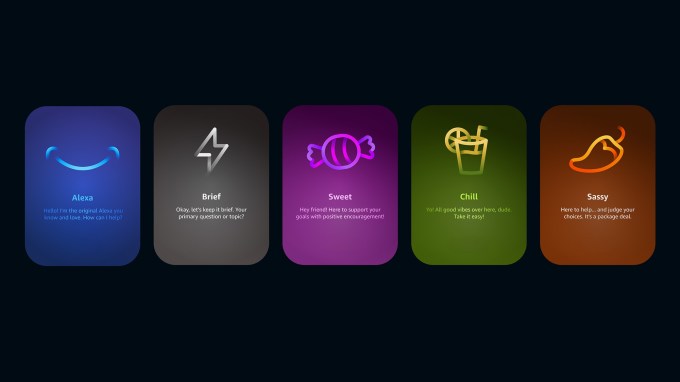
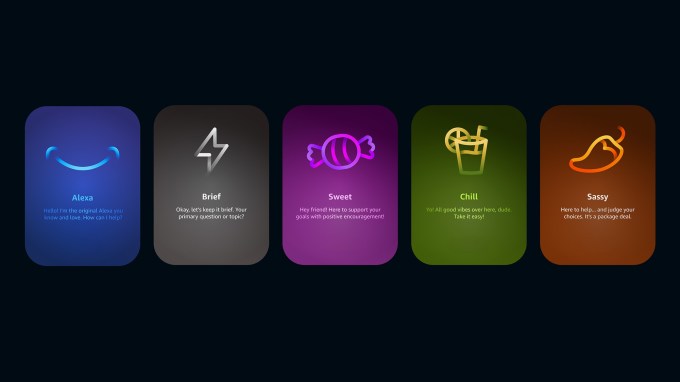
Amazon’s AI assistant Alexa+ is receiving yet another new character. On Thursday, the firm revealed its intention to broaden its range of personality styles for users, introducing a “Sassy” option, designated exclusively for adults. Amazon notes that prior to utilizing the Sassy persona, users must complete additional security protocols within the Alexa app.

According to Amazon, this personality style will also be inaccessible when Amazon Kids is activated.

This new selection complements existing styles such as Brief, Chill, and Sweet, which were introduced last month.

Image Credits:Amazon

When you enable the Sassy option in the Alexa mobile application, you are notified that the Sassy style incorporates explicit language, which necessitates a security verification. On iOS devices, this involved a Face ID scan.

The AI assistant articulated its persona as follows: “The Sassy style is constructed on one principle: help first, judge always. Every response is encapsulated with humor and a cleverly timed jab — it will address your inquiry; it will simply evoke a reaction first. Anticipate reality checks presented with charm, compliments that have an edge, and unexpected warmth. Equal-opportunity irreverence, no apologies. Genuine, incisive, and amusing — and somehow that proves to be more beneficial than just helpful.”

Alexa’s app also advised that this style might feature “mature subject matter.”

Nevertheless, further inquiry revealed that this is not Amazon’s equivalent to Grok’s adult AI companions. The AI assistant clarified that the new option will avoid topics such as explicit sexual content, hate speech, unlawful activities, personal attacks, or anything that may inflict harm on oneself or others.

Techcrunch event

San Francisco, CA
|
October 13-15, 2026

This development exemplifies Amazon’s efforts to make Alexa+ more tailored, as it updates the assistant for the generative AI age. By presenting the assistant with various personalities — including one aimed at adults — Amazon is partaking in a broader trend in AI, where businesses are testing different tones, styles, and identities to make their assistants more engaging and personalized according to individual user preferences.

Alexa+ introduces a fresh ‘adults only’ persona choice that includes cursing but refrains from delving into NSFW material.

Alexa+ introduces a fresh ‘adults only’ persona choice that includes cursing but refrains from delving into NSFW material.

Amazon’s AI assistant Alexa+ is adopting a fresh personality. On Thursday, the company revealed it is enlarging its selection of personality styles for users, introducing a “Sassy” choice, designated for adults exclusively. Amazon notes that prior to utilizing the Sassy personality, users must complete additional security checks within the Alexa app.

According to Amazon, this personality option will also be unavailable when Amazon Kids is activated.

This new choice joins others like Brief, Chill, and Sweet, which were introduced last month.

Image Credits:Amazon

When activating the Sassy option in the Alexa mobile app, you are alerted that the Sassy style incorporates explicit language, necessitating a security check. On iOS, this required a Face ID scan.

The AI assistant described its style as follows: “The Sassy style operates on one principle: help first, judge always. Each response is delivered with wit and a well-timed roast — it will address your question, just ensuring you feel something about it first. Anticipate reality checks served with charm, stinging compliments, and unexpected warmth. Equal-opportunity irreverence, no apologies. Honest, sharp, and humorous — and ironically, that’s more beneficial than merely being helpful.”

Additionally, Alexa’s app had cautioned that this style might encompass “mature subject matter.”

Nevertheless, further exploration revealed that this is not Amazon’s approach similar to Grok’s adult AI companions. The AI assistant clarified that the new option will refrain from delving into topics like explicit sexual content, hate speech, illegal actions, personal assaults, or anything that may endanger oneself or others.

Techcrunch event

San Francisco, CA
|
October 13-15, 2026

This initiative exemplifies how Amazon is working to enhance the customization of Alexa+, as it modernizes the assistant for the generative AI landscape. By providing the assistant with varied personalities — including one tailored for adults — Amazon is tapping into a larger trend in AI, where firms are experimenting with tone, style, and characters to make their assistants more engaging and tailored to the individual preferences of users.

Apple's Newest MacBook Air and Pro Variants Showcase Advanced Chips, Expanded Storage, and Elevated Prices

Apple’s Newest MacBook Air and Pro Variants Showcase Advanced Chips, Expanded Storage, and Elevated Prices

Alongside its affordable iPhone 17e and M4 iPad Air announced on Monday, Apple has unveiled updates for the MacBook Pro, MacBook Air, and its infrequently updated desktop display line. It seems Apple is reserving its anticipated new entry-level MacBook for an in-person event in New York City on Wednesday, but today’s announcements are likely to please those looking to upgrade.

The MacBook Air now features the newest M5 chip. This is a somewhat minor enhancement but aligns it with Apple’s latest processor that was introduced in the MacBook Pro last autumn. There are no other major hardware changes—it now comes with 512 GB of base storage utilizing “faster SSD technology”—but buyers can still opt for a 13- or 15-inch display.

This laptop also includes Apple’s N1 wireless chip, supporting Wi-Fi 7 and Bluetooth 6, in line with the latest connectivity standards. It retains the standard 16 GB of RAM, though there’s a regrettable $100 price hike due to the extra storage. The starting prices are now $1,099 for the 13-inch variant and $1,299 for the 15-inch variant. Apple announces that pre-orders will commence on Wednesday, with sales starting on March 11.

More significantly, Apple is broadening the M5 chip family with the M5 Pro and M5 Max, now available in the 14-inch and 16-inch MacBook Pro. As with previous generations of Apple silicon, the “Pro” and “Max” versions deliver markedly improved multicore CPU and graphics performance.

The M5 Pro and M5 Max can be configured with up to 18 CPU cores (12 performance cores and 6 “super” cores), a boost from 16 on the M4 Max. The M5 Pro can be upgraded to include up to 20 GPU cores, while the M5 Max can go up to 40 GPU cores. Apple claims a 30 percent enhancement in multithreaded CPU performance for the M5 Pro compared to the M4 Pro. The M5 Max CPU upgrade is a bit more modest—just 15 percent higher than the M4 Max, according to Apple.

Thanks to higher memory bandwidth, a more efficient Neural Engine, and improved GPU architecture, Apple asserts that both the M5 Pro and M5 Max provide “over 4X the peak CPU compute for AI” compared to the last generation and deliver 20 percent better GPU performance.

The new MacBook Pros maintain the same hardware configuration that has remained unchanged since 2021—identical port options, Mini-LED display, speakers, and webcam. Even the reported 24-hour battery life remains stable with the M4 models, launched in late 2024. Notably, Bloomberg reported last week that Apple plans to introduce a more significant update for the MacBook Pro this year, expected to reveal the M6 chip, an OLED touchscreen, and a sleeker design.

L.L.Bean Promo Codes and Deals: Enjoy Discounts of Up to 75% on Camping Equipment

L.L.Bean Promo Codes and Deals: Enjoy Discounts of Up to 75% on Camping Equipment

L.L. Bean is renowned among outdoor aficionados, providing a range of products from outerwear and equipment to casual lifestyle items. Established in 1912 by Leon Leonwood Bean in Maine, the company continues to operate from that location, routinely introducing both timeless and contemporary essentials for nature enthusiasts. Consider the Bean Boots, for instance: L.L. Bean’s signature product that has come to represent the brand. These legendary shoes are suitable for hiking paths and rainy urban environments, remaining faithful to the initial design. If you aim to adopt the rugged Mainer lifestyle or cultivate a warm cabin vibe at home, there are plenty of L.L. Bean promo codes available.

Get 10% Off Your First Order With an L.L.Bean Promo Code
Enjoy a 10% discount on your first order by subscribing to L.L. Bean’s email notifications. This promotion is valid a single time per email address, so select your purchase carefully.

Take Up to 75% Off Outdoor Gear in the L.L.Bean Sale Section
Replenish your outdoor equipment and camping necessities by exploring the L.L. Bean sale section. Whether you require fishing supplies or products from the L.L. Bean Noah Kahan collaboration, you can save as much as 75% without a promo code.

This sale presents new offers twice daily at 6 AM and 2 PM Eastern time. While stock is limited, substantial discounts akin to Black Friday promotions are accessible.

The daily markdown sale showcases a fresh discount from 6 AM until midnight Eastern time, mainly concentrated on items such as backpacks, blankets, and footwear.

Score Free Shipping on Orders Over $75
Eliminate shipping charges by making sure your order reaches $75 or more, as standard shipping is $8 for orders that fall below that threshold.

Military, First Responders, Medical Workers, and Students Can Save an Additional 10%
L.L. Bean provides a 10% discount for medical professionals, first responders, and military personnel, both active and retired. These promotions also apply to family members. Educators and college students can additionally obtain a 10% discount. Verification through SheerID is necessary to take advantage of these discounts.

Earn 20% Off With the L.L.Bean Mastercard
For loyal L.L. Bean enthusiasts, applying for an L.L. Bean Mastercard can provide a 20% discount upon approval, along with free shipping on all orders with no minimum requirement.

Conflict in Iran Drives Up Oil Prices; Trump to Affect Future Rates

Conflict in Iran Drives Up Oil Prices; Trump to Affect Future Rates

Oil prices soared on Monday following the United States and Israel’s assault on Iran over the weekend, with forecasts indicating that prices might surpass $100 a barrel. Increasing assaults on regional oil and gas facilities, coupled with blocked traffic in a crucial shipping lane, have experts asserting that the actions of the White House and responses from Iran and other oil producers will be pivotal in shaping future prices.

Brent crude prices surged to almost $80 a barrel—a 13 percent increase since Friday—when markets opened on Sunday evening. Tyson Slocum from Public Citizen highlights that the potential risks of the US’s confrontational approach toward Iran had already been integrated into market values, averting an even steeper rise. Nonetheless, the chaotic US reaction post-attack on Ayatollah Ali Khamenei, Iran’s supreme leader, has added more unpredictability.

Iran governs the Strait of Hormuz, a vital shipping corridor. One-fifth of the globe’s oil transits through this route. OPEC nations depend greatly on it to sell their oil. Rory Johnston, a Canadian oil market analyst, mentions that OPEC would typically boost production during a crisis, but its supplies are situated on the opposite side of the conflict zone, limiting its capacity to respond.

Throughout the weekend, while Iran conveyed mixed signals regarding the formal closure of the strait, traffic significantly diminished. Insurance costs for vessels navigating through the strait have surged, and several ships have faced attacks. Johnston characterizes the scenario as a “voluntary closure.”

The likelihood of worsened outcomes persists if regional tensions escalate. In 2019, drone assaults on Saudi oil installations increased oil prices by 15 percent. Similarly, recent drone strikes compelled Saudi Arabia to shutter a refinery, and Qatar’s LNG production was interrupted, triggering a rise in European gas prices. Should these assaults persist, prices may skyrocket.

Clayton Seigle from the Center for Strategic and International Studies cautions that growing Iranian desperation might lead to leveraging energy as a bargaining chip. Should Gulf trade be abandoned or significant oil infrastructure be compromised, prices reaching triple digits could make a comeback.

When the Internet Breaks Down, Reality Vanishes

When the Internet Breaks Down, Reality Vanishes

Alaqad asserts that the loss of on-the-ground journalists equates to a loss of vital truths, as mainstream media outlets dictate the storyline. “Voices that are silenced and censored prevent us from fully grasping events,” she remarks.

During crises, disrupted communication leads to a lack of accountability and overlooked injustices. “Injustice shouts,” Alaqad claims, “while justice must be even louder.”

Journalists encounter ongoing suppression. In December 2025, Reporters Without Borders highlighted the deaths of 67 journalists that year, with 43 percent occurring in Gaza at the hands of Israeli forces. Since October 7, 2023, RSF reports over 220 fatalities among journalists in Gaza, whereas the UN reports a figure exceeding 260.

Dagher points out that the media blackout is part of a comprehensive tactic that includes limited movement and communication. Israel refutes the claim of targeting journalists.

“Murders of journalists stifle the truth,” Alaqad states. This leads to several consequences—diminishing on-ground reports and portraying journalists as dangers. “Such a message discourages individuals from interacting with journalists,” she observes.

Her protective press gear signaled her as a target, causing her mother to worry about her safety. Initial warm greetings and hospitality shifted to caution upon witnessing the targeting of journalists, Alaqad reflects.

Operating in Gaza involved navigating unpredictable conditions. Plans seldom extended beyond daylight hours, and circumstances rapidly evolved. “Uncertainty is the sole certainty,” Alaqad notes.

She frequently discovered that those she interviewed were subsequently killed in airstrikes. Now residing in Beirut, she studies media at the American University, backed by the Shireen Abu Akleh scholarship, named in honor of a journalist who lost her life due to Israeli forces.

Her widespread social media presence unveiled the truth of Gaza, yet also put her life at risk. While digital reporting reaches a broad audience, its permanence remains unstable, as accounts and content can vanish in an instant.