US Employs High-Powered Laser to Take Down Drones Close to Mexico Border

US Employs High-Powered Laser to Take Down Drones Close to Mexico Border

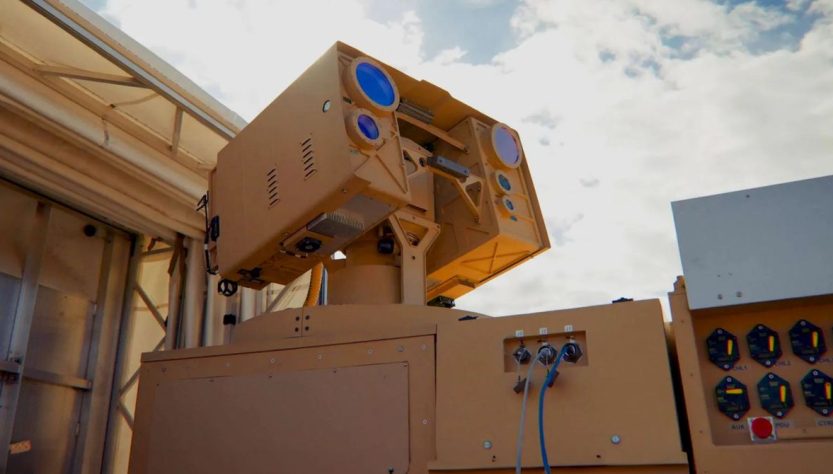
This week, the US Army effectively employed a high-energy multipurpose laser to neutralize three drones near the US-Mexico boundary, as they represented a danger to US military personnel and CBP associates at Customs and Border Patrol. The operation took place overnight from August 25 to 26 in the Rio Grande Valley of Texas, under the supervision of the Joint Task Force Southern Border (JTF-SB), which operates under US Northern Command. The mission utilized technology from the Army’s High-Energy Multipurpose Laser (AMP-HEL) system, a military program concentrating on high-energy lasers for improved defense.

Reports suggest the initiative commenced in September 2025 when AeroVironment provided initial prototypes of these laser weapon systems to the US Armed Forces. By December of that year, two enhanced systems were integrated into the program. The Locust Laser Weapon System, designed for vehicle mounting as utilized by the Army, functions at 20 kilowatts, utilizing a concentrated light beam for target identification, tracking, illumination, and eventual neutralization from a distance. The system incorporates sensors, cameras, and radars to identify targets, then accurately focuses the beam to produce heat and incapacitate the drone, with results varying based on distance, exposure duration, and target characteristics.

The most recent Locust systems, similar to the one received last December, feature radar and command-and-control technologies, permitting integration into more sophisticated mobile defense configurations instead of standalone operation. The precise location of the mission remains undisclosed, and there is no information regarding the drones’ origin or their operators. Curtis Taylor, commander of JTF-SB, hypothesized that the drones could be linked to drug trafficking organizations operating within Mexican territory.

“Cartel networks are increasingly utilizing unmanned aerial systems for smuggling and unauthorized surveillance on our forces and law enforcement. By incorporating directed-energy systems like this laser, we have demonstrated that we will not allow hostile surveillance, and we value our collaboration with the Mexican Army to address this border threat,” Major General Taylor remarked in a press release.

The official statement did not specify the precise AMP-HEL models utilized. However, media sources connected this action to President Donald Trump’s ongoing campaign against illegal immigration and drug cartels since the beginning of his second term. Trump promised stringent measures against these concerns, particularly at the US-Mexico border, implementing various technological approaches, including HEL systems, as part of this endeavor.

This article originally appeared on WIRED en Español and was translated from Spanish.

How Trump's Strategy to Capture Iran's Nuclear Fuel Might Truly Function

How Trump’s Strategy to Capture Iran’s Nuclear Fuel Might Truly Function

President Donald Trump and senior defense officials are reportedly contemplating the deployment of ground forces to Iran to procure the nation’s highly enriched uranium. Nonetheless, the administration has not revealed specifics regarding the deployment, the extraction procedure, or where the nuclear material will be taken.

“Individuals will need to go and retrieve it,” Secretary of State Marco Rubio mentioned during a congressional briefing earlier this month, alluding to the prospective operation.

Indications suggest that a military operation might be on the horizon. On Tuesday, The Wall Street Journal highlighted that the Pentagon intends to position 3,000 brigade combat troops in the Middle East. (As of this writing, the official order has yet to be given.) These soldiers would be drawn from the Army’s 82nd Airborne Division, renowned for its joint forcible entry capabilities. Following this, on Wednesday, Iran’s government dismissed Trump’s 15-point strategy to conclude the conflict, while White House Press Secretary Karoline Leavitt stated that the president “is ready to unleash hell” in Iran if a peace agreement is not achieved—a strategy that has raised concerns among some lawmakers.

Utilizing publicly sourced intelligence and their own expertise, two analysts described the potential intricacies and dangers of a ground operation aimed at nuclear facilities. They informed WIRED that any ground operation would be exceedingly complex and could jeopardize American military personnel.

“I personally believe that a ground operation utilizing special forces backed by a larger contingent is markedly high-risk and ultimately impractical,” stated Spencer Faragasso, a senior research fellow at the Institute for Science and International Security.

According to the analysts, any iteration of the operation might require several weeks and necessitate concurrent actions at multiple far-off locations. Jonathan Hackett, a former operations specialist for the Marines and the Defense Intelligence Agency, noted that up to 10 sites could be targeted: the Isfahan, Arak, and Darkhovin research reactors; the Natanz, Fordow, and Parchin enrichment sites; the Saghand, Chine, and Yazd mines; and the Bushehr power plant.

As per the International Atomic Energy Agency, Isfahan likely contains the majority of the country’s 60 percent highly enriched uranium, which could facilitate a self-sustaining nuclear chain reaction, although weapon-grade material typically comprises 90 percent enriched uranium. Hackett suggested that the other two enrichment facilities might also hold 60 percent highly enriched uranium, and that the power plant along with all three research reactors could possess 20 percent enriched uranium. Faragasso emphasized that all such materials should be examined closely.

Hackett indicated that eight of the 10 locations—excluding Isfahan, which is expected to remain intact underground, and “Pickaxe Mountain,” a newer enrichment facility near Natanz—were largely or partially buried as a result of the air strikes in June. Right before the conflict, Faragasso noted, Iran backfilled the tunnel entrances to the Isfahan facility with soil.

The most dangerous scenario for a ground operation would involve American forces directly retrieving nuclear material. Hackett explained that this material would be stored as uranium hexafluoride gas in “large cement vats.” Faragasso added that it remains uncertain how many of these vats could be broken or compromised. At damaged locations, troops would require excavators and heavy machinery to move significant quantities of soil to access them.

A considerably less hazardous approach to the operation would still necessitate ground troops, according to Hackett. However, it would primarily rely on aerial strikes to entomb nuclear material within their facilities. Ensuring that the nuclear material is made inaccessible in the short to medium term, Faragasso said, would involve obliterating the entrances to underground facilities and ideally collapsing the roofs of those underground structures.

Hackett conveyed to WIRED that, based on his experience and all publicly available data, Trump’s negotiations with Iran are “probably a diversion” to gain time for troop positioning.

Hackett speculated that an operation would likely initiate with aerial bombardments in the vicinity of the target sites. These bombers, he indicated, would probably come from the 82nd Airborne Division or the 11th or 31st Marine Expeditionary Units (MEU). The 11th MEU, a rapid-response unit, and the 31st MEU, the sole Marine contingent continuously stationed abroad in strategic locations, have reportedly both been sent to the Middle East.