
Wager on Wildfire Hazards: Forecast Markets and the Security of Your Community

Wager on Wildfire Hazards: Forecast Markets and the Security of Your Community

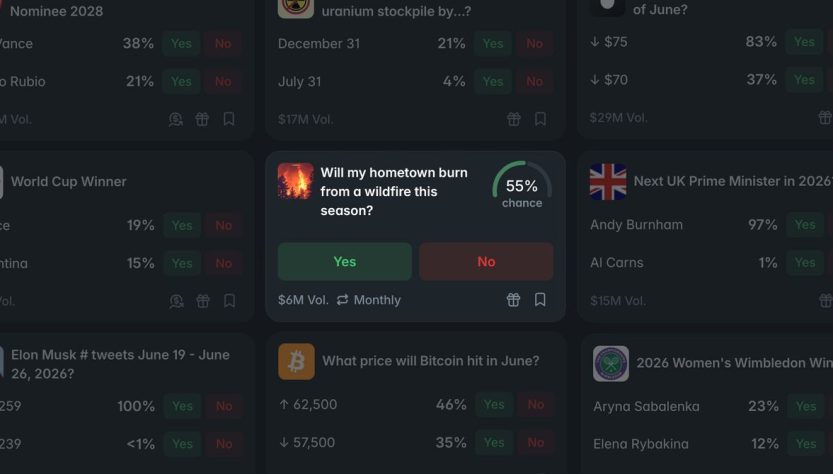
Sylvie Andrews and her spouse lost their recently constructed home and ten years of hard work when the Eaton Fire swept through Altadena, California, in January 2025, along with the community they had built. “We invested a tremendous amount of effort into it,” Andrews revealed. “That’s what we lost in the blaze.” The Eaton and Palisades Fires obliterated more than 16,000 structures and resulted in 31 fatalities. While Andrews and others evacuated, some viewed it as an investment opportunity, wagering on the fires via Polymarket, the leading prediction market platform. Participants placed bets on the fires’ spread, duration, and devastation.

Prediction markets operate like gambling establishments for differing event results. From elections to sports to climate, anything can be wagered upon. Markets frame inquiries in a “yes” or “no” format, with prices fluctuating between $0 and $1. A price of 50 cents on a “yes” contract indicates a 50% probability of the event happening according to bettors. Market operators earn revenue by imposing fees on bets.

In January 2025, Polymarket featured nearly 20 wildfire-related questions for Southern California, established by the platform’s “markets team.” Inquiries covered the acreage the Palisades Fire would consume, whether it would reach Santa Monica, its level of containment, and if all fires would be under control by the beginning of February. Individuals wagered $1.2 million on these propositions, as reported by Aeon Magazine. “Wow,” Andrews repeatedly said upon discovering the sum. “It’s morally outrageous,” she remarked. “The notion that anyone could feel comfortable doing that astonishes me.”

Susan Sherman from Pacific Palisades, who lost her familial home in the Palisades Fire, commented, “The prediction markets are simply the wild, wild West,” describing the betting as “extremely crude and unfeeling.” As prediction markets expand with a new wildfire season, survivors and ethicists contend that betting fosters cold-hearted reasoning and reckless behavior. A key worry is arson fueled by these markets. Sherman voiced her concerns about this, emphasizing how easily someone could exploit fire for personal gain.

Systems profiting from wildfire outcomes may inadvertently promote misconduct like arson, which is contrary to the US Forest Service’s mission, as stated by their spokesperson. Ann Skeet from the Markkula Center for Applied Ethics cautioned about unscrupulous individuals leveraging such markets to provoke harmful actions, labeling such a market as perilous. Firefighters or land managers possessing unique fire insights might feel tempted to wager, creating concerns surrounding insider trading.
Spotify Recognizes Streaming Fraud After Kalshi Trader's Allegation

Spotify Recognizes Streaming Fraud After Kalshi Trader’s Allegation

Caleb Davies, a well-known trader on Kalshi, often shares with the media how prediction markets play a role in his financial achievements. The IT expert from Minneapolis indicates that he has made roughly $1.2 million across different prediction platforms, with $414,000 coming from Kalshi’s culture markets. Davies is particularly focused on music charts, utilizing Spotify data to inform his betting strategies. “Every morning, I download the data and update my projections,” he tells WIRED.

Nonetheless, this summer, Davies has expressed concerns regarding what he sees as automated manipulation within Spotify-related markets. He has collected and disseminated evidence supporting these concerns and has contacted Spotify, Kalshi, and Polymarket to relay his apprehensions.

The situation escalated when Malcolm Todd’s song “Earrings” unexpectedly soared to the top of a Spotify chart. In a series of posts on X, Davies speculated about the presence of “botting,” where automated systems artificially boost streaming numbers. He proposed that traders in the prediction market were employing bots to modify event contracts. Todd’s surprising ascent wasn’t even represented on Polymarket, suggesting a statistical anomaly that Davies deemed questionable.

Spotify confirmed that it examined the manipulation incidents pointed out by Davies and detected fraudulent streaming activity. “All streaming services face continuous manipulation. Spotify deploys advanced detection measures and does not compensate for manipulated streams,” stated spokesperson Laura Batey. There was no formal statement regarding Davies’ theory on prediction markets manipulation.

After the inquiry, Spotify revised its charts, eliminating over 500,000 fraudulent streams, which resulted in Todd’s drop from first to fourth place. This adjustment arrived too late for Kalshi, which had already rewarded those who bet on Todd’s track.

Kalshi spokesperson Elisabeth Diana disclosed that they have been in ongoing discussions with Spotify. Consequently, Kalshi removed Spotify’s branding from relevant markets and specified that Spotify had not authenticated the chart outcomes.

When Davies raised his concerns with Kalshi, the company’s head of enforcement, Robert DeNault, indicated that only Spotify could validate botting activity. He also proposed alternative explanations for the surge.

Davies informed WIRED, “No one from Polymarket profited from the fraud. This contradicts Kalshi’s perspective as Malcolm Todd wasn’t an option there.”

Polymarket counters this assertion. “This assertion is impractical because we did not list Malcolm Todd in this Spotify market,” conveyed spokesperson Annabel Walsh. The platform is probing the larger issue of streaming manipulation, but has not identified any immediate problems.

The motives of those responsible for the manipulation remain unclear, as no direct communications have occurred. Todd has not made any remarks, and there is no evidence of his involvement.