FIFA Does Not Have a Strategy to Tackle Climate Change

FIFA Does Not Have a Strategy to Tackle Climate Change

The final match of the World Cup between Argentina and Spain is set to take place on Sunday near New York City, yet wildfire smoke from Canada poses a new threat to the event. FIFA, the governing authority of the sport, currently has no solid strategy to safeguard players and fans. Recent smoke has impacted extensive areas of the Midwest and East Coast, considerably worsening air quality. New York recently recorded levels considered “unhealthy,” leading officials to suggest limiting outdoor activities. On Friday, air quality around the stadium remained subpar. While some improvement is anticipated, erratic smoke patterns may still bring challenges during the final. Without an enclosed venue, both participants and attendees could encounter health hazards, especially those with respiratory conditions. In spite of the lingering adverse circumstances, which included the Spanish team’s training in New Jersey amid poor air quality, FIFA has not implemented any protective measures or alterations due to wildfire smoke. In contrast to the National Women’s Soccer League, Major League Baseball, and Major League Soccer, which have established air quality protocols, FIFA’s current plans only address issues related to heat and hydration. As the World Cup reaches its concluding phase, FIFA has been fortunate with clearer skies thus far, but this situation has highlighted a lack of readiness for smoke-related interruptions. Even though some experts foresee better conditions for the final, uncertainty lingers. Critics are calling for more thorough initiatives from FIFA and other entities to tackle climate-related threats, pointing out inadequacies even in their policies concerning heat.

Canadian Wildfire Smoke Covers the Northeast

Canadian Wildfire Smoke Covers the Northeast

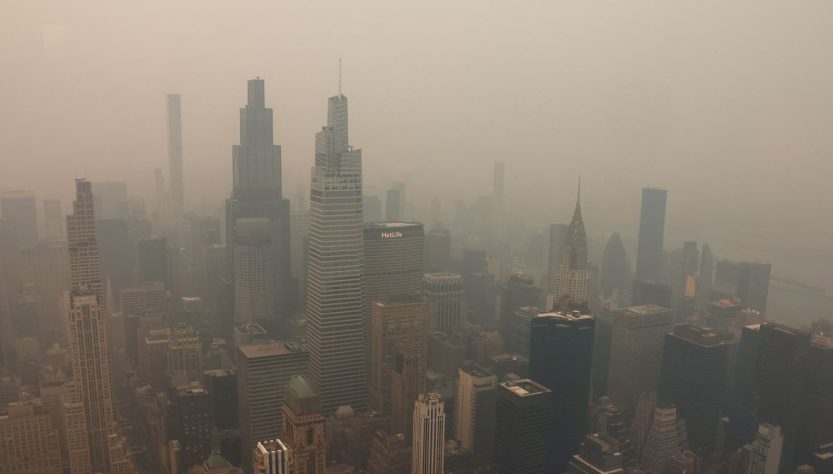
Smoke emanating from significant wildfires in Canada is drifting into the Midwest and Northeast, triggering air quality warnings in cities throughout the region.

The elevated smoke levels imply that even healthy adults should take precautions to safeguard their wellbeing. The intensifying severity of wildfires across the continent, partly attributed to climate change, indicates that regions without active fires will still experience repercussions.

As of Wednesday, more than 100 uncontrolled blazes are raging in Canada, with numerous others being monitored or extinguished. The smoke has spread south and east, creating hazy skies from Minnesota to New York. Notably, on Wednesday, Toronto encountered orange-hued skies. The area is also enduring a heatwave, with temperatures exceeding 90 degrees Fahrenheit in many spots and an even higher heat index.

On Wednesday evening, the air quality index (AQI) in New York City reached 180, classifying the air as “unhealthy” according to the US Environmental Protection Agency. Other regions faced worse situations, with Duluth, Minnesota, registering an AQI above 500 (anything over 301 is classified as “hazardous” and dangerous for everyone). Smoky conditions are likely to intensify in parts of the Northeast US on Thursday, impacting areas such as New York.

The smoke contains tiny PM2.5 particles, measuring less than 2.5 micrometers, about 30 times finer than a human hair.

Exposure to PM2.5 can aggravate numerous health problems, particularly in vulnerable populations. Nicholas Nassikas, an assistant professor of medicine at Harvard Medical School, recommends that his patients with ailments like asthma avoid being outdoors in these smoky situations. Children breathe more rapidly, resulting in greater exposure, while the elderly, often residing in poorly-ventilated spaces, are also at greater risk.

Jennifer Stowell from the University of Maryland’s School of Public Health mentions that even those in good health should exercise caution when the AQI surpasses 100. She advises limiting outdoor activities to lower exposure and, if necessary to be outside for extended periods, wearing an N95 mask is recommended. Stowell, located in Boston where the AQI reached 110 on Wednesday, chose to skip outdoor activities until later in the evening.

Dan Westervelt from Columbia University is also wary, deciding to keep his children indoors and forgoing physical activities such as running.

Climate change is raising temperatures, extending wildfire seasons, and fostering hotter, drier conditions that facilitate large fires. A study released last year suggests that wildfire smoke already causes 40,000 US deaths annually, potentially rising to 70,000 by 2050 if warming trends continue. As days with poor air quality from wildfire smoke become more common, research into the long-term effects of exposure is ongoing. The Northeast saw a comparable smoke event from Canadian wildfires in 2023.

Westervelt articulates, “Extended exposure to high air pollution has been demonstrated in numerous studies to cause premature mortality. Frequent encounters with elevated air pollution levels can decrease life expectancy.”

Wager on Wildfire Hazards: Forecast Markets and the Security of Your Community

Wager on Wildfire Hazards: Forecast Markets and the Security of Your Community

Sylvie Andrews and her spouse lost their recently constructed home and ten years of hard work when the Eaton Fire swept through Altadena, California, in January 2025, along with the community they had built. “We invested a tremendous amount of effort into it,” Andrews revealed. “That’s what we lost in the blaze.” The Eaton and Palisades Fires obliterated more than 16,000 structures and resulted in 31 fatalities. While Andrews and others evacuated, some viewed it as an investment opportunity, wagering on the fires via Polymarket, the leading prediction market platform. Participants placed bets on the fires’ spread, duration, and devastation.

Prediction markets operate like gambling establishments for differing event results. From elections to sports to climate, anything can be wagered upon. Markets frame inquiries in a “yes” or “no” format, with prices fluctuating between $0 and $1. A price of 50 cents on a “yes” contract indicates a 50% probability of the event happening according to bettors. Market operators earn revenue by imposing fees on bets.

In January 2025, Polymarket featured nearly 20 wildfire-related questions for Southern California, established by the platform’s “markets team.” Inquiries covered the acreage the Palisades Fire would consume, whether it would reach Santa Monica, its level of containment, and if all fires would be under control by the beginning of February. Individuals wagered $1.2 million on these propositions, as reported by Aeon Magazine. “Wow,” Andrews repeatedly said upon discovering the sum. “It’s morally outrageous,” she remarked. “The notion that anyone could feel comfortable doing that astonishes me.”

Susan Sherman from Pacific Palisades, who lost her familial home in the Palisades Fire, commented, “The prediction markets are simply the wild, wild West,” describing the betting as “extremely crude and unfeeling.” As prediction markets expand with a new wildfire season, survivors and ethicists contend that betting fosters cold-hearted reasoning and reckless behavior. A key worry is arson fueled by these markets. Sherman voiced her concerns about this, emphasizing how easily someone could exploit fire for personal gain.

Systems profiting from wildfire outcomes may inadvertently promote misconduct like arson, which is contrary to the US Forest Service’s mission, as stated by their spokesperson. Ann Skeet from the Markkula Center for Applied Ethics cautioned about unscrupulous individuals leveraging such markets to provoke harmful actions, labeling such a market as perilous. Firefighters or land managers possessing unique fire insights might feel tempted to wager, creating concerns surrounding insider trading.

New York set to endure heat levels exceeding those of Phoenix

New York set to endure heat levels exceeding those of Phoenix

The eastern part of the United States is facing severe heat, with New York predicted to reach temperatures close to 100 degrees Fahrenheit (38 degrees Celsius), feeling even more like 109 degrees Fahrenheit (43 degrees Celsius) when factoring in humidity. Cities such as Detroit, Washington, DC, and Boston will also endure temperatures 20 degrees above average as the holiday weekend draws near.

While not as elevated as Phoenix, the mix of heat and humidity generates uncomfortable and potentially hazardous conditions. Humidity diminishes the efficiency of sweating, an essential cooling process for the human body. Richard Allan, a climate scientist, states that high humidity during heatwaves hampers the body’s ability to cool itself effectively.

The National Weather Service has released severe heat warnings and watches, highlighting the gravity of the forthcoming weather. Daytime temperatures are expected to be high, and nighttime lows will offer minimal comfort, heightening risks of heat stress.

New York Mayor Zohran Mamdani underscored the necessity of a heat plan, urging individuals to ensure air conditioning access and to look in on those who are more vulnerable to heat-related health risks.

This intense heat in the US comes on the heels of Europe’s recent experience with unprecedented temperatures. The combustion of fossil fuels has exacerbated heatwaves around the globe, transforming moderate heat into more extreme conditions.

El Niño, a natural climatic phenomenon, may also play a role in this heatwave. It affects global weather systems, especially elevating temperatures in the northern US and certain regions of Canada. With El Niño officially recognized and anticipated to intensify, more extreme heat is expected in the upcoming months.

A Solo Hit Won't Disable the Gulf's Desalination Infrastructure

A Solo Hit Won’t Disable the Gulf’s Desalination Infrastructure

Across the region, facilities associated with water and electricity, such as desalination plants, are under threat or experiencing damage due to Iranian attacks aimed at locations outside traditional areas.

A single attack is unlikely to sever the gulf’s water supply. The system can manage isolated interruptions, but prolonged or multi-site assaults could quickly put pressure on supply.

“In the Gulf, desalination is engineered with sufficient buffer capacity so that the loss of one facility doesn’t instantly impact the availability at the tap,” remarks Rabee Rustum, a professor of water and environmental engineering at Heriot-Watt University Dubai.

In Kuwait, Iranian drone strikes have damaged power and desalination facilities and ignited fires at oil sites. Other regions, including Fujairah in the UAE, may also be at risk.

“Attacking desalination facilities would be tactical but could cross a line,” observes Andreas Krieg, a senior lecturer at King’s College London.

Water infrastructure is unique. “It’s not merely another utility,” Krieg emphasizes. “In regions that depend on desalination, it underpins civilian survival, public health, hospital functions, sanitation, and fundamental state credibility.”

International humanitarian law provides specific protection to civilian assets essential for survival. “This is why assaults on water systems carry significant legal and ethical consequences,” Krieg further states.

These occurrences highlight a structural reality: Desalination is crucial for water supply in the gulf, and any disruption swiftly impacts everyday life.

How the System Manages Disruption

Initially, desalination appears at risk. Shutting down a facility diminishes supply. In actuality, the system features multiple layers of redundancy.

Plants are dispersed across several sites, enabling output redistribution if one slows down. Water is stored at various network points, including central reservoirs and tanks, creating a buffer for delays.

Veolia, an environmental services provider that oversees nearly 19 percent of the region’s desalination, indicates the water supply is diversified through numerous facilities along the coast.

The company further notes that distribution systems are interconnected, allowing plants to assist and substitute for one another, thereby ensuring service continuity.

In the UAE, storage can last around a week, while in other regions, it’s restricted to two to three days, according to Veolia.

This indicates that the system can temporarily manage disruptions. Once reserves are exhausted, water supply relies on the capability of plants to generate enough to satisfy demand.

The System That Generates Water

Unlike many regions, the Gulf does not depend on rivers or precipitation. It relies on desalination plants along the coast, continuously converting seawater into drinkable water.

Seawater undergoes processing through reverse osmosis or thermal methods, eliminating salt and impurities. The resulting water is distributed, stored, and sent to homes, hospitals, and industries.

It is a rigid system, designed for ongoing operation, supporting cities, industries, and services. Gulf states produce approximately 40 percent of the world’s desalinated water, with over 400 plants in operation.

Dependence varies but remains high across nations. In the UAE, desalination comprises 41 to 42 percent of total water usage, 90 percent of Kuwait’s drinking water, and around 70 percent in Saudi Arabia.

When Disruption Becomes Apparent

For residents, disruption isn’t immediately perceived—water continues to flow.

Rustum notes that buildings contain internal storage and pumps, concealing early changes in supply. Water pressure usually remains stable as the system adapts.

The US Saw a Notable Increase in Battery Demand Last Year

The US Saw a Notable Increase in Battery Demand Last Year

In 2025, the United States saw a historic rise in energy storage, as detailed in a freshly released solar industry report on Monday. This boom in battery storage signifies a considerable milestone for clean energy amid the renewable-unfriendly second term of the Trump administration and suggests that utilities may be modifying electric grids to meet increasing demand across the country.

The report, issued by the Solar Energy Industries Association (SEIA), corresponds with recent findings from Bloomberg New Energy Finance, showcasing a comparable surge in battery development. As per SEIA, the United States added 57 gigawatt hours of new energy storage in 2025, representing nearly a 30 percent rise from the prior year. This capacity is enough to supply power to over five million homes each year.

The report predicts a 21 percent market growth by the conclusion of this year, with an additional 70 gigawatt hours anticipated in 2026. These statistics sharply contrast with less than a decade ago when storage on the grid amounted to only around half a gigawatt.

Batteries have demonstrated considerable political endurance. Tax incentives for wind and solar were cut last summer amid legislative challenges to renewables, yet faced opposition from Republican lawmakers in regions with clean energy initiatives. Nonetheless, battery tax credits largely remained unharmed.

In spite of the federal administration’s position on renewables, batteries and solar experienced considerable advancement in certain conservative states last year. Texas stands out, where solar energy constituted over 15 percent of summer demand, exceeding coal for the first time. SEIA projects that Texas will outpace California this year in terms of gigawatt hours of storage deployed.

Jigar Shah, from the advisory firm Multiplier and a former director of the Department of Energy’s Loan Programs Office, points out that Texas’s independent and deregulated power grid favors solar and batteries over alternative solutions, notwithstanding White House opposition. Recent surveys reveal that MAGA voters back solar power, and prominent individuals like Katie Miller have voiced support for solar energy.

“Texas fundamentally ignores cultural prejudices,” Shah states. “‘Heed the market signals. Construct whatever you wish, whether it’s coal plants or batteries.’ Batteries received the most financial backing.”

While solar and batteries thrive in Texas, the majority of battery installations last year were standalone, not linked to particular solar projects, which is a positive trend for grids coping with heightened demand.

Generally, US energy grids utilize only about 50 percent of their available energy on a daily basis. This intentional underutilization guarantees capacity for peak demand days. Deploying batteries at all levels of the grid aids in harnessing surplus energy during off-peak hours to mitigate waste.