FIFA Does Not Have a Strategy to Tackle Climate Change

FIFA Does Not Have a Strategy to Tackle Climate Change

The final match of the World Cup between Argentina and Spain is set to take place on Sunday near New York City, yet wildfire smoke from Canada poses a new threat to the event. FIFA, the governing authority of the sport, currently has no solid strategy to safeguard players and fans. Recent smoke has impacted extensive areas of the Midwest and East Coast, considerably worsening air quality. New York recently recorded levels considered “unhealthy,” leading officials to suggest limiting outdoor activities. On Friday, air quality around the stadium remained subpar. While some improvement is anticipated, erratic smoke patterns may still bring challenges during the final. Without an enclosed venue, both participants and attendees could encounter health hazards, especially those with respiratory conditions. In spite of the lingering adverse circumstances, which included the Spanish team’s training in New Jersey amid poor air quality, FIFA has not implemented any protective measures or alterations due to wildfire smoke. In contrast to the National Women’s Soccer League, Major League Baseball, and Major League Soccer, which have established air quality protocols, FIFA’s current plans only address issues related to heat and hydration. As the World Cup reaches its concluding phase, FIFA has been fortunate with clearer skies thus far, but this situation has highlighted a lack of readiness for smoke-related interruptions. Even though some experts foresee better conditions for the final, uncertainty lingers. Critics are calling for more thorough initiatives from FIFA and other entities to tackle climate-related threats, pointing out inadequacies even in their policies concerning heat.
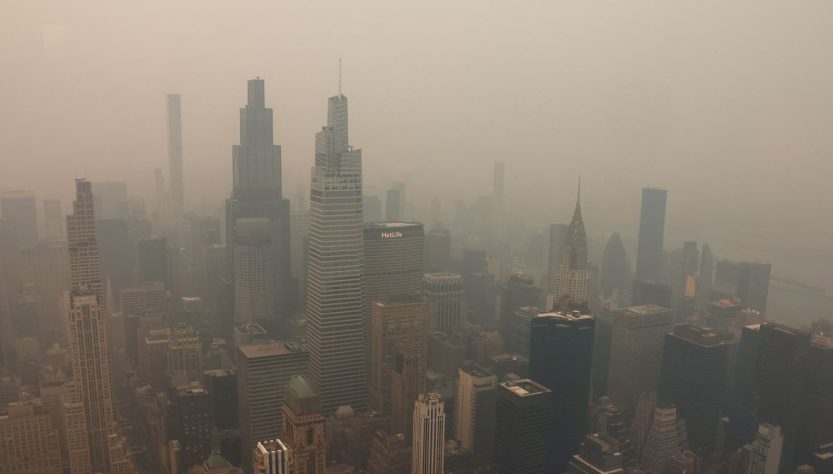
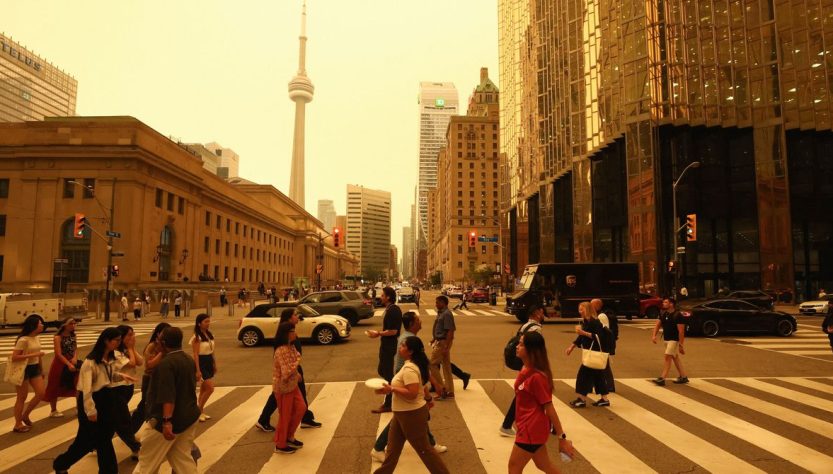
Canadian Wildfire Smoke Covers the Northeast

Canadian Wildfire Smoke Covers the Northeast

Smoke emanating from significant wildfires in Canada is drifting into the Midwest and Northeast, triggering air quality warnings in cities throughout the region.

The elevated smoke levels imply that even healthy adults should take precautions to safeguard their wellbeing. The intensifying severity of wildfires across the continent, partly attributed to climate change, indicates that regions without active fires will still experience repercussions.

As of Wednesday, more than 100 uncontrolled blazes are raging in Canada, with numerous others being monitored or extinguished. The smoke has spread south and east, creating hazy skies from Minnesota to New York. Notably, on Wednesday, Toronto encountered orange-hued skies. The area is also enduring a heatwave, with temperatures exceeding 90 degrees Fahrenheit in many spots and an even higher heat index.

On Wednesday evening, the air quality index (AQI) in New York City reached 180, classifying the air as “unhealthy” according to the US Environmental Protection Agency. Other regions faced worse situations, with Duluth, Minnesota, registering an AQI above 500 (anything over 301 is classified as “hazardous” and dangerous for everyone). Smoky conditions are likely to intensify in parts of the Northeast US on Thursday, impacting areas such as New York.

The smoke contains tiny PM2.5 particles, measuring less than 2.5 micrometers, about 30 times finer than a human hair.

Exposure to PM2.5 can aggravate numerous health problems, particularly in vulnerable populations. Nicholas Nassikas, an assistant professor of medicine at Harvard Medical School, recommends that his patients with ailments like asthma avoid being outdoors in these smoky situations. Children breathe more rapidly, resulting in greater exposure, while the elderly, often residing in poorly-ventilated spaces, are also at greater risk.

Jennifer Stowell from the University of Maryland’s School of Public Health mentions that even those in good health should exercise caution when the AQI surpasses 100. She advises limiting outdoor activities to lower exposure and, if necessary to be outside for extended periods, wearing an N95 mask is recommended. Stowell, located in Boston where the AQI reached 110 on Wednesday, chose to skip outdoor activities until later in the evening.

Dan Westervelt from Columbia University is also wary, deciding to keep his children indoors and forgoing physical activities such as running.

Climate change is raising temperatures, extending wildfire seasons, and fostering hotter, drier conditions that facilitate large fires. A study released last year suggests that wildfire smoke already causes 40,000 US deaths annually, potentially rising to 70,000 by 2050 if warming trends continue. As days with poor air quality from wildfire smoke become more common, research into the long-term effects of exposure is ongoing. The Northeast saw a comparable smoke event from Canadian wildfires in 2023.

Westervelt articulates, “Extended exposure to high air pollution has been demonstrated in numerous studies to cause premature mortality. Frequent encounters with elevated air pollution levels can decrease life expectancy.”

Wager on Wildfire Hazards: Forecast Markets and the Security of Your Community

Wager on Wildfire Hazards: Forecast Markets and the Security of Your Community

Sylvie Andrews and her spouse lost their recently constructed home and ten years of hard work when the Eaton Fire swept through Altadena, California, in January 2025, along with the community they had built. “We invested a tremendous amount of effort into it,” Andrews revealed. “That’s what we lost in the blaze.” The Eaton and Palisades Fires obliterated more than 16,000 structures and resulted in 31 fatalities. While Andrews and others evacuated, some viewed it as an investment opportunity, wagering on the fires via Polymarket, the leading prediction market platform. Participants placed bets on the fires’ spread, duration, and devastation.

Prediction markets operate like gambling establishments for differing event results. From elections to sports to climate, anything can be wagered upon. Markets frame inquiries in a “yes” or “no” format, with prices fluctuating between $0 and $1. A price of 50 cents on a “yes” contract indicates a 50% probability of the event happening according to bettors. Market operators earn revenue by imposing fees on bets.

In January 2025, Polymarket featured nearly 20 wildfire-related questions for Southern California, established by the platform’s “markets team.” Inquiries covered the acreage the Palisades Fire would consume, whether it would reach Santa Monica, its level of containment, and if all fires would be under control by the beginning of February. Individuals wagered $1.2 million on these propositions, as reported by Aeon Magazine. “Wow,” Andrews repeatedly said upon discovering the sum. “It’s morally outrageous,” she remarked. “The notion that anyone could feel comfortable doing that astonishes me.”

Susan Sherman from Pacific Palisades, who lost her familial home in the Palisades Fire, commented, “The prediction markets are simply the wild, wild West,” describing the betting as “extremely crude and unfeeling.” As prediction markets expand with a new wildfire season, survivors and ethicists contend that betting fosters cold-hearted reasoning and reckless behavior. A key worry is arson fueled by these markets. Sherman voiced her concerns about this, emphasizing how easily someone could exploit fire for personal gain.

Systems profiting from wildfire outcomes may inadvertently promote misconduct like arson, which is contrary to the US Forest Service’s mission, as stated by their spokesperson. Ann Skeet from the Markkula Center for Applied Ethics cautioned about unscrupulous individuals leveraging such markets to provoke harmful actions, labeling such a market as perilous. Firefighters or land managers possessing unique fire insights might feel tempted to wager, creating concerns surrounding insider trading.